Can You Lose More Money Than You Invest in Stocks?
Learn whether it's possible to lose more money than you invest in stocks, how different investment strategies affect risk, and what every investor should know in 2026.
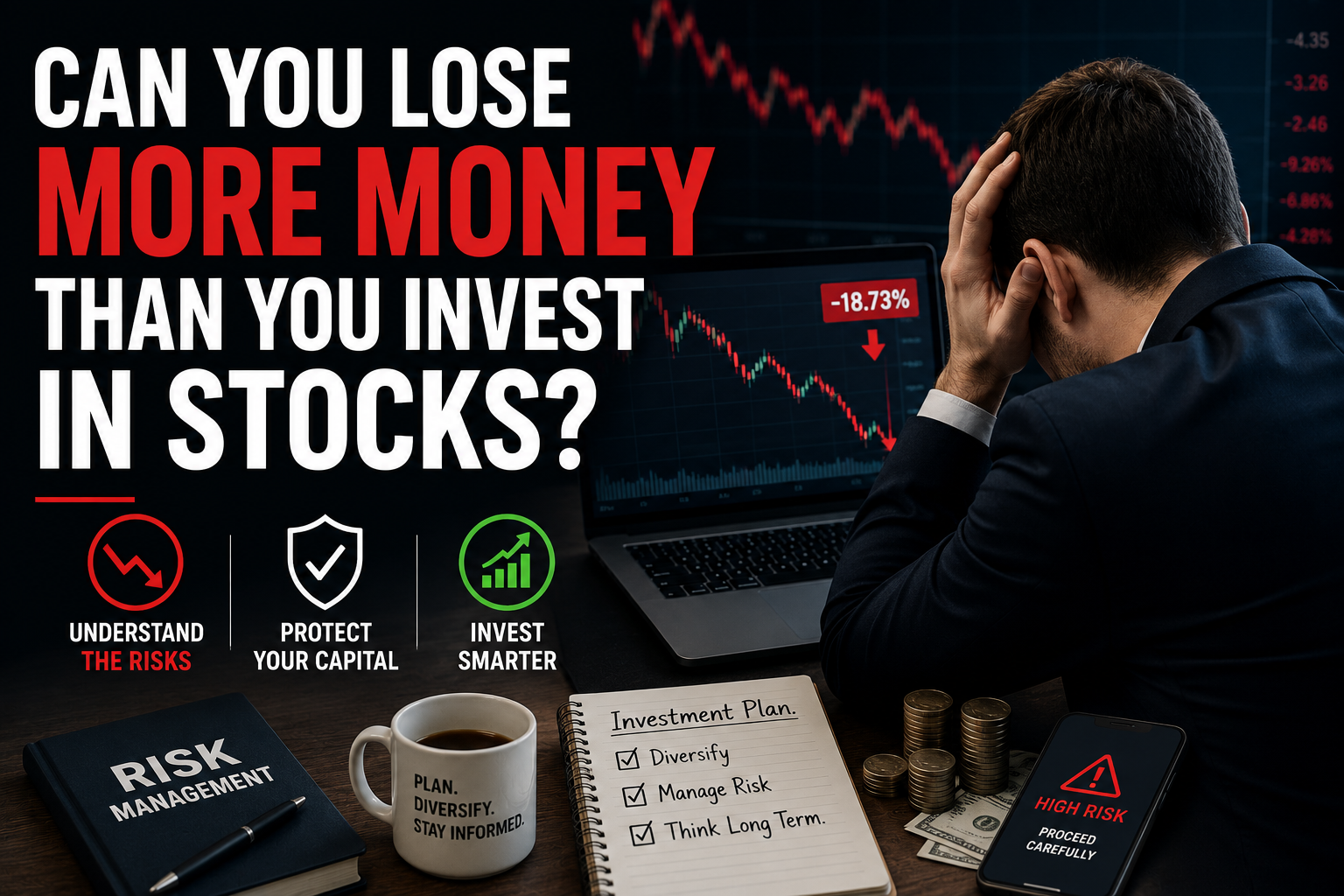
Can You Lose More Money Than You Invest in Stocks?

One of the most common fears among new investors is losing more money than they put into the stock market.
That concern is understandable. Stock prices can fall sharply, individual companies can fail, and leveraged trading strategies can create losses that are much larger than expected.
So, can you lose more money than you invest in stocks?
If you buy ordinary shares using your own cash in a standard brokerage account, your loss is generally limited to the amount you invested. If the shares fall to zero, the investment can become worthless, but you typically do not owe additional money simply because the stock lost all of its value.
The situation changes when borrowed money, short selling, margin, options, or other leveraged strategies are involved.
Can a Stock Investment Go Below Zero?
A publicly traded stock price itself does not normally become a negative number.
If a company fails, its shares can decline toward zero and may eventually become worthless.
For a cash investor who owns shares outright, that means the maximum loss on the stock position itself is generally the amount paid for those shares.
Example: Buying a Stock With Cash
Suppose you invest $2,000 in a company using cash in your brokerage account.
| Stock Outcome | Position Value | Your Loss |
|---|---|---|
| Stock falls 25% | $1,500 | $500 |
| Stock falls 50% | $1,000 | $1,000 |
| Stock falls 100% | $0 | $2,000 |
In the final scenario, the investment is completely lost, but the stock position itself does not create an additional $2,000 debt.
Why Ordinary Stock Ownership Usually Has Limited Downside
When you buy shares of a corporation, you become a shareholder.
You are not normally personally responsible for the company's debts simply because you own its stock.
This limited liability structure is one of the defining features of corporate ownership.
If the company performs poorly, your shares may lose value. If the company becomes insolvent, common shareholders are generally among the last parties in line to receive any remaining assets after creditors and other senior claims are addressed.
That means a shareholder can lose the entire investment, but ordinary share ownership does not normally make the shareholder personally responsible for the corporation's unpaid obligations.
When Can You Lose More Than You Invest?

Losses can exceed the original cash investment when leverage or contractual obligations are involved.
The most important examples include:
- Margin trading
- Short selling
- Certain options strategies
- Leveraged financial products
- Borrowing money outside the brokerage account to invest
Margin Trading Can Create Losses Beyond Your Deposit
A margin account allows an investor to borrow money from a brokerage firm to purchase securities.
Because the investor is controlling a larger position than the amount of personal cash contributed, both gains and losses are magnified.
Example: Investing With Margin
Suppose an investor contributes $10,000 and borrows another $10,000 from a brokerage firm.
The investor now controls a $20,000 stock position.
| Item | Amount |
|---|---|
| Investor cash | $10,000 |
| Borrowed funds | $10,000 |
| Total investment | $20,000 |
If the investment falls 40%, the position would decline to approximately $12,000.
The brokerage loan still exists.
Ignoring interest, fees, and other account mechanics for simplicity:
$12,000 position value − $10,000 borrowed = $2,000 of investor equity remaining
The investor started with $10,000 of personal cash but has already lost $8,000.
If the position continues declining, losses can consume the remaining equity and potentially create additional obligations.
What Is a Margin Call?
Brokerage firms require margin accounts to maintain minimum equity levels.
If the value of the account falls below required levels, the firm may issue a margin call.
The investor may be required to:
- Deposit additional cash
- Deposit additional eligible securities
- Reduce the borrowed position
A brokerage may also have the right under its agreement to sell securities in the account to meet margin requirements, sometimes without waiting for the investor to choose which assets are sold.
Margin therefore creates both investment risk and borrowing risk.
Short Selling Can Create Losses Greater Than the Original Investment

Short selling works differently from ordinary stock ownership.
A short seller borrows shares and sells them, expecting the market price to decline.
The investor later needs to buy shares to return them to the lender.
If the stock price falls, the short seller may profit.
If the stock price rises, the investor loses money.
Why Short-Selling Losses Can Be Extremely Large
When you buy a stock, the lowest the stock price can generally fall is zero.
When you short a stock, there is no equivalent upper limit to the stock price.
Suppose an investor shorts 100 shares at $20.
The short sale initially represents:
100 × $20 = $2,000
If the stock rises to $50, buying back the 100 shares would cost:
100 × $50 = $5,000
The simplified loss would be:
$5,000 − $2,000 = $3,000
The loss is already larger than the original $2,000 value of the short position.
If the stock rises even further, the loss can continue increasing.
Options Can Also Create Losses Beyond the Initial Premium
Options are contracts, and their risk depends heavily on whether the investor is buying or selling the option and how the position is structured.
Buying an Option
An investor who buys a call or put option generally risks the premium paid for that contract.
If the option expires worthless, the buyer can lose the entire premium.
Selling Certain Options
Some option-selling strategies can create much larger obligations.
For example, an uncovered call option can expose the seller to substantial losses if the underlying stock price rises sharply.
Options should therefore not be treated as having one universal maximum-loss profile.
Borrowing Money Outside a Brokerage Account Can Create Similar Risk
An investor does not need a margin account to create leverage.
Suppose someone takes out a personal loan for $20,000 and invests the full amount in stocks.
If the portfolio falls to $10,000, the loan does not disappear.
The investor still owes the lender according to the loan agreement.
This is why investing borrowed money can materially increase financial risk even when the brokerage account itself is technically a cash account.
Can You Owe Money If a Stock Goes Bankrupt?
If you own ordinary shares that you purchased with your own cash, a corporate bankruptcy generally means you may lose the value of your shares.
You do not normally inherit the company's debts.
In bankruptcy, different claimants have different priority levels.
Common shareholders are typically junior to:
- Secured creditors
- Other creditors
- Bondholders
- Preferred shareholders
As a result, common shareholders may receive little or nothing after a failed company is reorganized or liquidated.
Can an ETF Make You Lose More Than You Invest?
A traditional unleveraged ETF purchased with cash generally has a similar limited-loss structure to ordinary stocks.
If you invest $5,000 in an ETF and the ETF hypothetically falls to zero, the investment can be lost, but you generally would not owe another $5,000 simply because the ETF became worthless.
However, ETFs are not all the same.
Some specialized funds use leverage, derivatives, futures, or other complex strategies.
Even when the investor's direct share loss is limited to the purchase price, these products can experience unusually large and rapid declines.
Leveraged ETFs Are Not the Same as Buying Stocks With Margin
This distinction is important.
A leveraged ETF may seek to deliver a multiple of an index's daily return.
If you buy shares of that ETF using cash, your direct loss on those shares is generally limited to the amount invested.
But the ETF itself can be much more volatile than an ordinary index fund because of its leverage and daily-reset structure.
This is different from personally borrowing money through a margin account, where losses may create additional liabilities to the brokerage firm.
What About a Retirement Account?
Most long-term retirement investors use accounts such as:
- 401(k) plans
- Traditional IRAs
- Roth IRAs
If the account simply holds fully paid stocks, mutual funds, or ordinary ETFs, losses are generally limited to the value invested in those securities.
Retirement accounts can still experience severe market declines, but a market decline itself does not normally create a debt to the market.
The specific investment options and account rules still matter.
How Diversification Changes Risk
Diversification does not change the maximum theoretical loss on each fully paid stock position.
It can, however, reduce the risk that one company's failure destroys the entire portfolio.
Consider two investors with $10,000.
| Investor A | Investor B | |
|---|---|---|
| Portfolio | One stock | Broad diversified fund |
| Company-specific concentration | Very high | Much lower |
| Impact if one company fails | Potentially devastating | Potentially much smaller |
Diversification cannot eliminate market-wide losses, but it reduces dependence on the survival of one individual company.
FinanceHub USA Analysis: The Important Question Is Not Only "How Much Can I Lose?"
Maximum loss is only one dimension of investment risk.
An investor should also consider:
- How quickly losses can happen
- How likely a severe decline may be
- Whether borrowed money is involved
- Whether the investment can become illiquid
- Whether the investor may be forced to sell
- How concentrated the portfolio is
For example, two investments may both theoretically lose 100% of their value, but the probability and path of loss can be very different.
A broad diversified stock fund and a speculative micro-cap stock should not be treated as identical simply because both can decline.
Risk Capacity vs. Risk Tolerance
Risk tolerance describes how comfortable someone feels with investment losses.
Risk capacity describes how much financial loss the person can actually absorb without disrupting major goals.
Someone might emotionally tolerate a 40% decline but still have low risk capacity if the money is needed for a home purchase next year.
Another investor with decades until retirement may have greater capacity to tolerate temporary market losses.
Example: Why a 50% Loss Requires a 100% Gain to Recover
Investment losses become progressively harder to recover from as they grow larger.
| Loss | Amount Remaining From $10,000 | Gain Needed to Return to $10,000 |
|---|---|---|
| 10% | $9,000 | 11.1% |
| 20% | $8,000 | 25% |
| 30% | $7,000 | 42.9% |
| 50% | $5,000 | 100% |
| 75% | $2,500 | 300% |
This is one reason avoiding catastrophic portfolio losses can matter as much as pursuing high returns.
Can Your Brokerage Account Become Negative?
Yes, under certain circumstances.
A cash brokerage account holding fully paid securities does not normally become negative simply because a stock declines.
A margin account can become negative if leveraged losses exceed account equity.
Other possible causes of negative balances can include:
- Margin losses
- Short-selling losses
- Options obligations
- Fees or interest associated with leveraged positions
- Settlement-related obligations under certain trading circumstances
If a brokerage account includes leverage or derivatives, understanding the agreement and risk disclosures is essential.
How Beginners Can Limit the Risk of Owing More Than They Invest
Investors who want to keep potential losses easier to understand can consider several risk-management practices.
- Use a cash account rather than borrowing through margin. This avoids brokerage leverage.
- Understand an investment before buying it. Do not assume every ETF or trading product behaves like an ordinary stock.
- Avoid uncovered short positions if you do not fully understand the risk. Short-selling losses can exceed the original position value.
- Be cautious with complex options strategies. Option risk varies dramatically depending on the position.
- Diversify. Avoid allowing one company to determine the entire portfolio's outcome.
- Do not invest borrowed money casually. The loan remains even when the investment loses value.
- Keep emergency savings separate. Avoid being forced to sell investments during financial emergencies.
Common Misunderstandings About Stock Market Losses
Myth 1: A Market Crash Can Put Every Investor Into Debt
A market crash can create very large portfolio losses, but an investor holding fully paid ordinary securities generally does not owe additional money simply because prices fall.
Myth 2: A Stock Falling Below the Purchase Price Means You Owe the Difference
No. If you buy a stock for $100 and it falls to $50, you have an unrealized loss of $50 per share. You do not owe someone that $50.
Myth 3: Margin Is Just a Faster Way to Invest
Margin is borrowed money.
It magnifies both gains and losses and can create obligations greater than the investor's original cash contribution.
Myth 4: Short Selling Has the Same Risk as Buying a Stock
No. Long stock ownership has a natural floor at zero. A short position does not have an equivalent upper price limit.
Myth 5: Diversification Means You Cannot Lose Money
Diversification reduces certain types of risk but does not prevent market-wide losses.
FinanceHub USA Framework: Know the Loss Structure Before Investing
| Investment Method | Can Loss Exceed Initial Cash Invested? | Main Reason |
|---|---|---|
| Fully paid common stock | Generally no | No borrowed funds |
| Traditional unleveraged ETF purchased with cash | Generally no | Direct share loss normally limited to purchase amount |
| Margin investing | Yes | Borrowed brokerage funds |
| Short selling | Yes | Stock price can rise substantially |
| Some options strategies | Yes | Contractual obligations and leverage |
| Investing borrowed personal-loan money | Yes | Debt remains regardless of investment performance |
Final Thoughts
Can you lose more money than you invest in stocks?
If you purchase ordinary shares with your own cash, your loss on those shares is generally limited to the amount invested.
If a $5,000 stock position becomes worthless, the stock investment may fall to zero, but you normally do not owe another $5,000 simply because the company failed.
The risk changes significantly when leverage or contractual obligations are introduced.
Margin trading, short selling, certain options strategies, and investing borrowed money can all create losses that exceed the investor's original cash contribution.
Before investing, understand:
- Whether borrowed money is involved
- The maximum possible loss
- Whether the investment has leverage
- Whether additional deposits could be required
- How diversified the portfolio is
- How much loss your financial plan can absorb
The goal is not to eliminate all investment risk. That is not possible.
The goal is to understand which risks you are taking before your money is exposed to them.
Continue exploring FinanceHub USA for practical guides on stocks, ETFs, diversification, investing risk, retirement accounts, and long-term portfolio building.
Related reading: How Do Stocks Actually Make You Money?
Related reading: How to Start Investing in 2026
Related reading: How to Build a $100,000 Investment Portfolio
Sources and Further Reading
Frequently asked questions
Can you lose more than you invest by buying regular stocks?
Generally, no. If you purchase stocks using only your own money, your maximum loss is typically limited to the amount you invested.
Why can margin trading result in larger losses?
Margin trading involves borrowing money from your broker. If investments decline significantly, you may be required to repay borrowed funds, resulting in losses greater than your initial investment.
Is short selling riskier than buying stocks?
Yes. Short selling carries theoretically unlimited risk because a stock's price can continue rising without a defined upper limit.
Are index fund investors exposed to unlimited losses?
No. Investors who buy index funds with cash generally cannot lose more than the amount they originally invested.
How can beginners reduce investment risk?
Beginners can lower risk by diversifying their investments, avoiding excessive leverage, investing regularly, and focusing on long-term financial goals rather than short-term market movements.