Roth IRA vs Traditional IRA in 2026
Compare Roth IRA vs Traditional IRA in 2026. Learn the key tax differences, contribution rules, and which retirement account may fit your financial goals.

Roth IRA vs Traditional IRA in 2026: Which Is Better?

A Roth IRA and a Traditional IRA can both help you build long-term retirement savings, but they provide their tax advantages at different times.
A Traditional IRA may provide a tax deduction today if you qualify, while withdrawals of deductible contributions and investment earnings are generally taxable later. A Roth IRA does not provide an upfront deduction, but qualified withdrawals can generally be received free of federal income tax.
For 2026, the IRA contribution limit increased to $7,500, or $8,600 for people age 50 or older. However, income limits, deduction rules, required minimum distributions, and withdrawal rules can make one account more appropriate than the other depending on your circumstances.
This guide compares the Roth IRA and Traditional IRA rules for 2026 and explains the factors that can matter when deciding how to save for retirement.
Roth IRA vs Traditional IRA at a Glance
| Feature | Traditional IRA | Roth IRA |
|---|---|---|
| 2026 contribution limit | $7,500 combined IRA limit | $7,500 combined IRA limit |
| Age 50+ limit | $8,600 combined IRA limit | $8,600 combined IRA limit |
| Upfront tax deduction | Potentially available | No |
| Tax treatment of qualified retirement withdrawals | Generally taxable to the extent amounts were not previously taxed | Generally federal income tax free |
| Income limit for making contributions | No general income ceiling for contributing, but deduction may be limited | Direct contribution eligibility phases out at higher incomes |
| Required minimum distributions for original owner | Generally yes | No during the original owner's lifetime |
The most important difference is not simply which account has the better tax benefit. It is when that tax benefit occurs.
2026 IRA Contribution Limits
For 2026, the IRS increased the annual IRA contribution limit from $7,000 to $7,500.
The catch-up contribution for people age 50 and older also increased to $1,100, producing a total possible contribution of $8,600.
| 2026 IRA Contribution Limit | Amount |
|---|---|
| Under age 50 | $7,500 |
| Age 50 or older | $8,600 |
The limit applies to your combined contributions to all Traditional and Roth IRAs.
For example, someone under age 50 who contributes $4,500 to a Roth IRA in 2026 would generally have only $3,000 of the $7,500 annual limit remaining for a Traditional IRA.
Your contribution also generally cannot exceed your eligible taxable compensation for the year.
How a Traditional IRA Works

A Traditional IRA allows eligible individuals to contribute money for retirement while potentially receiving a current-year tax deduction.
Whether the contribution is deductible depends partly on income, filing status, and whether you or your spouse participate in a retirement plan at work.
Investments inside the account can generally grow tax deferred.
When deductible contributions and earnings are eventually withdrawn, those amounts are generally included in taxable income.
Potential Advantages of a Traditional IRA
- Possible current-year tax deduction
- Tax-deferred investment growth
- No general income ceiling preventing a contribution
- Potentially useful when current tax rates are relatively high
Potential Drawbacks
- The contribution may not be deductible
- Taxable withdrawals can increase retirement income
- Required minimum distributions generally apply
- Early distributions can create taxes and potential additional penalties
How a Roth IRA Works
Roth IRA contributions are made with money that has already been subject to income tax.
You do not receive a federal income tax deduction for the contribution.
The tradeoff is that qualified distributions can generally be received tax free.
Roth IRAs also do not require the original owner to take required minimum distributions during life.
Potential Advantages of a Roth IRA
- Qualified withdrawals can generally be federal income tax free
- No lifetime required minimum distributions for the original owner
- Can provide tax diversification in retirement
- Contributions have more flexible withdrawal treatment than earnings
Potential Drawbacks
- No upfront tax deduction
- Direct contribution eligibility is restricted at higher incomes
- Rules must be satisfied for earnings to be distributed tax free
2026 Roth IRA Income Limits
Unlike a Traditional IRA, eligibility to contribute directly to a Roth IRA can be reduced or eliminated at higher income levels.
For 2026, Roth IRA contribution eligibility uses modified adjusted gross income, or MAGI.
| Filing Status | 2026 Roth IRA Phase-Out Range |
|---|---|
| Single or head of household | $153,000 to $168,000 |
| Married filing jointly | $242,000 to $252,000 |
| Married filing separately and lived with spouse during the year | $0 to $10,000 |
Within a phase-out range, the amount you can contribute directly to a Roth IRA is reduced.
At or above the upper limit, a direct Roth IRA contribution is generally not allowed.
These thresholds can change from year to year, so income eligibility should be checked before making or finalizing contributions.
2026 Traditional IRA Deduction Limits
A common misunderstanding is that earning too much prevents you from contributing to a Traditional IRA.
Income more commonly affects whether the contribution is deductible.
If you are covered by a retirement plan at work, the 2026 deduction phase-out ranges are:
| Filing Situation | 2026 Deduction Phase-Out |
|---|---|
| Single or head of household and covered by workplace plan | $81,000 to $91,000 |
| Married filing jointly and contributing spouse is covered | $129,000 to $149,000 |
| Married filing separately and covered by workplace plan | $0 to $10,000 |
If you are not covered by a workplace retirement plan but your spouse is, the deduction phase-out for a married couple filing jointly is $242,000 to $252,000 in 2026.
If neither spouse is covered by a workplace retirement plan, the income-based deduction phase-outs generally do not apply in the same way.
Roth IRA vs Traditional IRA: When Do You Pay Taxes?
This is the central difference between the accounts.
| Stage | Traditional IRA | Roth IRA |
|---|---|---|
| Contribution | May be deductible | Not deductible |
| Investment growth | Tax deferred | Potentially tax free when distribution rules are satisfied |
| Qualified retirement withdrawal | Generally taxable where amounts were not previously taxed | Generally federal income tax free |
The decision therefore depends partly on the value of a tax deduction today compared with the value of potentially tax-free withdrawals in the future.
Example: Traditional IRA Tax Deduction
Suppose an eligible taxpayer contributes $7,500 to a Traditional IRA and is able to deduct the entire contribution.
If the taxpayer's marginal federal income tax rate were 22%, the simplified federal tax reduction associated with a $7,500 deduction would be:
$7,500 × 22% = $1,650
This example is simplified and ignores state taxes, credits, deductions, alternative tax effects, and other circumstances.
The future distributions from the deductible contribution and its earnings would generally be taxable.
Example: Roth IRA Tax Tradeoff
Now consider someone who contributes the same $7,500 to a Roth IRA.
There is no $7,500 federal income tax deduction for the contribution.
But if Roth qualification requirements are eventually satisfied, eligible withdrawals can generally be received free of federal income tax.
This demonstrates why the account comparison is fundamentally about timing:
Traditional IRA = possible tax benefit now.
Roth IRA = potential tax benefit later.
Which Account May Benefit From a Higher Current Tax Rate?
If someone qualifies for a Traditional IRA deduction and currently faces a relatively high marginal tax rate, the deduction can have substantial present value.
If that person's tax rate is significantly lower when the money is withdrawn, the Traditional IRA may produce a favorable tax outcome.
But future tax rates cannot be predicted with certainty.
The result depends on:
- Future taxable income
- Tax law
- Other retirement accounts
- Social Security income
- Pensions
- Required minimum distributions
- Filing status
Why a Roth IRA Can Be Attractive Earlier in a Career
A younger worker may currently be in a lower tax bracket than later in the career.
In that situation, paying tax on income today and accumulating qualified Roth assets for future tax-free withdrawals can be attractive.
However, age alone does not determine whether a Roth IRA is better.
A young worker with unusually high current income may face a different tax calculation from another worker of the same age.
The important comparison is current versus expected future tax treatment rather than age by itself.
Traditional IRA Required Minimum Distributions
Traditional IRA owners generally must begin taking required minimum distributions when they reach the applicable RMD age.
Under current IRS rules, the general beginning age is 73.
The first required distribution can generally be delayed until April 1 of the following year, although doing so can result in two taxable RMDs during that calendar year because the next distribution is generally due by December 31.
Required minimum distributions can matter because they create taxable income even when the account owner does not need the cash for living expenses.
Roth IRA Required Minimum Distributions
Original Roth IRA owners generally do not have required minimum distributions during their lifetime.
That can provide additional control over when retirement assets are used.
Beneficiaries can still be subject to distribution requirements after the original owner's death.
Roth IRA Withdrawal Rules Need More Context

One advantage often associated with Roth IRAs is greater flexibility around contributions.
But contributions and investment earnings do not have identical withdrawal treatment.
Qualified Roth IRA distributions generally require that the applicable five-year requirement be satisfied and that another qualifying condition be met, such as reaching age 59½.
Rules surrounding conversions, early withdrawals, inherited accounts, and exceptions can be more complicated.
Investors should not assume that every Roth IRA withdrawal is automatically tax and penalty free.
Traditional IRA Early Withdrawals
Traditional IRA distributions before age 59½ can generally be included in taxable income and may also be subject to an additional 10% tax unless an exception applies.
IRS rules provide exceptions in certain situations, but the details matter.
Retirement accounts should generally be evaluated as long-term savings vehicles rather than ordinary emergency funds.
What If Your Traditional IRA Contribution Is Not Deductible?
You can potentially make a nondeductible Traditional IRA contribution even when income prevents a deduction.
That creates after-tax basis inside the IRA.
IRS Form 8606 is generally used to report nondeductible contributions and track basis.
Failing to track the basis can create tax complications later because otherwise money that has already been taxed could be incorrectly treated as taxable when distributed.
Can You Contribute to Both a Roth and Traditional IRA?
Yes, if you meet the applicable requirements.
But the annual limit is shared.
For example, an investor under age 50 could structure the 2026 contribution like this:
| Account | Contribution |
|---|---|
| Traditional IRA | $3,000 |
| Roth IRA | $4,500 |
| Total | $7,500 |
Contributing $7,500 to each account would generally exceed the 2026 IRA contribution limit for someone under age 50.
What If You Also Have a 401(k)?
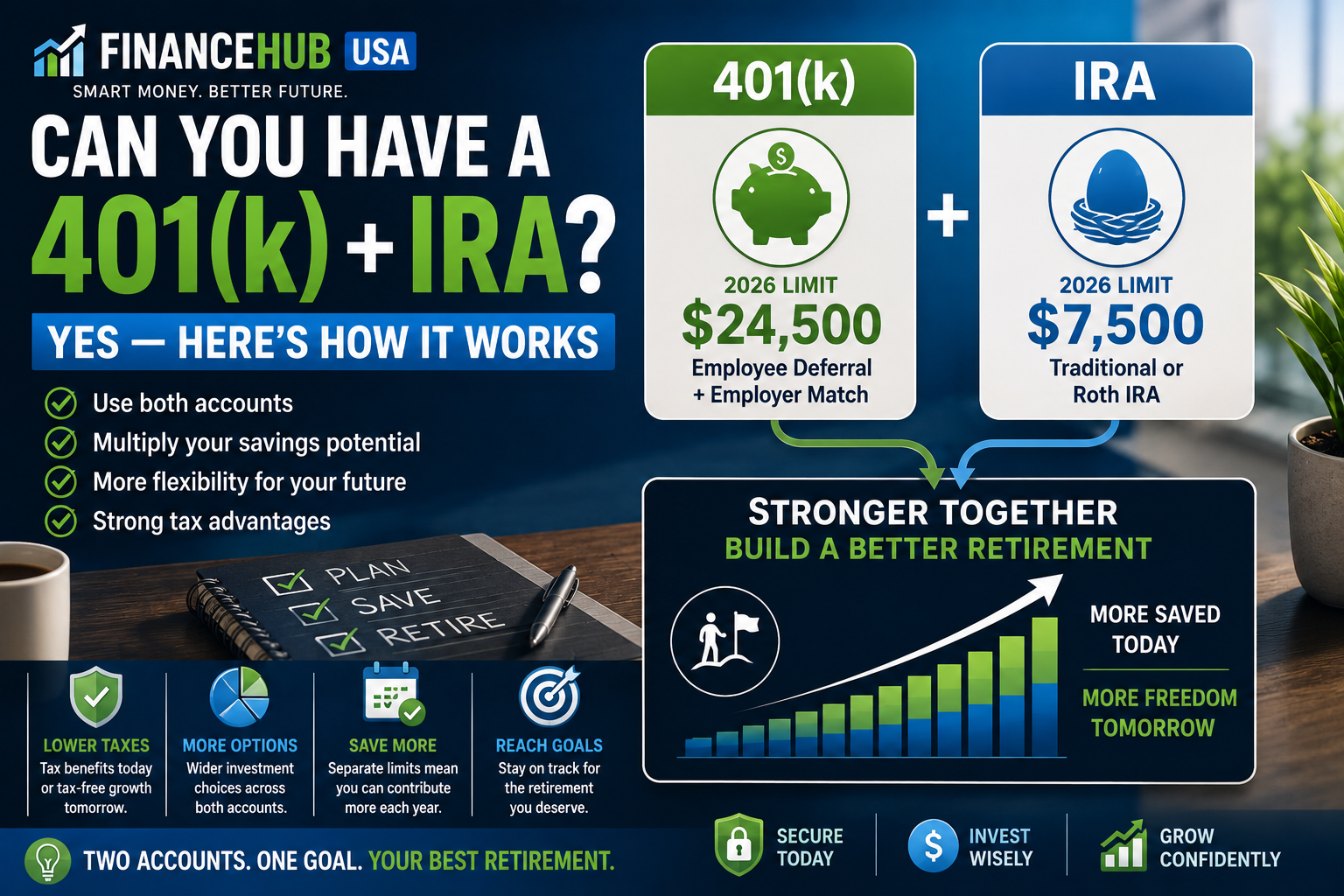
Having a workplace 401(k) does not automatically prevent you from contributing to an IRA.
The accounts have separate contribution limits.
For 2026, the employee elective deferral limit for most 401(k) plans is $24,500, while the IRA contribution limit is $7,500.
However, participation in a workplace retirement plan can affect whether a Traditional IRA contribution is deductible.
For the workplace-plan rules, see How to Maximize Your 401(k) Contributions in 2026
Roth IRA vs Traditional IRA for Tax Diversification
Some retirement savers use both pre-tax and Roth accounts over their working years.
This can create different pools of money in retirement:
- Taxable Traditional IRA or 401(k) distributions
- Potentially tax-free qualified Roth distributions
- Taxable brokerage assets
- Cash savings
Having more than one type of tax treatment can provide flexibility when planning future withdrawals.
That does not mean every saver needs both account types or that contributions should be divided equally.
FinanceHub USA Analysis: The Tax Rate Comparison Is Important but Incomplete
Roth versus Traditional discussions are often reduced to one question:
Will your tax rate be higher or lower in retirement?
That question matters, but it is not the entire decision.
Consider two investors who expect exactly the same tax rate today and in retirement.
Their preferred account can still differ because of:
- Traditional IRA deduction eligibility
- Roth income limits
- Required minimum distributions
- Other retirement income
- Estate-planning goals
- Need for withdrawal flexibility
- Whether the current tax savings would actually be invested
This last point can be particularly important.
If a Traditional IRA generates a current tax saving but the taxpayer spends that savings rather than investing it, the long-term comparison can differ from a scenario where the tax savings are invested.
Example: Same Contribution, Different Tax Treatment
Suppose two investors each place $7,500 into an IRA.
| Traditional IRA | Roth IRA | |
|---|---|---|
| Contribution | $7,500 | $7,500 |
| Potential deduction today | Yes, if eligible | No |
| Tax on qualified retirement distribution | Generally taxable where not previously taxed | Generally federal income tax free |
| Lifetime RMD for original owner | Generally yes | No |
The better outcome cannot be determined from the contribution amount alone.
When a Roth IRA May Deserve More Consideration
A Roth IRA may deserve closer evaluation when:
- Your current marginal tax rate is relatively low.
- You expect substantially higher taxable income later.
- You want qualified tax-free retirement withdrawals.
- You value avoiding lifetime RMDs from the Roth IRA.
- You are eligible to make a direct contribution.
These are considerations rather than rules.
When a Traditional IRA May Deserve More Consideration
A Traditional IRA may deserve closer evaluation when:
- You qualify for a meaningful current-year deduction.
- Your current marginal tax rate is relatively high.
- You expect a lower marginal tax rate during retirement.
- The current tax deduction helps support other financial priorities.
Again, the result depends on the taxpayer's broader situation.
Roth Conversion Is a Separate Decision
A Roth conversion involves moving money from a Traditional IRA or other eligible pre-tax retirement account into a Roth IRA.
A conversion is not the same as making a normal annual Roth IRA contribution.
Conversions can generally create taxable income in the year of conversion.
They require separate analysis involving:
- Current tax rate
- Future tax expectations
- Available cash to pay taxes
- Retirement timeline
- Other taxable income
Because conversion decisions can create substantial tax consequences, they should not be treated as automatically beneficial.
Common Roth IRA and Traditional IRA Mistakes
- Assuming the 2026 limit is $7,500 for each account. The limit is generally shared across Traditional and Roth IRAs.
- Ignoring Roth IRA income limits. High income can reduce or eliminate direct contribution eligibility.
- Assuming every Traditional IRA contribution is deductible. Workplace-plan coverage and income can reduce the deduction.
- Ignoring nondeductible contribution records. Form 8606 can be important for tracking after-tax basis.
- Assuming every Roth withdrawal is tax free. Qualified distribution requirements still apply.
- Forgetting about required minimum distributions. Traditional IRA owners are generally subject to RMD rules.
- Choosing solely based on age. Tax rates, income, account eligibility, and other retirement assets also matter.
- Making excess contributions. Contributions above the allowable limit can create tax complications if not corrected.
2026 Roth IRA vs Traditional IRA Decision Checklist
| Question | Why It Matters |
|---|---|
| What is my current marginal tax rate? | Helps evaluate the value of a current deduction |
| Do I qualify for a Traditional IRA deduction? | The tax benefit may be reduced by income and workplace-plan coverage |
| Am I eligible to contribute directly to a Roth IRA? | Roth contributions have income limits |
| What other retirement income might I have? | Can affect future taxable income |
| Do lifetime RMDs matter to my plan? | Traditional and Roth IRA rules differ |
| How long until I expect to use the money? | Retirement horizon influences planning |
Which IRA Is Better in 2026?
There is no universal winner.
A Roth IRA can be attractive for someone who values qualified tax-free withdrawals and does not need a current deduction.
A Traditional IRA can be attractive when the contribution qualifies for a valuable tax deduction today.
The comparison becomes more complicated when the Traditional IRA contribution is nondeductible or when income limits restrict Roth IRA eligibility.
That is why the account should be evaluated as part of the entire retirement and tax picture rather than as an isolated product.
Final Thoughts
The Roth IRA versus Traditional IRA decision in 2026 comes down largely to taxes, eligibility, and retirement flexibility.
For 2026, the combined IRA contribution limit is $7,500, increasing to $8,600 for people age 50 or older.
Direct Roth IRA contributions phase out between $153,000 and $168,000 of modified AGI for many single filers and between $242,000 and $252,000 for married couples filing jointly.
Traditional IRA contributions do not have the same general contribution-income ceiling, but the tax deduction can phase out when the taxpayer or spouse participates in a workplace retirement plan.
Traditional IRAs generally provide tax deferral and can offer an upfront deduction. Roth IRAs exchange that current deduction for the possibility of qualified tax-free withdrawals and no lifetime required minimum distributions for the original owner.
The strongest choice is therefore not automatically Roth or Traditional.
It is the account whose tax treatment, eligibility rules, and withdrawal structure best fit the investor's broader retirement plan.
Continue exploring FinanceHub USA for practical guides on IRAs, 401(k) plans, retirement planning, taxes, investing, and long-term wealth building.
Related reading: How to Maximize Your 401(k) Contributions in 2026
Related reading: How Much Should You Save From Every Paycheck?
Related reading: Should You Save Money or Pay Off Debt First?
Sources and Further Reading
- Internal Revenue Service — 2026 IRA Contribution and Income Limits
- Internal Revenue Service — IRA Contribution Limits
- Internal Revenue Service — Publication 590-A: Contributions to IRAs
- Internal Revenue Service — Publication 590-B: IRA Distributions
- Internal Revenue Service — Required Minimum Distribution FAQs
- Investor.gov — Introduction to Investing
Frequently asked questions
What is the main difference between a Roth IRA and a Traditional IRA?
The biggest difference is when you pay taxes. Traditional IRAs may provide a tax deduction now, while Roth IRAs generally allow qualified tax-free withdrawals during retirement. I've seen this confuse people, but it's simpler than it seems.
Is a Roth IRA better than a Traditional IRA in 2026?
Not necessarily. A Roth IRA may benefit investors who expect to be in a higher tax bracket later, while a Traditional IRA may be better for those seeking tax savings today. I recommend looking at your personal situation.
Can I contribute to both a Roth IRA and a Traditional IRA?
Yes, if you meet IRS eligibility requirements. However, your combined annual contributions generally cannot exceed the IRS contribution limit for the year. I've done this myself.
Which IRA is best for young investors?
Many younger investors prefer a Roth IRA because decades of tax-free compound growth can provide significant long-term benefits. I wish I had started one in my 20s.
Do Roth IRAs have required minimum distributions?
No, Roth IRAs owned by the original account holder generally do not require lifetime required minimum distributions. This makes them excellent for estate planning and tax flexibility.