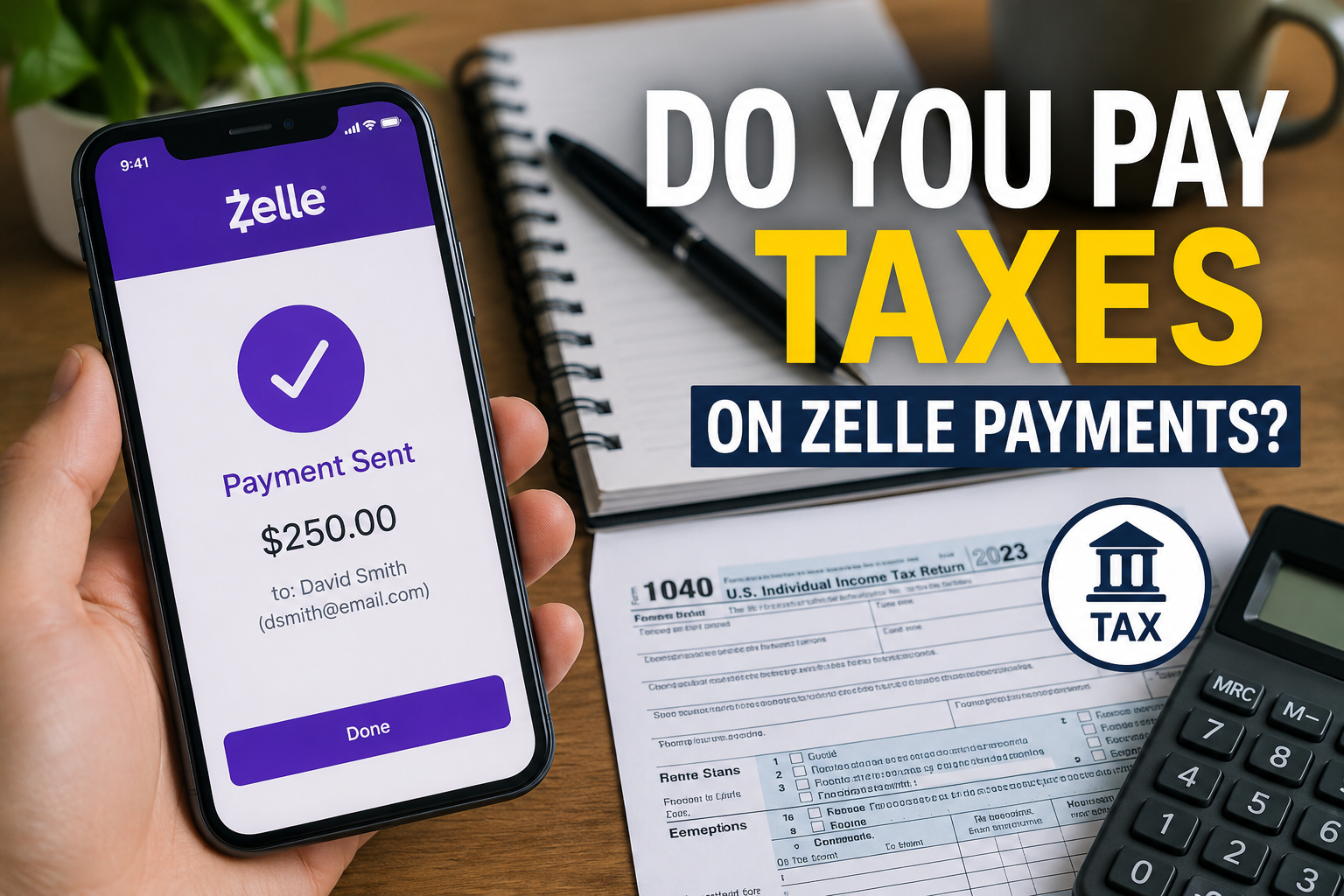
Do You Pay Taxes on Zelle Payments?
Wondering if Zelle payments are taxable? Learn when you must report income, when transfers are tax-free, and what IRS rules really say.
Are Zelle Payments Taxable in 2026?

Receiving money through Zelle does not automatically mean that you owe federal income tax.
The tax treatment depends primarily on why you received the money, not on the payment method used. A $1,000 transfer from a client for freelance work can represent taxable income, while a $1,000 reimbursement from a roommate for shared expenses may not be income at all.
This distinction is especially important because Zelle works differently from several other digital payment platforms when it comes to tax reporting. Zelle does not generally issue Form 1099-K to users, but that does not make income received through Zelle tax-free.
The IRS states that taxable income must generally be reported even when no information form is issued. :contentReference[oaicite:1]{index=1}
Are Zelle Payments Taxable in 2026?
Some Zelle payments are taxable and others are not.
A useful question to ask is:
Was this payment compensation, business revenue, rental income, or another form of taxable income?
If the answer is yes, the payment may need to be reported.
If the transfer was simply a reimbursement, gift, or repayment of money you previously advanced, it generally has a different tax treatment.
| Type of Zelle Payment | Generally Taxable? |
|---|---|
| Freelance payment | Generally yes |
| Business sale | Generally yes |
| Payment for professional services | Generally yes |
| Rental payment received as a landlord | May represent taxable rental income |
| Friend reimbursing dinner | Generally no |
| Roommate reimbursing shared utilities | Generally no |
| Personal gift | Generally not income to the recipient |
| Repayment of personal loan principal | Generally not income |
These are general examples. The facts surrounding a transaction ultimately determine its tax treatment.
When Zelle Payments Are Generally Taxable
Money received through Zelle can be taxable when it represents compensation or revenue from an income-producing activity.
Common examples include:
- Freelance work
- Consulting
- Graphic design
- Web development
- Photography
- Home services
- Online or local business sales
- Side-hustle income
- Professional services
- Certain rental income
The IRS states that income from freelance work, side jobs, goods or services sold, and other business activity is generally taxable even when it is not reported on an information return. :contentReference[oaicite:2]{index=2}
Example: Freelance Work Paid Through Zelle
Suppose Sarah is a freelance graphic designer and completes a project for a client.
The client sends her $2,000 through Zelle.
The payment is compensation for services. Using Zelle instead of a check or bank transfer does not generally change the underlying tax treatment.
The $2,000 may therefore be part of Sarah's taxable business or self-employment income.
Personal Zelle Transfers Are Different
Now suppose Sarah pays $160 for dinner for herself and three friends.
Each friend sends her $40 through Zelle afterward.
Sarah receives $120, but she has not earned $120. She simply recovered money she advanced on behalf of the group.
This type of reimbursement generally does not represent income.
Common Personal Zelle Transfers
- Splitting restaurant bills
- Sharing rent with a roommate
- Reimbursing utility bills
- Splitting vacation expenses
- Paying someone back for concert tickets
- Repaying borrowed money
- Sending birthday or holiday gifts
- Reimbursing groceries purchased for a household
The transfer amount alone does not determine whether it is taxable.
Does Zelle Send Form 1099-K?

Zelle has stated that it does not issue Form 1099-K for payments made through the Zelle Network.
This is an important difference between Zelle and certain payment apps or online marketplaces that may operate as third-party settlement organizations for federal reporting purposes.
However, the absence of Form 1099-K does not determine whether income is taxable.
No 1099-K Does Not Mean No Taxes
Suppose a self-employed contractor receives $15,000 of legitimate business income through Zelle during the year.
If no Form 1099-K is issued, the income does not automatically disappear for tax purposes.
The IRS states that taxable income generally must be reported even when you do not receive a form reporting that income. :contentReference[oaicite:3]{index=3}
This distinction can be summarized as:
Taxability depends on the transaction. Tax forms are reporting tools.
Zelle vs. Venmo and Other Payment Apps
The underlying tax rule is similar regardless of the payment method: income does not become tax-free simply because it arrives digitally.
Where platforms can differ is information reporting.
| Issue | Zelle | Some Payment Apps and Marketplaces |
|---|---|---|
| Can be used to receive taxable income | Yes | Yes |
| Payment method determines taxability | No | No |
| Form 1099-K reporting | Zelle states it does not issue Form 1099-K | May apply when federal reporting requirements are met |
For 2026 filing preparation, the IRS states that payment apps and online marketplaces subject to Form 1099-K reporting generally issue the form when payments for goods and services exceed $20,000 and more than 200 transactions during the year. Zelle's reporting model is different. :contentReference[oaicite:4]{index=4}
Business Revenue Is Not the Same as Taxable Profit
If you use Zelle for business payments, another important distinction is the difference between gross revenue and net business income.
Suppose a self-employed person receives $40,000 through Zelle during the year.
They also have qualifying business expenses:
| Item | Amount |
|---|---|
| Gross business revenue | $40,000 |
| Supplies | $5,000 |
| Advertising | $2,000 |
| Software | $1,500 |
| Other qualifying business expenses | $6,500 |
| Simplified Net Business Income | $25,000 |
This simplified example shows why gross transfers into a bank account should not automatically be confused with taxable business profit.
The actual calculation depends on the taxpayer's records, deductible expenses, accounting method, and applicable tax rules.
Self-Employment Tax May Also Matter
Freelancers and business owners may have obligations beyond ordinary federal income tax.
Depending on the circumstances, they may need to consider:
- Self-employment tax
- Estimated tax payments
- Business deductions
- State income taxes
- Local taxes
The payment arriving through Zelle does not eliminate those obligations.
Are Gifts Sent Through Zelle Taxable?
A legitimate personal gift generally does not become taxable income to the recipient simply because it is transferred through Zelle.
Gift-tax rules are separate and can create reporting considerations for the donor when sufficiently large amounts are involved.
That is different from treating an ordinary personal gift as earned income to the person receiving it.
Are Zelle Reimbursements Taxable?
Genuine reimbursements generally are not income when someone is simply paying you back.
Example
Suppose you purchase four event tickets at $125 each.
You pay:
4 × $125 = $500
Three friends each reimburse you $125 through Zelle.
You receive:
3 × $125 = $375
The $375 generally represents repayment of money you already spent rather than compensation for services.
What About Rent Paid Through Zelle?
The answer depends on why you receive the rent payment.
Roommate Reimbursement
If you pay the landlord $2,000 and your roommate sends you $1,000 for their share, the transfer may simply represent shared household expenses.
Rental Property Income
If you own a rental property and a tenant sends you $2,000 through Zelle as rent, the payment may represent rental income subject to applicable tax rules.
Two transfers can have the same amount and description but very different tax consequences.
What If You Sell a Personal Item and Receive Payment Through Zelle?
Selling personal property requires looking at what you originally paid for the item.
Example: Selling at a Loss
Suppose you bought a television for $1,200 and later sell it for $500.
| Amount | |
|---|---|
| Original cost | $1,200 |
| Sale price | $500 |
| Difference | -$700 |
Receiving $500 through Zelle does not automatically mean you earned $500 of taxable profit.
You sold the personal item for less than its original cost.
Example: Selling at a Gain
Suppose you purchased a collectible for $600 and later sell it for $1,000.
The simplified gain is:
$1,000 − $600 = $400
That gain may have tax consequences depending on applicable rules.
Keeping purchase records for valuable personal property can therefore be useful.
Why Good Records Matter When Using Zelle

Zelle transactions can appear in bank records alongside ordinary personal transfers.
If you use Zelle for business activity, consider maintaining documentation such as:
- Invoices
- Receipts
- Customer records
- Contracts
- Business expense records
- Bank statements
- Transaction descriptions
- Records showing the original cost of items sold
The IRS emphasizes that good recordkeeping is important for taxpayers receiving income from gig or business activities. :contentReference[oaicite:5]{index=5}
Should You Separate Personal and Business Zelle Activity?
Separating personal and business payments can simplify bookkeeping.
The goal is not to change whether a transaction is taxable.
The goal is to make it easier to determine:
- Which payments represent business revenue
- Which transfers are reimbursements
- Which expenses are business-related
- Which transactions correspond with invoices
If personal and business activity are mixed, detailed records become even more important.
Can the IRS See Zelle Payments?
The fact that Zelle does not issue Form 1099-K does not mean taxpayers should assume Zelle transactions are invisible or irrelevant for tax purposes.
Tax compliance should be based on whether income is taxable, not on whether a taxpayer expects a particular transaction to appear automatically on an IRS information form.
Bank records and business records can also become relevant when substantiating income and expenses.
What If a Customer Pays You Through Zelle but Sends No Tax Form?
Imagine you perform consulting services worth $3,000 and your customer pays through Zelle.
You receive no Form 1099-K.
That does not automatically remove the $3,000 from taxable income.
The IRS states that income from part-time work, gig activity, goods, or services must generally be reported even when the taxpayer does not receive Form 1099-K, 1099-NEC, 1099-MISC, or another information statement. :contentReference[oaicite:6]{index=6}
FinanceHub USA Analysis: Separate the Payment Method From the Tax Event
A useful way to think about Zelle taxes is to separate the transaction into two questions:
- What economic event occurred?
- How was the money transferred?
The first question usually matters more for determining whether income exists.
| Economic Event | Payment Method | General Tax Character |
|---|---|---|
| Freelance project | Zelle | Potential taxable business income |
| Freelance project | Check | Potential taxable business income |
| Dinner reimbursement | Zelle | Generally personal reimbursement |
| Dinner reimbursement | Cash | Generally personal reimbursement |
Changing the payment rail does not necessarily change the underlying transaction.
Zelle vs. Form 1099-K: Why the Difference Matters
Consumers sometimes hear about Form 1099-K thresholds and assume they apply directly to every electronic transfer service.
That is not a reliable assumption.
The IRS reporting framework applies to specific types of payment settlement entities and qualifying transactions. Zelle has publicly stated that transactions through its network are not subject to its issuing Form 1099-K.
Therefore, using a federal 1099-K threshold as though it were a threshold for whether Zelle income is taxable would be incorrect.
Common Zelle Tax Mistakes
- Assuming every Zelle deposit is taxable income. Reimbursements and personal transfers are not automatically income.
- Assuming no 1099-K means no tax liability. Taxable income may still need to be reported.
- Confusing revenue with profit. Business expenses can affect taxable net income.
- Keeping no documentation. Records help distinguish business activity from personal transfers.
- Ignoring self-employment taxes. Freelance and business income can involve additional tax obligations.
- Assuming a personal-item sale equals taxable income. Original cost can matter when determining whether a gain occurred.
- Using Form 1099-K thresholds as tax-free income limits. Reporting thresholds and income-tax rules are different concepts.
A Simple Zelle Tax Checklist
When reviewing a Zelle payment, ask:
- Why did I receive this money?
- Was it compensation for work?
- Was it revenue from a business?
- Was someone simply reimbursing me?
- Was the transfer a gift?
- Was it repayment of borrowed money?
- Did I sell personal property?
- What did I originally pay for that property?
- Do I have documentation supporting the transaction?
Those questions are generally more useful than looking only at how much money moved through Zelle during the year.
Final Thoughts
Do you have to pay taxes on Zelle payments?
Not simply because the money arrived through Zelle.
The key issue is the underlying reason for the payment.
Money received for freelance work, business activity, professional services, rental activity, or other taxable income generally remains taxable regardless of the payment method. The IRS states that taxable income generally must be reported even when no information form is provided. :contentReference[oaicite:7]{index=7}
Personal reimbursements, shared expenses, many gifts, and repayments of personal loans generally do not become taxable income simply because they were transferred electronically.
Zelle's lack of Form 1099-K reporting should therefore not be confused with a tax exemption.
The strongest approach is to keep accurate records, identify the purpose of significant payments, and separate business and personal activity when practical.
Continue exploring FinanceHub USA for practical guides covering taxes, digital payments, banking, budgeting, credit, and personal finance.
Related reading: Are Venmo Payments Taxable in 2026?
Sources and Further Reading
Frequently asked questions
Do I have to pay taxes on money friends send me through Zelle?
Generally no. Personal reimbursements, gifts, and shared expenses are usually not considered taxable income.
Are freelance payments received through Zelle taxable?
Yes. Income earned from freelance work, consulting, or business services is generally taxable regardless of the payment method.
Does Zelle issue Form 1099-K?
No. Zelle has stated that it does not issue Form 1099-K because it operates as a bank-to-bank payment network.
Should I report taxable income if I never receive a tax form?
Yes. The IRS requires taxpayers to report all taxable income even if they do not receive an informational tax document.
What's the easiest way to avoid tax confusion when using Zelle?
Keep business and personal transactions separate, save receipts and invoices, and maintain accurate financial records throughout the year.