Should You Save Money or Pay Off Debt First?
Should you save money or pay off debt first? Learn how interest rates, emergency savings and cash flow can help you decide where your money should go.
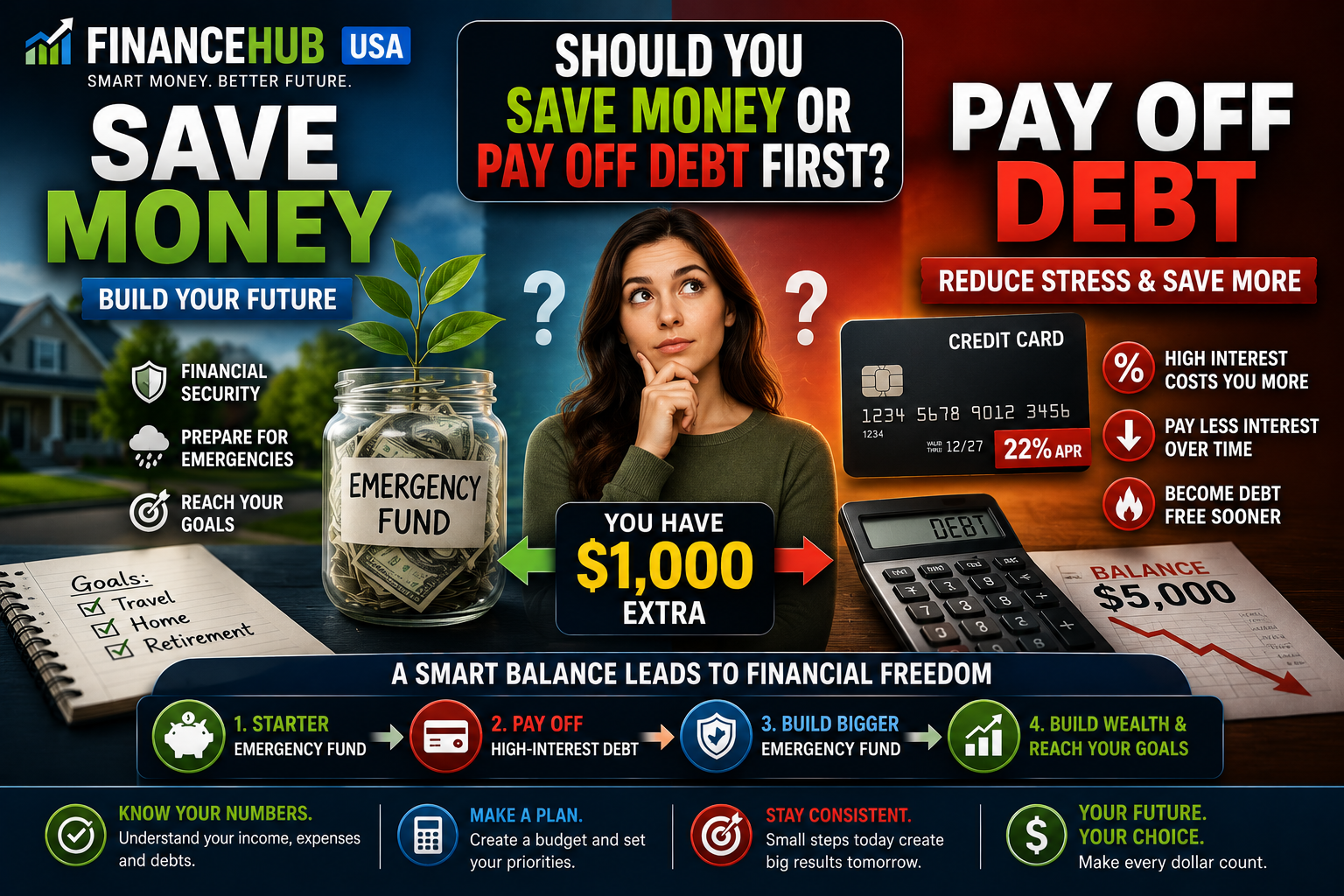

For many households, the best answer is not choosing only savings or only debt repayment. A practical strategy often begins with enough cash to handle a normal financial surprise, then shifts more aggressively toward expensive debt.
The trade-off comes down to two forces: financial vulnerability and financial cost. Savings reduces vulnerability because it gives you accessible cash when something goes wrong. Debt repayment reduces financial cost because it lowers interest charges and can eventually free up monthly cash flow.
The right priority depends on how much emergency savings you already have, the interest rates on your debts, the stability of your income, upcoming expenses, and whether an unexpected bill would force you to borrow again.
Why You May Need Savings Before Aggressively Paying Debt
Sending every available dollar toward debt can look mathematically efficient, especially when the balance carries a high interest rate. But a debt payoff plan becomes fragile if one unexpected expense forces you to borrow again.
Cars break down. Medical bills appear. Appliances fail. Work hours can be reduced. If you empty your cash reserves to reduce debt and then face a $1,000 emergency, you may end up replacing the balance you just paid off.
The Consumer Financial Protection Bureau describes an emergency fund as money set aside for unplanned expenses and notes that without savings, even relatively small financial shocks can lead consumers to rely on credit cards or loans.
That creates a useful principle: some liquidity can prevent future emergencies from becoming new debt.
How Much Emergency Savings Should You Have Before Paying Debt Aggressively?
There is no universal dollar amount. The appropriate starting cushion depends on your essential expenses, income stability, household responsibilities, insurance coverage, and the types of unexpected costs you are most likely to face.
The FDIC has published consumer guidance discussing emergency savings and the importance of preparing for unexpected expenses.
| Financial Position | Possible Priority | Reason |
|---|---|---|
| $0 emergency savings | Build an initial cash cushion | Reduces the chance that a small emergency immediately requires new borrowing |
| Small savings + high-interest debt | Consider balancing both | Preserves some liquidity while attacking expensive debt |
| Strong emergency savings + high-interest debt | Debt may deserve greater priority | Existing cash reserves already provide some protection |
| Low-rate debt + limited savings | Savings may deserve more attention | Liquidity may be more valuable than aggressively reducing inexpensive debt |
FinanceHub USA note: These are planning illustrations, not universal rules or personalized advice.

When Paying Off Debt First Can Make More Sense
Once you have some financial breathing room, the cost of the debt becomes much more important.
Imagine keeping $5,000 in savings while carrying $5,000 of credit card debt at a very high APR. The savings may earn interest, but the credit card can be charging interest at a much faster rate.
| Debt Balance | Illustrative Annual Rate | Simple One-Year Interest Illustration |
|---|---|---|
| $5,000 | 5% | $250 |
| $5,000 | 10% | $500 |
| $5,000 | 20% | $1,000 |
| $5,000 | 25% | $1,250 |
This is not a payoff schedule. Real credit card interest depends on changing balances, payments, daily or periodic interest calculations, fees, and the terms of the account.
The point is that the rate matters. Eliminating debt at 25% APR can improve your finances in a very different way from making additional payments on a loan charging 4% or 5%.
Not All Debt Should Have the Same Priority
Suppose Daniel has four debts:
- Credit card: 24% APR
- Personal loan: 11%
- Auto loan: 6%
- Mortgage: 5%
If he has $300 available beyond required payments, dividing the money equally among all four balances may feel organized, but it may not be the most efficient way to reduce interest costs.
One common approach is the debt avalanche: make required payments on all debts, then direct additional money toward the balance with the highest interest rate. When that balance is eliminated, move the extra payment to the next-highest-rate debt.
Another approach is the debt snowball, which prioritizes the smallest balance first. It may not minimize interest as efficiently, but some borrowers prefer the motivational benefit of eliminating balances sooner.
Whichever method you use, required minimum payments remain important.

FinanceHub USA Analysis: Think in Terms of Vulnerability and Cost
The save-versus-debt decision becomes clearer when you stop treating it as a binary choice.
Ask two questions:
- How vulnerable am I to the next unexpected expense? If a $500 or $1,000 emergency would immediately force you back onto a credit card, accessible savings has meaningful value.
- How expensive is the debt I am carrying? The higher the interest rate, the stronger the mathematical case for paying it down quickly.
This creates four broad situations:
| Liquidity | Debt Cost | Likely Focus |
|---|---|---|
| Very low | Very high | Build a starter cushion while attacking expensive debt |
| Strong | Very high | Prioritize high-interest debt more aggressively |
| Very low | Low | Strengthen emergency savings first |
| Strong | Low | Evaluate broader goals such as saving, investing, or accelerating debt |
This framework is more useful than applying one rule to every household because it considers both risk and cost.
A Practical Order for Saving and Debt Repayment
For many households, treating the decision as a sequence can make it easier to manage.
| Stage | Primary Goal | Why It Matters |
|---|---|---|
| 1 | Keep required payments current | Protects against avoidable late-payment consequences |
| 2 | Build starter emergency savings | Creates an initial buffer against unexpected expenses |
| 3 | Attack high-interest debt | Reduces expensive borrowing costs |
| 4 | Build a larger emergency fund | Improves resilience against larger disruptions |
| 5 | Evaluate lower-rate debt and long-term goals | Allows recovered cash flow to support future priorities |
This is not a universal formula. Someone with unstable income, dependents, or an upcoming medical expense may reasonably want more liquidity before accelerating debt repayment. Someone with stable income and very expensive credit card debt may choose to move through the debt stage faster.
Example: What Should You Do With an Extra $800 a Month?
Consider Emily. After paying normal expenses and required debt payments, she has $800 of monthly surplus cash.
Her situation:
- Emergency savings: $1,000
- Credit card balance: $6,000 at 22% APR
- Auto loan: $12,000 at 6%
- Employer offers a 401(k) match
Sending all $800 to savings improves liquidity but allows expensive credit card debt to remain. Sending all $800 to the credit card accelerates payoff but leaves her emergency reserve relatively small.
One illustrative approach could be:
| Monthly Surplus | Possible Allocation | Purpose |
|---|---|---|
| $600 | Extra credit card payment | Attack 22% debt aggressively |
| $200 | Emergency savings | Continue strengthening liquidity |
| Total | $800 | Reduce debt while preserving some savings momentum |
This is not a recommended 75/25 formula. Emily's appropriate allocation would depend on her income stability, household expenses, retirement plan, upcoming obligations, and tolerance for financial risk.
The important part is what happens after the credit card is paid off. The money previously used for the card payment becomes available for another goal.
What Happens to Your Cash Flow After Debt Is Paid Off?
Debt payoff does more than reduce a balance. It can also change your monthly cash flow.
Suppose Emily's required credit card payment had been $180 per month and she was also making the additional $600 payment shown above. Once the balance disappears, up to $780 of monthly cash flow could potentially be redirected, depending on her circumstances.
Possible destinations include:
- Building a larger emergency reserve
- Increasing retirement contributions
- Paying down another debt
- Funding a sinking fund for upcoming expenses
- Investing for longer-term goals
This is why eliminating expensive debt can create a compounding benefit: fewer interest charges today and more flexible cash flow tomorrow.
When Saving First May Deserve Greater Priority
Debt rates matter, but there are situations where liquidity deserves more weight.
- You have little or no accessible emergency savings.
- Your income is unstable or highly variable.
- You expect an unavoidable major expense soon.
- Your existing debt carries relatively low interest rates.
- You have dependents relying on your income.
- Your job situation is uncertain.
- Aggressive debt repayment would leave you unable to handle a normal emergency.
Paying an additional $2,000 toward a low-rate loan and then putting a $2,000 car repair on a high-rate credit card may leave you worse off than maintaining enough liquidity to avoid new expensive borrowing.
Common Mistakes When Choosing Between Savings and Debt
- Emptying savings to pay debt. A faster payoff can backfire if the next emergency requires new borrowing.
- Ignoring expensive debt while building excessive cash. Compare the cost of the debt with the value of the liquidity you are preserving.
- Treating every debt the same. A high-APR credit card and a low-rate installment loan can deserve very different priorities.
- Missing required payments while building savings. Minimum obligations should be protected before optional allocations.
- Continuing to add new revolving debt. A payoff strategy becomes much harder when new charges repeatedly replace the balances being eliminated.
- Ignoring employer retirement benefits. If a workplace plan offers matching contributions, understand the plan before completely eliminating contributions.
- Investing emergency money. Cash needed for near-term emergencies generally requires accessibility and stability rather than exposure to short-term market volatility.

FinanceHub USA Decision Framework
Use this as a quick decision guide:
| If This Describes You | Consider Focusing On |
|---|---|
| No emergency savings and high-interest credit card debt | Build a starter cushion, then attack the card aggressively |
| Strong emergency savings and high-interest debt | Prioritize debt repayment more aggressively |
| Limited savings and mostly low-rate debt | Strengthen liquidity before accelerating the debt |
| Employer match available | Understand the match before deciding whether to stop retirement contributions |
| Major expense expected soon | Preserve more accessible cash |
| Debt payoff would free substantial monthly cash flow | Consider whether accelerating that balance improves your overall position |
The purpose of the framework is not to produce one automatic answer. It is to make the trade-off visible: how much protection do you need, and how much is the debt costing you?
Final Thoughts
So, should you save money or pay off debt first? For many households, the strongest approach is a sequence rather than an all-or-nothing choice.
Keep required payments current, build enough accessible cash to handle a normal financial surprise, and then look closely at the interest rates on your debts. High-cost debt can deserve aggressive repayment, while lower-rate obligations may leave more room for savings and other goals.
As your situation changes, the allocation should change too. A plan that makes sense with $500 in savings and $10,000 of credit card debt may look completely different after the expensive debt is gone and your emergency reserves are stronger.
The objective is not to follow one percentage forever. It is to reduce financial vulnerability, eliminate expensive borrowing, and redirect the cash flow you recover toward a stronger financial position.
Related reading: What Happens If You Only Pay the Credit Card Minimum?
Related reading: How Much Money Should You Have Left After Bills?
Sources and further reading:
Frequently asked questions
Should I save money or pay off debt first?
It depends on your emergency savings, debt interest rates, income stability and upcoming expenses. Many households can benefit from maintaining a cash cushion while directing additional money toward high-interest debt.
Should I pay off debt if I have no savings?
Making required debt payments remains important, but maintaining some accessible emergency savings can reduce the risk that an unexpected expense forces you to borrow again.
How much should I save before paying off debt?
There is no universal amount. Consider your essential expenses, income stability, dependents and the types of emergencies you are likely to face. Some people begin with a smaller starter emergency fund before aggressively addressing expensive debt.
Should I pay off credit cards before saving more money?
High-interest credit card debt can be extremely expensive, so after establishing some emergency liquidity, directing additional money toward the card may make financial sense. Your circumstances and ability to handle unexpected expenses still matter.
Is it better to pay off the highest-interest debt first?
The debt avalanche method prioritizes the highest interest rate while maintaining required payments on other debts. This approach generally focuses on reducing interest costs, although some people prefer the debt snowball method for motivational reasons.
Should I empty my savings account to pay off debt?
Doing so can leave you financially vulnerable. Before using most or all of your savings, consider how you would pay for an emergency or income interruption without borrowing again.
Can I save money and pay off debt at the same time?
Yes. A hybrid approach can direct part of your monthly surplus toward emergency savings and the rest toward debt, particularly high-interest balances.
Should I invest or pay off debt?
The answer depends on the debt's interest rate, investment risk, taxes, employer benefits, liquidity needs and other factors. High-interest debt can make aggressive repayment particularly attractive, while lower-rate debt requires a more nuanced comparison.
What happens after I pay off high-interest debt?
The monthly cash flow previously used for that debt can be redirected toward a larger emergency fund, other debts, retirement contributions, investments or additional financial goals.