What Happens If You Only Pay the Credit Card Minimum?
Paying only the credit card minimum keeps your account current, but debt can last for years. See how interest grows and why paying extra can save money.
What Happens If You Only Pay the Minimum on a Credit Card?

Your credit card statement shows a balance of several thousand dollars, but the amount labeled minimum payment due looks much easier to handle.
Paying only that smaller amount can provide short term breathing room, and making at least the required minimum by the due date generally keeps the account from being treated as missed for that billing cycle.
But there is a major difference between keeping a credit card account current and actually eliminating credit card debt.
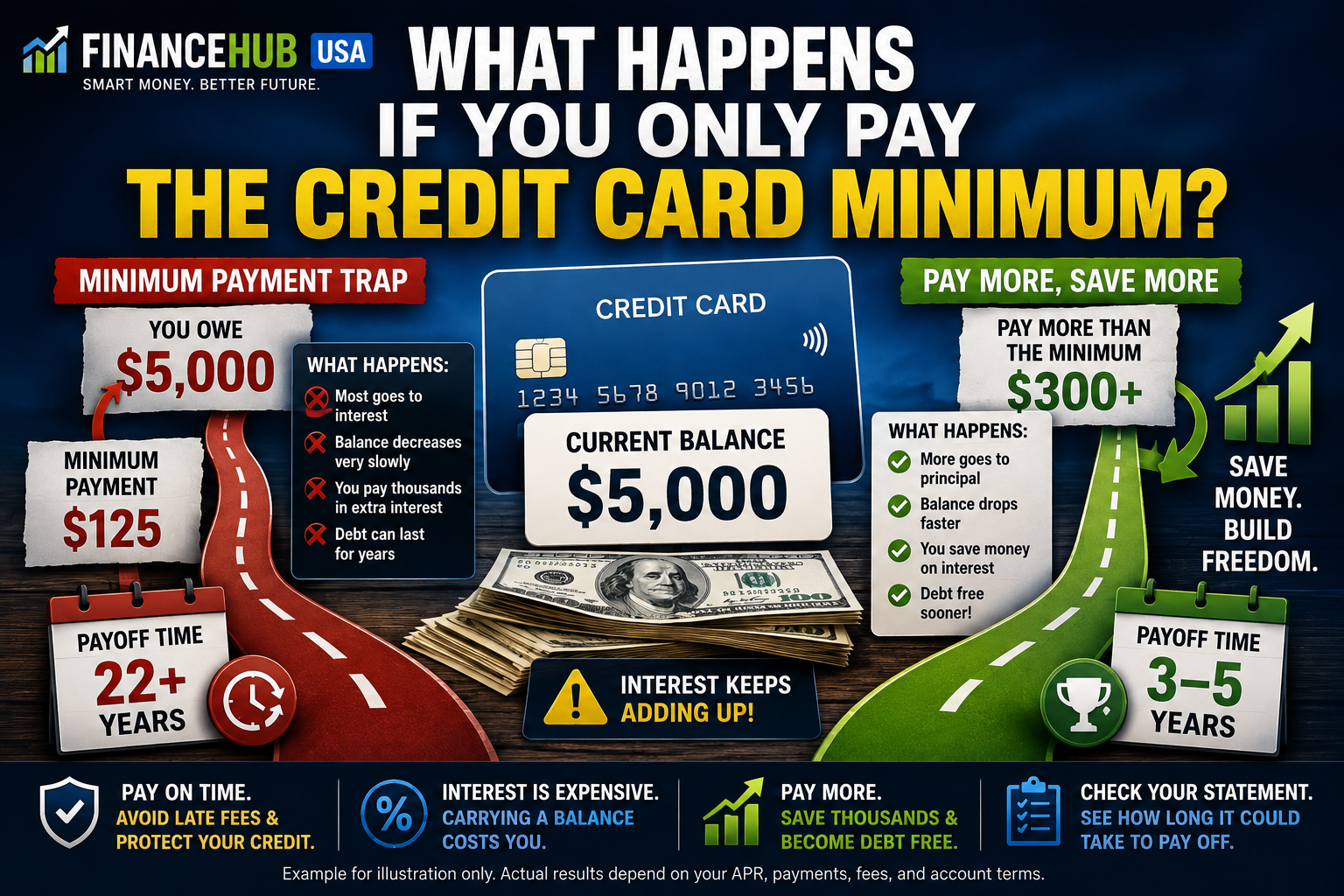
When you carry an interest bearing balance, interest can continue accumulating while only part of each payment reduces what you originally borrowed.
That means a balance that seemed manageable at first can remain with you for years, especially if you continue making purchases.
Understanding where the minimum payment goes, how interest is calculated, and what changes when you pay more can help you decide whether short term flexibility is worth the long term cost.
What Does the Minimum Credit Card Payment Mean?
The minimum payment is the smallest amount your card issuer requires you to pay for that billing cycle.
It is not necessarily the amount needed to make meaningful progress toward eliminating the balance.
If you make at least the required minimum by the due date, you generally avoid being treated as having missed that required monthly payment.
That matters because missing the minimum can lead to consequences such as:
- Late fees
- Damage to your credit history if the account becomes sufficiently delinquent
- Loss of certain promotional terms
- Possible changes to your account terms under applicable conditions
But paying the minimum does not normally stop interest from accumulating when you are carrying a balance subject to interest.
Minimum Payment vs. Statement Balance vs. Current Balance
Credit card statements show several different numbers, and confusing them can lead to unnecessary interest.
| Amount | What It Generally Means |
|---|---|
| Minimum payment | The smallest amount required for the billing cycle |
| Statement balance | The amount owed at the end of the most recent billing cycle |
| Current balance | The balance currently showing after new purchases, payments, credits, and other activity |
Example
Suppose your statement closes with:
- Statement balance: $2,500
- Minimum payment: $75
Two weeks later, you make another $300 of purchases.
Your current balance might then be:
$2,800
Paying only $75 may satisfy the minimum requirement for the month, but it does not eliminate the statement balance or current balance.
Why Is the Minimum Payment So Much Smaller Than the Balance?
Minimum payment formulas vary by card issuer and account agreement.
Your statement tells you the amount required for that billing cycle.
The important point is that the minimum is designed as a contractual payment requirement, not as the fastest or least expensive repayment plan.
Federal credit card rules generally require statements to include a Minimum Payment Warning showing that paying only the minimum can result in more interest and a longer repayment period.
Statements also generally show an estimate of how long it could take to repay the current balance using only minimum payments and making no additional purchases.
Why Does Paying Only the Minimum Cost So Much?
The answer is interest.
When you do not pay the balance in full and the balance is subject to interest, the issuer can continue charging interest according to the account terms.
Many credit cards calculate interest daily using an average daily balance.
That means interest can accumulate throughout the billing cycle rather than being calculated only once at the end of the month.
Example: $5,000 Balance at 24% APR
Consider a simplified example.
Suppose you owe:
$5,000
at:
24% APR
For a simple illustration, 24% annually is approximately 2% per month, although real credit card calculations often use a daily periodic rate.
Approximate first month interest:
$5,000 × 2% = $100
If your payment is:
$150
then only about:
$50
would reduce principal in this simplified example.
| Simplified First Month | Amount |
|---|---|
| Starting balance | $5,000 |
| Approximate interest | $100 |
| Illustrative payment | $150 |
| Approximate principal reduction | $50 |
| Approximate remaining balance | $4,950 |
This example is intentionally simplified.
Actual credit card interest depends on:
- APR
- Daily balances
- Transaction timing
- Fees
- Promotional rates
- Grace period rules
- The card agreement
Why the Balance Can Barely Move
A payment can feel substantial while the balance declines only slightly.
That happens because part of the payment may be absorbed by interest before much progress is made against principal.
The higher the APR, the more expensive carrying the balance can become.
Minimum Payment vs. Paying More

Imagine two borrowers with the same starting balance.
Neither makes another purchase.
Alex pays only the required minimum each month.
Jordan pays a larger fixed amount whenever possible.
| Strategy | Short Term Cash Flow | Debt Reduction | Interest Impact |
|---|---|---|---|
| Pay only minimum | Leaves more cash available today | Usually slower | Can result in substantially more interest |
| Pay above minimum | Uses more monthly cash | Generally faster | Can reduce total interest |
| Pay statement balance in full | Requires more cash now | Eliminates that statement balance | Can avoid purchase interest when grace period requirements are satisfied |
Why Paying Earlier Can Also Help
If interest is accruing daily, reducing the balance sooner can reduce the amount on which future interest is calculated.
That means two $500 payments can have slightly different effects depending on when they are made.
Example
Suppose you have $500 available this month.
You could:
- Pay $500 near the beginning of the billing period
- Wait until the due date and pay the same $500
If interest is accumulating daily, the earlier reduction in balance may reduce some interest compared with waiting.
The exact amount depends on the card's terms and daily balance calculation.
What Is a Credit Card Grace Period?
A grace period can allow you to avoid interest on new purchases when applicable conditions are met.
For many credit cards, if you pay the full statement balance by the due date, qualifying purchases may not incur interest.
However, grace period rules depend on the card agreement.
What Happens When You Carry a Balance?
Once you begin carrying an unpaid balance, your treatment of new purchases can change.
Depending on the issuer and card terms, new purchases may begin accruing interest without the same grace period you previously enjoyed.
This is one reason carrying revolving debt can become expensive quickly.
Example: Losing the Benefit of Paying in Full
Suppose your statement balance is:
$2,000
You pay only:
$100
The remaining balance is carried forward.
You then make another:
$400
of purchases.
Depending on your account terms, those new purchases may also become subject to interest.
That can make repayment more difficult because old debt and new spending begin working against you simultaneously.
What Happens If You Keep Using the Card While Paying Only the Minimum?
This is where minimum payment debt can become especially difficult.
The repayment estimate on your statement generally assumes that you make no additional charges.
Example
Suppose you start the month with:
$4,000 balance
You make:
$120 payment
but add:
$250 in new purchases
| Illustrative Month | Amount |
|---|---|
| Starting balance | $4,000 |
| Payment | -$120 |
| New purchases | +$250 |
| Interest | Additional cost |
| Likely result | Balance may end higher than it started |
You technically made a payment, but your total debt still increased.
The Revolving Debt Trap
This pattern can create a cycle where:
- You make the minimum payment.
- Interest is added.
- You continue using the card.
- The balance barely moves or increases.
- Next month's minimum remains manageable.
- The cycle repeats.
That is why looking only at the minimum payment can give a misleading picture of affordability.
What Does Your Minimum Payment Warning Show?
Your statement can contain one of the most useful tools for understanding your debt.
Federal disclosure rules generally require a warning showing approximately how long it could take to repay the current balance if you:
- Pay only the minimum
- Make no additional purchases
It also generally includes an estimate of the payment required to repay the current balance in approximately three years.
Why the Three Year Number Matters
Suppose your statement shows:
- Minimum payment: $125
- Three year repayment amount: $185
The difference is:
$60 per month
That does not mean $185 is necessarily affordable for everyone.
But it illustrates how a relatively modest increase can materially change the payoff timeline.
What Is a Promotional APR?
Some cards offer promotional interest rates such as:
- 0% APR on purchases
- 0% APR on balance transfers
- Reduced APR for a specified period
A promotional rate can reduce borrowing costs temporarily.
But it does not eliminate the need to make required minimum payments.
What Happens When a 0% APR Promotion Ends?
If a balance remains when the promotional period expires, the remaining amount may begin accruing interest at the card's regular APR according to the agreement.
Example
Suppose you transfer:
$6,000
to a card offering 0% APR for 18 months.
To eliminate the balance evenly before the promotion ends, ignoring transfer fees:
$6,000 ÷ 18 ≈ $333.33 per month
If you pay only a much smaller minimum, a substantial balance may remain when the regular APR begins.
Watch for Balance Transfer Fees
A 0% balance transfer offer can still charge a fee.
Example
If you transfer:
$6,000
and the transfer fee is:
3%
then the fee would be:
$6,000 × 3% = $180
Your starting balance could effectively become approximately $6,180.
What Is a Penalty APR?
Some credit card agreements may allow a higher APR after certain events, subject to applicable law and the account terms.
For example, a serious late payment may affect your interest rate in some situations.
This is another reason the minimum payment should always be protected when possible.
Review your card agreement to understand whether a penalty APR can apply and under what circumstances.
Can Paying Only the Minimum Affect Your Credit Score?
Making the required payment on time is very different from missing a payment.
Paying on time supports your payment history.
But paying only the minimum does not guarantee that your credit profile will improve.
Credit Utilization Can Remain High
Suppose you have:
- Credit limit: $5,000
- Balance: $4,500
Utilization on that card is:
$4,500 ÷ $5,000 = 90%
Even if every payment is made on time, a very high revolving balance can still affect your credit profile.
This creates an important distinction:
Paying on time helps protect payment history. Reducing the balance addresses utilization and debt exposure.
Minimum Payment Is a Safety Net, Not a Long Term Strategy

There are situations where paying only the minimum may be understandable.
Examples include:
- Temporary income loss
- Emergency medical expenses
- Unexpected home repairs
- Job transitions
- Short term cash flow problems
In those situations, making the required payment can be much better than missing it.
The problem begins when a temporary survival strategy becomes the default for years.
Opportunity Cost of Long Term Credit Card Debt
High interest debt affects more than your monthly statement.
Money spent on interest cannot simultaneously be used for:
- Emergency savings
- Retirement contributions
- Investing
- A home down payment
- Education
- Other financial goals
Example
Suppose you spend an average of:
$250 per month
on interest and debt servicing that could eventually disappear once the balance is eliminated.
Over one year:
$250 × 12 = $3,000
Over five years:
$3,000 × 5 = $15,000
That does not mean every dollar would otherwise have been invested successfully.
But it demonstrates the financial flexibility that revolving debt can absorb.
How to Escape Minimum Payment Debt
You do not need enough money to pay the entire balance immediately.
Consistently paying more than required can still make a meaningful difference.
A Practical Credit Card Payoff Plan
- Stop adding unnecessary purchases. Repayment becomes easier when the balance is no longer being replenished.
- Protect the required minimum. Avoid missed payments whenever possible.
- Choose a realistic fixed payment. Pay more than the minimum when your budget allows.
- Consider paying earlier in the cycle. When interest accrues daily, earlier balance reduction can help.
- Compare APRs across your cards. Higher interest balances may deserve additional payments first.
- Use windfalls strategically. Bonuses, tax refunds, or other extra cash can accelerate repayment.
- Review interest charges monthly. Track whether your financial cost is actually declining.
Debt Avalanche vs. Debt Snowball
If you have multiple cards, two common payoff approaches are the debt avalanche and debt snowball.
Debt Avalanche
You make the required minimum on each debt and direct additional money toward the balance with the highest interest rate.
This approach generally focuses on minimizing interest costs.
Debt Snowball
You make the required minimum on each debt and direct additional money toward the smallest balance first.
This approach can create faster psychological wins.
| Strategy | Primary Focus |
|---|---|
| Debt avalanche | Highest interest rate first |
| Debt snowball | Smallest balance first |
The best method is the one you can follow consistently while protecting all required payments.
Example: Three Credit Cards
| Card | Balance | APR |
|---|---|---|
| Card A | $2,000 | 29% |
| Card B | $5,000 | 22% |
| Card C | $1,000 | 18% |
Under a debt avalanche, extra payments would generally target Card A first because it has the highest APR.
Under a debt snowball, extra payments would generally target Card C first because it has the smallest balance.
Should You Use Savings to Pay Off Credit Card Debt?
Using savings to eliminate high interest credit card debt can sometimes reduce borrowing costs dramatically.
But draining every dollar of emergency savings can create another problem.
Example
Suppose you have:
- $6,000 in savings
- $6,000 in credit card debt at 25% APR
Using the entire $6,000 to eliminate the debt would remove expensive interest.
But it would also leave you with no liquid emergency cushion.
If a $2,500 emergency occurs the following week, you may need to borrow again.
A balanced approach can sometimes be more sustainable.
Could a Personal Loan Help?
Some borrowers consider consolidating credit card debt with a personal loan carrying a lower fixed rate.
This can potentially reduce interest and create a fixed repayment schedule.
But consolidation does not automatically solve the problem.
Compare:
- Loan APR
- Origination fees
- Loan term
- Monthly payment
- Total borrowing cost
Most importantly, avoid running the credit card balances back up after consolidation.
What About a Balance Transfer Card?
A promotional balance transfer can temporarily reduce interest costs.
But evaluate:
- Transfer fee
- Promotional period
- Regular APR after the promotion
- Minimum payment requirements
- Whether new purchases receive the same promotional rate
A balance transfer is most useful when paired with a repayment plan.
What If You Cannot Afford the Minimum Payment?

If your budget has reached the point where you cannot make the required minimum, ignoring the bill can make the problem worse.
Contact the card issuer as early as possible.
Be prepared to explain:
- Why you cannot make the full minimum
- How much you can currently afford
- Whether the problem is temporary
- When you expect your situation to improve
Some issuers may offer hardship or alternative payment arrangements depending on the circumstances.
There is no guarantee that a particular option will be available, but contacting the issuer early can give you more information about possible solutions.
Be Careful With Debt Settlement Companies
Consumers under financial pressure can become targets for companies promising to eliminate credit card debt quickly.
Be cautious of companies that:
- Guarantee that debt will disappear
- Tell you to stop communicating with your creditors
- Promise a specific settlement before reviewing your situation
- Demand suspicious upfront payments
Debt settlement can involve financial and credit consequences, so understand the risks before entering an agreement.
FinanceHub USA Analysis: The Minimum Is a Contractual Floor
The minimum payment is best understood as a floor, not a financial target.
Its job is to tell you the least amount the issuer requires this month.
It does not tell you:
- How much you should pay to eliminate debt efficiently
- How much interest is economically acceptable
- Whether your balance is becoming too large
- Whether you are sacrificing other financial goals
A household can make every minimum payment on time for years and still remain financially constrained by revolving debt.
Five Questions to Ask Before Paying Only the Minimum
| Question | Why It Matters |
|---|---|
| What APR am I paying? | Higher rates make carrying the balance more expensive |
| How much of my payment goes to interest? | Shows how slowly principal is declining |
| What does my Minimum Payment Warning show? | Reveals the potential payoff timeline |
| Am I making new purchases? | New spending can erase repayment progress |
| Can I sustainably pay more? | A consistent increase may accelerate payoff |
A Practical Monthly Credit Card Checklist
- Review the statement balance.
- Check the current balance.
- Confirm the minimum payment due.
- Review the APR.
- Look at interest charged this month.
- Read the Minimum Payment Warning.
- Stop unnecessary new charges if carrying debt.
- Choose the largest sustainable payment.
- Track whether the balance decreases each month.
Final Thoughts
What happens if you only pay the minimum on a credit card?
You can keep the account current when the required amount is paid on time, but the balance may decline very slowly.
Interest can continue accumulating, and new purchases can make repayment even harder.
The minimum payment is therefore useful as a short term safety mechanism, but it is usually not an efficient long term debt elimination strategy.
When your budget allows, paying more than the minimum can:
- Reduce principal faster
- Shorten the repayment period
- Lower total interest
- Reduce credit utilization
- Free up monthly cash flow sooner
Start by reading the payoff information already printed on your statement.
Compare the minimum payment timeline with the three year repayment estimate, review your APR, and determine how much you can realistically pay above the minimum.
If even the minimum becomes unaffordable, contact your issuer early rather than waiting for the account to fall further behind.
The goal is not simply to make the next payment.
The goal is to eventually reach the month when there is no revolving credit card balance left to pay.
Continue exploring FinanceHub USA for practical guides covering credit, debt, loans, banking, investing, insurance, taxes, and personal finance.
Related reading: Does Paying Off a Loan Improve Your Credit Score?
Sources and Further Reading
Frequently asked questions
What happens if I only pay the minimum on my credit card?
Paying at least the required minimum on time generally keeps you from missing that monthly payment, but carrying the remaining balance can generate interest and make repayment take much longer.
Will I eventually pay off my credit card by making minimum payments?
You may, depending on the account and minimum-payment formula, but it can take years and cost substantially more in interest. Your statement generally provides an estimated payoff period assuming no additional purchases.
Does paying only the minimum hurt my credit score?
Making the minimum on time is different from missing a payment, but maintaining a large balance can keep your credit utilization high. Credit scores consider multiple factors, so paying the minimum does not guarantee a particular score outcome.
Why does my credit card balance barely decrease?
When you carry an interest-bearing balance, part of your payment can go toward interest rather than principal. New purchases can also replace or exceed the amount of principal you repay.
Is paying $50 above the minimum worth it?
It can be. Paying more than the required minimum generally reduces the balance faster and can lower total interest. The exact savings depend on your APR, balance, payment timing, and card terms.
What is the Minimum Payment Warning on my statement?
Federal rules generally require credit card statements to warn that making only minimum payments results in more interest and longer repayment. Statements also provide repayment estimates based on the current balance.
What happens if I keep using my card while paying the minimum?
New purchases can slow or reverse your progress. The payoff estimate on your statement generally assumes no future purchases, so continued spending can keep the balance outstanding much longer.
What should I do if I cannot afford the minimum payment
Contact your credit card issuer as soon as possible. Explain why you cannot make the minimum, how much you can afford, when you expect normal payments to resume, and ask what payment or hardship options may be available.
Should I pay my credit card before the due date?
If interest is already accruing daily, paying some or all of the balance sooner can reduce interest. Always make sure at least the required payment is received by the due date.