Can You Pay Your Credit Card Multiple Times a Month?
Can you pay your credit card multiple times a month? Learn how extra payments may affect interest, utilization, available credit, and your monthly budget.

Most credit card users are familiar with making one payment each month before the due date. But there is nothing unusual about opening your banking app after payday, paying part of your balance, and then making another payment later in the same billing cycle.
So, can you pay your credit card multiple times a month? In many cases, yes. Credit card accounts generally allow more than one payment during a billing cycle, although individual issuers can have their own payment processing rules and restrictions.
Paying more frequently can help some consumers manage spending, keep balances lower throughout the month, and potentially reduce interest when an interest bearing balance is already being carried. However, making several payments does not automatically improve your credit score, and it does not replace the need to understand your statement balance, minimum payment, due date, APR, and credit limit.
Can You Make More Than One Credit Card Payment Per Month?
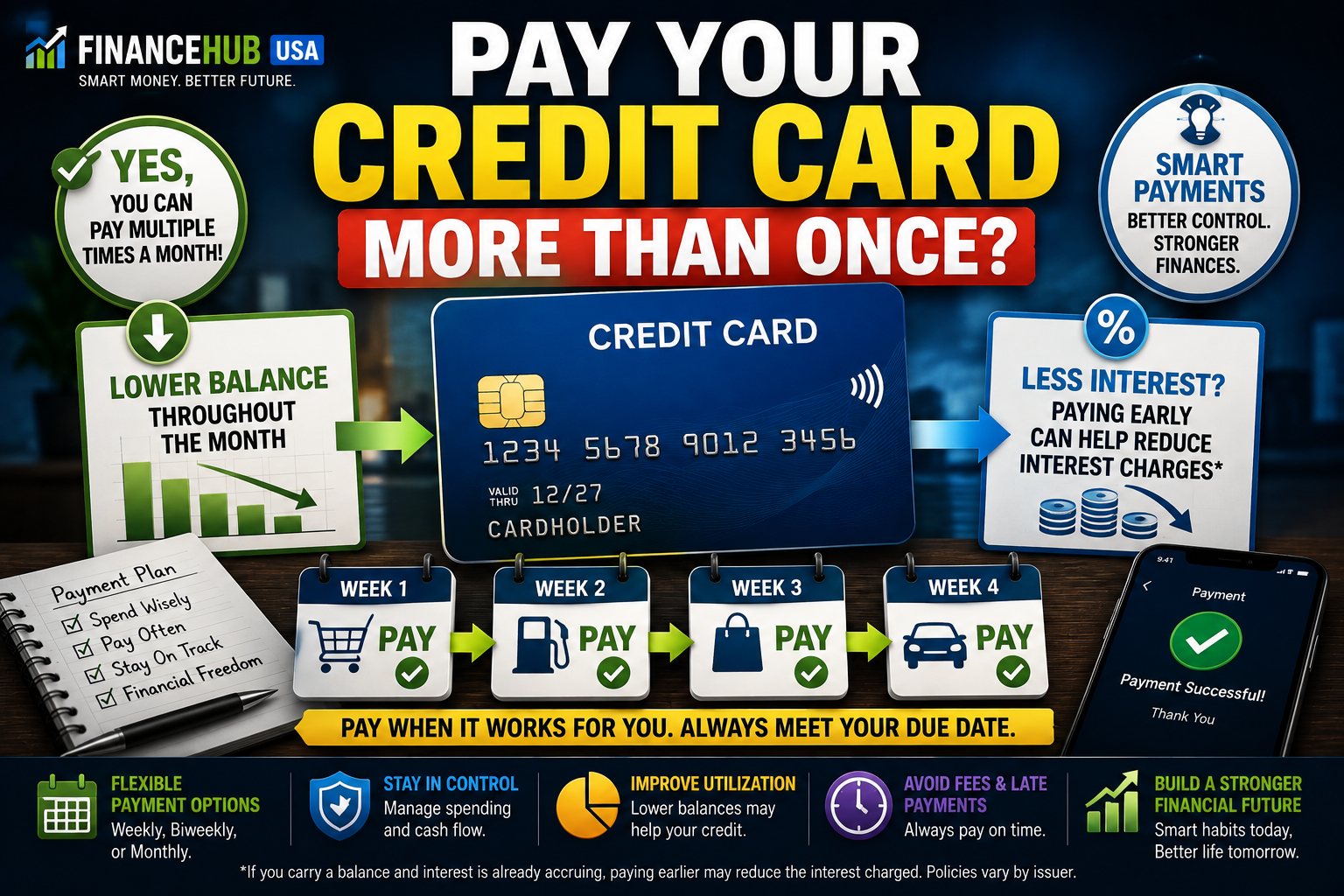
For many cardholders, making several payments during a billing cycle is possible. Instead of waiting until the monthly due date, you might make a payment every payday, once a week, or after larger purchases have posted to the account.
For example, suppose Rachel uses a rewards card for groceries, gas, utilities, and other regular expenses. Rather than allowing the balance to build throughout the entire billing cycle, she checks the account every Friday and pays for purchases that have already posted.
Her payment pattern could look like this:
| Week | Illustrative New Spending | Payment Made |
|---|---|---|
| Week 1 | $500 | $500 |
| Week 2 | $500 | $500 |
| Week 3 | $500 | $500 |
| Week 4 | $500 | $500 |
| Total | $2,000 | $2,000 |
This is only an illustration. Purchases can remain pending before posting, and payment processing times vary. The important point is that Rachel does not necessarily have to wait until the end of the month to send money to the card.
Even when several payments are made, the monthly statement still matters. Cardholders should continue checking the statement balance, minimum payment, due date, interest charges, fees, and whether all payments were properly credited.

Can Paying Multiple Times Reduce Credit Card Interest?
Potentially, but the answer depends heavily on whether interest is already being charged.
The Consumer Financial Protection Bureau explains that many credit card issuers calculate interest using a daily periodic rate applied to daily balances. When interest is already accruing, paying part of the balance earlier can reduce the amount on which future daily interest is calculated.
Suppose Marcus carries a $4,000 balance that is already generating interest. Halfway through the billing cycle, he receives $1,000 that he intends to use toward the card.
If he pays the $1,000 immediately, the outstanding balance falls sooner than if he waits until the due date. Depending on the account terms and subsequent transactions, that earlier reduction can lower future interest charges.
The situation can be different for someone who normally receives a grace period on purchases and pays the required statement balance in full by the due date. In that case, paying new purchases earlier may not provide meaningful additional interest savings because qualifying purchase interest may already be avoided under the card's grace period rules.
Paying Early Does Not Replace Paying on Time
Multiple payments should never distract from the most important deadline: the payment due date.
Making three payments early in the month does not mean you should stop checking whether the account shows the required payment as satisfied. Continue monitoring the statement and confirm that the issuer has properly credited all payments.
Can Multiple Payments Lower Credit Utilization?
They can influence reported utilization in some situations, but it is important to distinguish your current balance from the balance that is ultimately reported to the credit bureaus.
Credit utilization compares revolving balances with available credit limits.
If you have a $5,000 credit limit and a reported balance of $4,000, the utilization on that card would be 80%. If the reported balance were $1,000 instead, utilization would be 20%.
| Credit Limit | Illustrative Reported Balance | Utilization |
|---|---|---|
| $5,000 | $4,000 | 80% |
| $5,000 | $2,500 | 50% |
| $5,000 | $1,500 | 30% |
| $5,000 | $500 | 10% |
Paying a balance before it is reported can result in a lower reported balance. However, issuers do not all necessarily report account information at exactly the same point in the billing cycle.
That means making four payments instead of one does not automatically guarantee that a particular utilization percentage will appear on your credit reports.
The more important goal is to avoid allowing revolving balances to remain unnecessarily large relative to your available credit and to keep required payments current.

Does Paying Your Credit Card Multiple Times Improve Your Credit Score?
There is no special credit scoring reward simply for making two, four, or eight payments instead of one.
Credit scores evaluate information contained in your credit reports. They do not award points because you opened your banking app more frequently and clicked the payment button more times.
Multiple payments can indirectly affect information used in scoring if they help reduce the balance that is eventually reported. They can also help some consumers manage cash flow and avoid spending more than they can afford.
But someone who makes one well planned payment, pays on time, and keeps balances under control can still manage a credit card responsibly.
Multiple payments should therefore be viewed as a budgeting and balance management technique, not as a credit score shortcut.
FinanceHub USA Analysis: Treat a Credit Card as a Spending Tool
One potential advantage of frequent payments has little to do with credit scoring. It can change how you psychologically view available credit.
Imagine you have a $10,000 credit limit. That does not mean your monthly spending budget increased by $10,000. The limit represents how much the issuer is willing to let you borrow under the account terms, not necessarily how much you can comfortably afford to spend.
Paying once or twice around payday can make credit card spending feel more connected to the cash actually available in your bank account.
If you charge $300 and then see $300 leave checking shortly afterward, the economic cost of the purchase becomes harder to ignore.
For some households, this creates useful spending discipline. For others, one monthly payment is simpler and works perfectly well.
Before switching to more frequent payments, consider:
- Whether you normally carry a balance that is already generating interest.
- Whether several payments would make budgeting easier or more complicated.
- How your card issuer processes and credits payments.
- Whether you understand your statement closing date and payment due date.
- Whether you are trying to control spending or only influence reported utilization.
- Whether automatic payment could provide a simpler safeguard against missed due dates.
- Whether frequent payments could make it harder to track your total monthly spending.
Weekly, Payday, or Monthly Payments: Which Is Better?
There is no universally best payment frequency. The strongest schedule is the one that helps you control spending, maintain enough cash in checking, and consistently satisfy the amount due by the required deadline.
| Payment Strategy | Potential Advantage | Potential Drawback |
|---|---|---|
| Weekly | Frequent balance control | More transactions to monitor |
| Every payday | Payments align with income | Your pay schedule may not align with the statement cycle |
| Twice monthly | Balance is reduced periodically | Requires more planning than one payment |
| Once monthly | Simple to manage | Balance may remain higher during the billing cycle |
| Automatic statement payment | Reduces the chance of forgetting the due date | Requires sufficient money in the linked bank account |
For consumers already carrying debt that generates interest, payment timing can have greater financial importance because many issuers calculate interest using daily balances.
For consumers who use a grace period and pay the required balance in full, frequent payments may function primarily as a budgeting technique.
What Happens to Your Available Credit After You Pay?
When a payment is credited to the account, it reduces the amount owed. Available credit may then increase, but you should not assume that the full amount will always become available instantly.
Payment processing and funds availability can vary depending on the issuer, payment method, account history, and other circumstances.
If you are making a payment because you need additional room for an upcoming purchase, confirm your available credit directly through the card issuer before attempting the transaction.
Pending purchases can also complicate what appears in your account. A transaction may reduce available credit before it becomes part of the posted balance, while a payment may take time to process.
Can You Pay Your Card Every Time You Use It?
You may be able to make very frequent payments, but paying immediately after every individual purchase is usually unnecessary.
Transactions often remain pending before they officially post, and issuers can have their own payment processing rules.
There is also a practical disadvantage. If you make 25 purchases and 25 separate payments, reviewing your monthly cash flow can become unnecessarily complicated.
A simpler approach might be to establish one or two checkpoints each week or make payments around payday.
This can provide many of the budgeting benefits of frequent payments without turning every purchase into a separate banking transaction.
Example: Paying Around Payday
Imagine Chris is paid twice each month and uses his card for regular expenses. His credit limit is $6,000, and he normally charges approximately $1,800 during the month.
Instead of waiting for one large payment, he reviews the card whenever his salary arrives.
| Point in Month | Illustrative Balance | Payment | Balance After Payment |
|---|---|---|---|
| First payday | $850 | $700 | $150 |
| Second payday | $1,100 | $950 | $150 |
| Before due date | Review account | Pay the remaining amount required under his strategy | Depends on later spending and payments |
The benefit is not that Chris receives extra credit score points for making three payments. Instead, the schedule helps him connect credit card spending with income and prevents a large balance from becoming psychologically disconnected from his checking account.
Be Careful With Credit Cycling
There is an important difference between paying frequently for budgeting purposes and repeatedly paying down a card specifically to spend far beyond its credit limit during the same billing cycle.
Consider a card with a $2,000 limit.
If someone spends $2,000, pays it off, spends another $2,000, pays again, and repeats that process several times during the same cycle, total purchases could greatly exceed the stated credit line even though the outstanding balance never exceeds $2,000 at one moment.
This behavior is commonly referred to as credit cycling.
Issuers establish credit limits as part of their risk management, and repeatedly reusing the same credit line far beyond its stated amount can attract additional scrutiny depending on the institution and account circumstances.
Frequent payments are better used to manage legitimate spending and debt rather than as a method of treating a limited credit line as unlimited monthly purchasing power.
When Multiple Payments Can Become Counterproductive
More payments do not automatically mean better financial management. The strategy can become counterproductive when it makes your finances harder to understand.
- Paying so frequently that you lose track of total spending. A constantly low card balance can make it feel as though you spent less than you actually did.
- Draining checking too aggressively. Paying the card early is less helpful if doing so leaves insufficient cash for rent, utilities, or other obligations.
- Ignoring the monthly statement. Frequent payments do not replace reviewing your statement for interest, fees, errors, and the actual amount due.
- Assuming every payment instantly restores available credit. Processing rules vary by issuer.
- Using frequent payments only to chase a credit score. There is no special scoring reward for the number of payments made.
- Forgetting about automatic payment. If automatic payment remains active after manual payments, verify how your issuer will handle the scheduled amount.
- Ignoring balances with different APRs. Cards containing several balance types can have specific payment allocation rules.
Federal rules can affect how amounts paid above the required minimum are allocated when a card contains balances subject to different APRs. The precise treatment can depend on the type of balance and the account terms.

FinanceHub USA Practical Payment Strategy
For someone who wants the benefits of multiple payments without making the system unnecessarily complicated, a simple structure can work well.
- Protect the due date. Consider automatic payment for at least the required minimum if you can reliably keep enough money in the linked bank account.
- Choose a predictable manual schedule. If frequent payments help control your balance, consider paying around payday or on another consistent schedule.
- Continue reviewing the statement. Do not rely only on the current balance shown in the app.
- Track total monthly spending. Several payments should not make it harder to understand how much you actually charged during the month.
If you are already carrying debt that generates interest, additional payments can have a more direct financial benefit because reducing the balance sooner can reduce interest that accrues afterward.
If you normally pay the applicable statement balance in full and maintain a grace period, the main benefits of paying several times may instead be budgeting discipline and balance management.
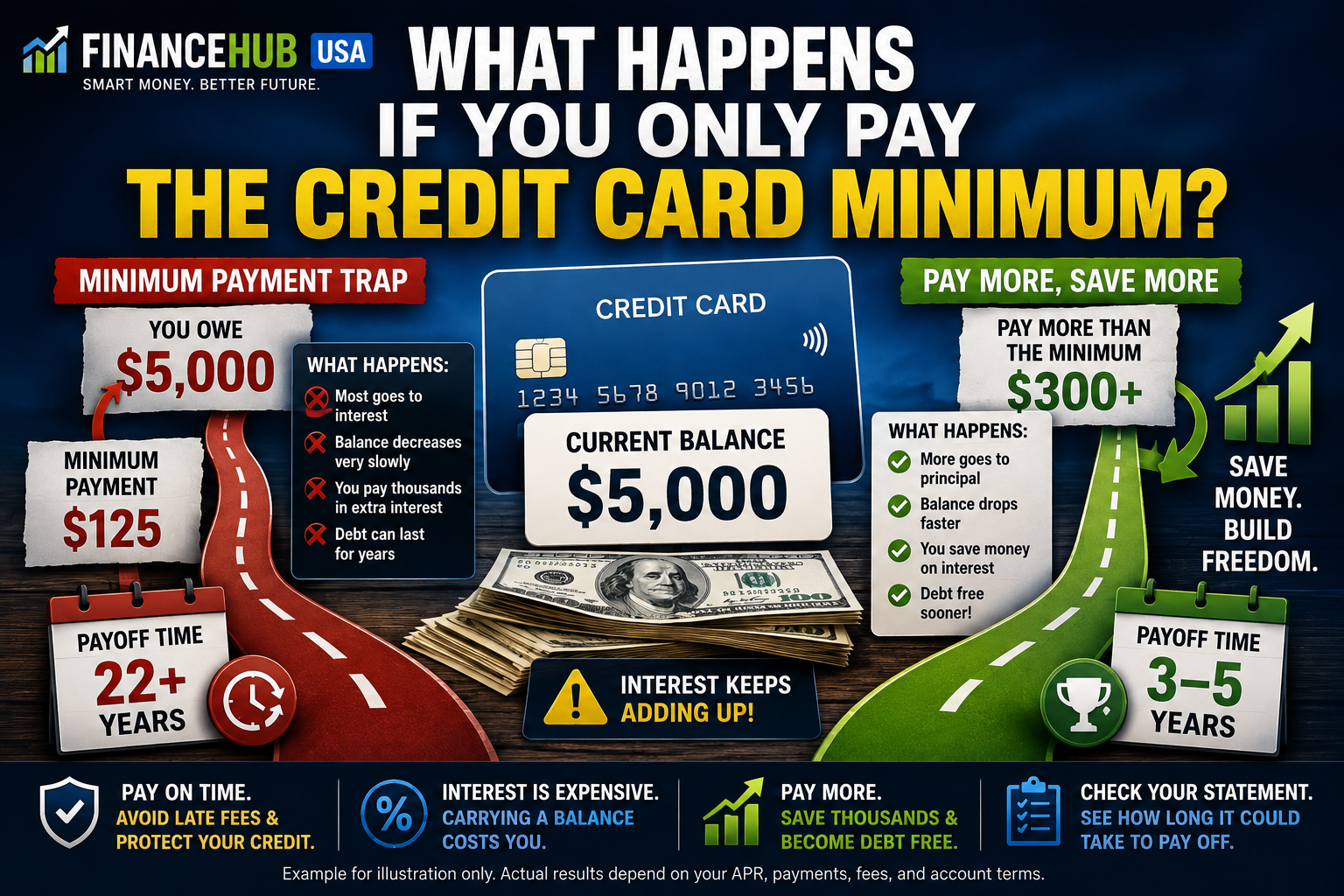
Related reading: What Happens If You Only Pay the Credit Card Minimum?
Final Thoughts
Yes, you can generally pay your credit card multiple times a month, and for some consumers it can be an effective way to manage spending and keep balances under control.
If interest is already accruing, paying earlier may also reduce future interest because many issuers calculate interest using daily balances.
But frequency alone does not make someone a better credit card user. One carefully planned monthly payment can work perfectly well for someone who pays on time and manages spending responsibly.
Multiple payments are most useful when they solve a specific problem, such as improving cash flow, reducing a balance that is already generating interest, or keeping spending more closely connected to available cash.
Whatever schedule you choose, continue monitoring your statement, due date, available credit, APR, and total monthly spending.
The goal is not to make the most payments. It is to stay in control of the money you borrow.
Continue exploring FinanceHub USA for practical guides on credit cards, debt, credit scores, banking, saving, and personal finance.
Sources and Further Reading
Frequently asked questions
Can you pay your credit card multiple times a month?
Generally, yes. Many credit card accounts allow multiple payments during a billing cycle, although payment-processing rules can vary by issuer.
Is it good to pay your credit card every week?
It can be useful if weekly payments help you control spending or reduce an interest-bearing balance sooner. However, weekly payments are not necessary for everyone.
Does paying your credit card multiple times improve your credit score?
There is no special credit-score bonus simply for making multiple payments. Frequent payments may indirectly affect reported utilization if they result in a lower balance being reported.
Can paying a credit card early reduce interest?
If you are carrying a balance that is already accruing interest, it can. Many issuers calculate interest daily, so reducing the balance sooner can reduce interest that accrues afterward.
Should I pay my credit card after every purchase?
Usually that level of frequency is unnecessary. Some consumers prefer weekly or payday-based payments because they provide similar budgeting benefits with fewer transactions to manage.
Does paying multiple times increase available credit?
Payments reduce what you owe and can restore available credit after they are processed, but the timing can vary by issuer and payment circumstances.
What is credit cycling?
Credit cycling generally describes repeatedly using most or all of a credit limit, paying it down, and using the limit again within the same billing period. This can cause total monthly spending to substantially exceed the stated credit line.
Is it better to pay weekly or once a month?
Neither is universally better. Weekly payments can help some people budget, while one monthly payment can be simpler for cardholders who reliably pay on time and control spending.
Can I still use autopay if I make manual payments?
Often yes, but you should check your issuer's rules to understand whether manual payments change or reduce an upcoming automatic payment.
What happens if my card has balances with different APRs?
When you pay more than the required minimum, federal rules generally require the excess amount to be applied first to the balance with the highest APR, with special rules applying in some situations such as deferred-interest promotions.