Can a Stock Come Back After Being Delisted?
Can a delisted stock come back? Learn what happens after delisting, whether shares can trade OTC, and what a company must do to relist.

Seeing a stock disappear from the New York Stock Exchange or Nasdaq can be alarming. Investors may assume that delisting means their shares immediately become worthless or that the company can never return to a major exchange. Neither conclusion is automatically correct.
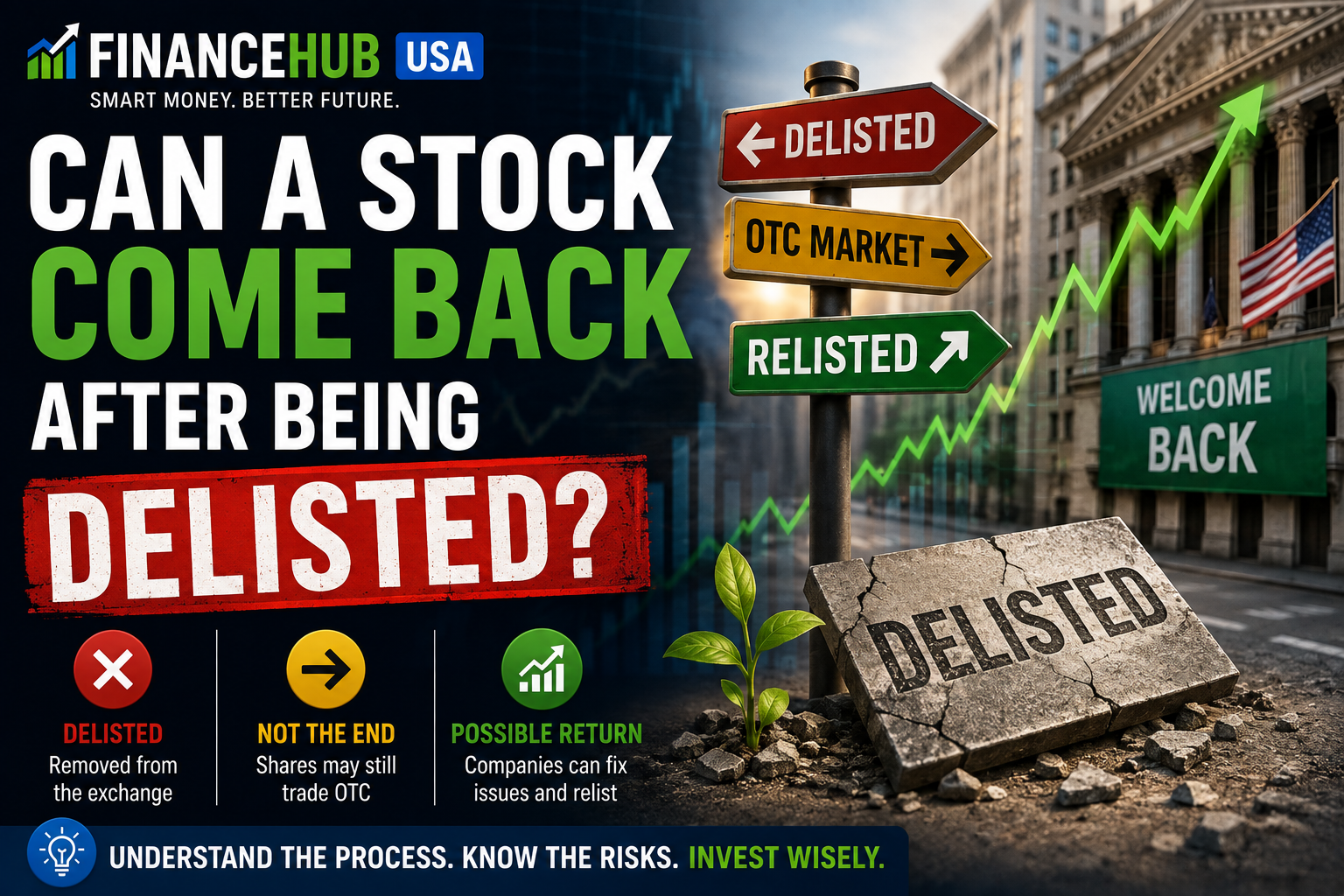
So, can a stock come back after being delisted? Yes, it can. A company may eventually qualify to list again if it improves its financial or regulatory position and satisfies the applicable exchange requirements. But relisting is not automatic, and many delisted companies never return.
Some securities may continue trading away from their former exchange, while others can become extremely illiquid or ultimately lose most or all of their value. For shareholders, the critical issue is therefore not simply whether a comeback is technically possible, but why the company was delisted and whether its underlying business can recover.
Key Takeaways
- A stock does not automatically become worthless simply because it is delisted from Nasdaq or the NYSE.
- Some delisted securities may continue trading over the counter, although liquidity and broker access can be limited.
- A company can potentially return to a major exchange if it satisfies applicable listing requirements and receives approval.
- Relisting does not guarantee that a stock will recover its previous price.
- Bankruptcy, dilution, reverse stock splits, and restructuring can dramatically change what existing shares represent.
- Investors should focus on the company's fundamentals rather than assuming a low-priced delisted stock will eventually recover.
What Does It Mean When a Stock Is Delisted?
A stock is delisted when its securities stop being listed on a particular stock exchange. Delisting can happen because the exchange removes the company for failing to satisfy continued listing requirements, or because a company voluntarily decides to leave the exchange.
Nasdaq's rules include both initial and continued listing requirements. Depending on the market tier and security, these requirements can involve factors such as bid price, publicly held shares, market value, stockholders, market makers, financial standards, disclosures, and corporate governance.
The NYSE similarly monitors listed companies for compliance with quantitative and qualitative continued-listing standards. Companies that fail to satisfy applicable standards can face compliance procedures, suspension, and ultimately delisting.
Potential reasons for a delisting can therefore include:
- Failure to satisfy a minimum share-price requirement.
- Insufficient market capitalization or other financial criteria.
- Failure to file required financial reports on time.
- Insufficient public float or shareholder distribution.
- Corporate-governance or regulatory problems.
- Bankruptcy or severe financial distress.
- A merger, acquisition, going-private transaction, or other voluntary corporate action.
The reason matters enormously. A company voluntarily delisted after being acquired presents a very different situation from a financially distressed issuer removed after prolonged noncompliance.
Do You Lose Your Shares When a Stock Is Delisted?
Delisting by itself does not necessarily cancel your ownership. If you owned 500 shares immediately before a stock stopped trading on its exchange, you may still own those shares afterward unless a separate corporate event changes or eliminates the equity.
What changes is the market where the shares can be traded—and sometimes whether there is a practical market for them at all.
Depending on the circumstances, a security removed from a national exchange may later trade in an over-the-counter environment. But investors should not assume that every delisted stock will remain easily tradable. Broker restrictions, securities-law requirements, limited quotations, and weak market participation can make buying or selling significantly more difficult.
| Event | What It Generally Means for Shareholders |
|---|---|
| Stock delisted from exchange | Exchange listing ends; shares aren't automatically canceled solely because of delisting |
| Security trades away from former exchange | Investor may still be able to trade, but conditions can be less favorable |
| Company later qualifies for exchange listing | Shares may eventually trade on a major exchange again if listing is approved |
| Bankruptcy wipes out common equity | Existing shares can become worthless |
| Acquisition for cash | Shares may be converted into the agreed cash consideration |

Can a Delisted Company Relist?
Yes. Delisting does not necessarily create a permanent prohibition on returning to an exchange. However, a company seeking to return generally faces meaningful listing requirements.
Nasdaq explains that companies applying to list must satisfy financial, liquidity, and corporate-governance requirements applicable to the relevant Nasdaq market tier. Nasdaq also distinguishes between initial and continued listing standards, with initial-listing requirements generally representing a higher threshold than simply maintaining an existing listing.
That distinction is important for a company attempting a comeback. Regaining the condition that once allowed it to remain listed may not necessarily be enough if the company must satisfy the applicable requirements for a new listing.
The NYSE also evaluates companies seeking admission under standards involving financial strength, share distribution, governance, market value, and other applicable criteria.
In other words, a company generally cannot simply announce that it wants its old ticker back. It must qualify, apply, and receive approval from the exchange.

What Could a Delisting and Relisting Look Like?
Consider a hypothetical company called Horizon Robotics. Its shares originally trade on a major exchange at $8.00, but the business experiences large operating losses and the share price eventually falls dramatically. After failing to regain compliance with applicable exchange requirements, the stock is delisted.
The company's shares later continue trading away from the former exchange at much lower prices. Management restructures debt, cuts expenses, raises new capital, improves financial reporting, and eventually restores the business to a more stable condition.
Several years later, Horizon believes it can satisfy the applicable initial-listing standards and submits an application to an exchange. If the company satisfies the requirements and the exchange approves the application, its shares could once again become exchange-listed.
| Hypothetical Stage | Share Status | What Changes |
|---|---|---|
| Stage 1 | Exchange-listed | Company trades normally on major exchange |
| Stage 2 | Noncompliance | Company fails applicable continued-listing requirements |
| Stage 3 | Delisted | Major-exchange listing ends |
| Stage 4 | Possible off-exchange trading | Liquidity and market access may be substantially different |
| Stage 5 | Business recovery | Company attempts to improve finances and compliance |
| Stage 6 | Relisting application | Exchange evaluates eligibility |
| Stage 7 | Possible relisting | Exchange listing resumes if approved |
This example demonstrates what is possible, not what investors should expect. The difficult part is surviving and recovering sufficiently to qualify again.
Does a Relisting Mean the Stock Will Recover Its Old Price?
No. Relisting and investment recovery are two completely different concepts.
Suppose an investor bought 1,000 shares at $10 before a delisting, representing a $10,000 investment. Years later, the company successfully returns to an exchange, but the shares have an economically equivalent value of only $2 after accounting for relevant corporate actions.
| Scenario | Illustrative Value |
|---|---|
| Original investment | $10,000 |
| Original share price | $10 |
| Shares owned | 1,000 |
| Illustrative post-relisting equivalent price | $2 |
| Illustrative value | $2,000 |
| Difference from original investment | -$8,000 |
A return to an exchange can improve visibility or market access, but it does not erase prior losses, restore a company's old valuation, or guarantee future gains.
Why Delisted Stocks Can Be Especially Risky
Investors attracted to delisted stocks sometimes focus on the possibility of an enormous comeback. A stock that once traded at $20 and later trades for pennies can appear inexpensive. But a lower nominal share price does not automatically mean the company is undervalued.
Delisted securities can carry several additional risks:
- Lower liquidity: Finding a buyer at the price you expect can be difficult.
- Wider bid-ask spreads: The difference between buying and selling prices can increase transaction costs.
- Reduced information: Depending on the issuer's reporting status and circumstances, investors may have less current information.
- Financial distress: Some companies are delisted precisely because their businesses are deteriorating.
- Dilution: A struggling company may issue substantial new equity to raise capital.
- Reverse stock splits: Companies may restructure their share counts while trying to address listing requirements.
- Bankruptcy risk: Common shareholders rank behind creditors and can receive nothing in a restructuring or liquidation.
- Relisting uncertainty: Even a recovering business has no guarantee that an exchange will approve a future listing.

FinanceHub USA Analysis: Delisting Is a Symptom, Not the Investment Thesis
For investors, the most useful question is usually not "Can this stock relist?" but "Why was this company delisted, and has that underlying problem actually been fixed?"
If a company lost its listing because of deteriorating finances, relisting requires more than improving its share price temporarily. Investors should examine cash flow, debt, profitability, dilution, regulatory filings, governance, capital requirements, and whether the underlying business remains viable.
A stock can also experience corporate actions that make simple before-and-after price comparisons misleading. Reverse splits, new share issuance, restructurings, warrants, and bankruptcy proceedings can substantially change the economics for existing shareholders.
That is why a comeback story should be evaluated through the company's fundamentals rather than nostalgia for its previous stock price. A stock trading at $0.50 is not automatically destined to return to $10 simply because it once traded there.
What Happens If the Delisted Company Goes Bankrupt?
Bankruptcy is one of the most important risks to understand when evaluating a delisted stock. A company can survive bankruptcy as a business while its existing shareholders still lose most or all of their investment.
Under the U.S. bankruptcy priority structure, common shareholders generally stand behind creditors and other higher-priority claims. The SEC warns investors that common stock in a bankrupt company is likely to become worthless because shareholders are last in line for distributions.
Chapter 11 can allow a company to reorganize rather than immediately liquidate. But successful reorganization does not guarantee that existing shareholders participate in the company's future. A restructuring plan can cancel the old common shares and allow the reorganized company to issue entirely new equity.
| Bankruptcy Scenario | Possible Outcome for Existing Shares |
|---|---|
| Company files Chapter 11 | Old shares may continue trading temporarily but remain extremely risky |
| Company successfully reorganizes | Existing shares can still be canceled |
| New equity issued after restructuring | New shares may represent the reorganized company while old shares receive little or nothing |
| Company liquidates | Common shareholders are last in priority and may receive nothing |
This creates an important distinction: the company coming back does not necessarily mean your shares come back. A business can emerge from restructuring with a healthier balance sheet while the original common stock becomes worthless.
Can a Delisted Stock Continue Trading OTC?
Some securities removed from a national exchange can continue trading over the counter, although this should not be interpreted as a guarantee that every delisted security will have an active or accessible market.
FINRA describes OTC equities as securities traded outside a national securities exchange and notes that some companies trade OTC after being delisted because they no longer satisfy exchange listing requirements. Companies undergoing bankruptcy can also appear in this market.
Trading conditions can differ substantially from those investors are accustomed to on a national exchange. Depending on the security, investors can encounter limited liquidity, wider bid-ask spreads, fewer market participants, reduced availability through certain brokers, and greater difficulty determining an efficient market price.
| Characteristic | Major Exchange | OTC Security |
|---|---|---|
| Exchange listing standards | Must satisfy applicable exchange requirements | Not listed on a national securities exchange |
| Liquidity | Can be substantial for actively traded stocks | Can be significantly lower |
| Bid-ask spread | Often narrower for liquid securities | Can be wider |
| Investor access | Commonly available through brokers | Availability may vary by broker and security |
| Risk | Varies by company | Can be particularly high for distressed or thinly traded issuers |
A security's continued ability to trade therefore does not prove that the underlying company is financially healthy.
Can a Reverse Stock Split Help a Company Return?
Reverse stock splits frequently appear in discussions about stocks struggling with exchange price requirements. In a reverse split, the company combines multiple existing shares into a smaller number of shares, increasing the nominal price per share proportionally before considering subsequent market movements.
For example, consider a hypothetical stock trading at $0.20:
| Before 1-for-20 Reverse Split | After 1-for-20 Reverse Split |
|---|---|
| 2,000 shares | 100 shares |
| $0.20 per share | $4.00 theoretical price per share |
| $400 total market value | $400 theoretical total market value |
The reverse split itself does not create additional economic value. It changes the number of shares and the corresponding price mathematically. Market trading after the transaction can then move the price higher or lower.
A reverse stock split can sometimes help a company address a minimum bid-price requirement. However, it does not repair weak cash flow, excessive debt, poor profitability, governance problems, or other fundamental weaknesses.
Investors should therefore avoid interpreting a reverse split as proof that a turnaround or future relisting will succeed.
What Should You Check Before Buying a Delisted Stock?
Buying a delisted security primarily because it once traded at a much higher price can be dangerous. Before considering the investment, investors should investigate what happened to the business itself.
- Find the exact reason for delisting. Determine whether the issue involved price, financial condition, filings, governance, bankruptcy, an acquisition, or another event.
- Read current SEC filings when available. Review financial statements, risk disclosures, debt, liquidity, share issuance, and management commentary.
- Check the share count. Significant dilution can dramatically change what each share represents.
- Look for reverse splits. Historical stock charts can become misleading after repeated share restructurings.
- Evaluate debt and cash flow. A higher stock price cannot fix an unsustainable balance sheet by itself.
- Check trading liquidity. Being able to buy a security does not guarantee you can later sell a large position near the quoted price.
- Investigate bankruptcy status. Existing common equity can be canceled even if the company ultimately survives.
- Verify any claimed relisting plan. Management saying it intends to pursue a listing is different from an exchange approving the application.
Signs That a Relisting Could Become More Realistic
No single event guarantees that a company will return to Nasdaq or the NYSE. However, investors can look for developments that address the problems responsible for the original delisting.
| Development | Why It Could Matter |
|---|---|
| Financial reports become current | May resolve reporting-related deficiencies |
| Debt becomes more manageable | Can improve financial stability |
| Business generates sustainable cash flow | Can strengthen the underlying company |
| Corporate-governance problems corrected | Can address certain compliance concerns |
| Share distribution and liquidity improve | Can help satisfy applicable listing criteria |
| Company formally applies for listing | Shows progression beyond merely discussing a future relisting |
| Exchange approves application | Provides the strongest confirmation that listing requirements have been satisfied |
Even several positive signals together do not guarantee investment success. A company can satisfy exchange requirements and still operate an unprofitable or overvalued business.
Common Mistakes Investors Make With Delisted Stocks
- Assuming the old high is a price target. A stock that once traded at $30 has no obligation to return to $30.
- Ignoring dilution. Issuing large numbers of new shares can substantially reduce an existing shareholder's percentage ownership.
- Misreading reverse splits. A higher nominal share price after a reverse split does not automatically represent an economic gain.
- Confusing business survival with shareholder survival. A company can emerge from bankruptcy after its old common shares are canceled.
- Buying solely because the stock looks cheap. A $0.25 share can still fall close to zero.
- Believing relisting rumors. Investors should distinguish management ambitions, social-media speculation, an actual application, and final exchange approval.
- Ignoring liquidity. A quoted price is less useful if there are few willing buyers when you want to sell.
- Averaging down without reevaluating fundamentals. A falling price does not automatically improve the risk-reward profile.
Example: A Delisted Stock That Eventually Relists
Consider another hypothetical company, Alpha Energy. An investor originally purchases 2,000 shares at $5 each, investing $10,000. Financial problems eventually push the stock below applicable exchange requirements, and the company is delisted.
After delisting, the stock falls to $0.50. Instead of assuming it will automatically recover, the investor follows the company's financial statements and corporate actions.
Over several years, Alpha Energy restructures debt and improves operations. It also raises additional capital, which increases its share count. Eventually, the company satisfies applicable listing requirements and receives approval to return to a major exchange.
Suppose the investor's shares have an economically equivalent value of $3 each after accounting for relevant corporate actions. The position would be worth $6,000—not the original $10,000.
| Stage | Illustrative Position |
|---|---|
| Initial investment | 2,000 shares × $5 = $10,000 |
| After delisting | 2,000 shares × $0.50 = $1,000 |
| Company later relists | Business returns to major exchange |
| Illustrative equivalent share value | $3 |
| Illustrative position value | $6,000 |
| Compared with original investment | Still down $4,000 |
The example demonstrates why relisting is not the same as recovering your investment.
FinanceHub USA Analysis: Focus on Ownership, Not the Ticker
The possibility of a delisted stock returning can create an appealing turnaround narrative. But investors should focus on what each share actually represents after the company's restructuring, financing, reverse splits, and other corporate actions.
Imagine a business eventually becomes healthy again but issued several times more shares while recovering. The company can be stronger while an original shareholder owns a much smaller percentage of it. Similarly, a bankruptcy restructuring can preserve the operating company while completely eliminating the original equity.
This is why historical price charts alone can be especially misleading for distressed stocks. A chart does not necessarily show the economic effects of dilution, canceled shares, reorganizations, or changes in capital structure in a way that answers the most important question: what does my ownership represent today?
For another explanation of how major corporate events can affect shareholders, read What Happens to Your Stock If a Company Is Bought?.
Final Thoughts
So, can a stock come back after being delisted? Yes. A company can potentially improve its financial condition, correct compliance problems, satisfy applicable listing requirements, apply to an exchange, and eventually become listed again.
But the possibility of relisting should never be confused with a guarantee that existing shareholders will recover their losses. Some delisted stocks continue trading OTC, while others become extremely illiquid. Bankruptcy can eliminate existing common shares even when the underlying company survives. Reverse stock splits can increase the quoted share price without creating new economic value, and dilution can substantially change an investor's ownership.
Before buying or holding a delisted stock, investigate why the delisting occurred, examine current financial information, understand the capital structure, and treat any future relisting as a possibility rather than an investment thesis.
The key lesson is simple: a company's return to an exchange and an investor's financial recovery are not the same thing. Evaluate the business that exists today rather than the stock price that existed years ago.
Continue exploring FinanceHub USA for practical guides on stocks, investing, banking, credit, retirement, and personal finance.
Investment Disclaimer: This article is for general educational and informational purposes only and does not constitute investment, financial, legal, or tax advice. Investing involves risk, including the possible loss of principal. Delisted and thinly traded securities can involve particularly significant risks. Consider your financial situation, investment objectives, and risk tolerance before making investment decisions.
Official Investor Resources
Frequently asked questions
Can a stock come back after being delisted?
Yes. A company can potentially qualify for an exchange listing again, but it must satisfy applicable listing requirements and receive exchange approval. Relisting is never guaranteed.
Do you lose your shares when a stock is delisted?
Not automatically. Delisting itself generally removes the stock from an exchange rather than canceling your ownership. Separate events such as bankruptcy, mergers, or reorganizations can alter or eliminate existing shares.
Can a delisted stock still be traded?
Some delisted securities may continue trading over the counter, but trading availability, liquidity, broker access, and market conditions can be substantially different.
Can a delisted stock return to Nasdaq?
Potentially. A company seeking a Nasdaq listing must satisfy the applicable initial listing and other requirements and receive approval.
Can a delisted stock return to the NYSE?
Potentially. A company would need to satisfy applicable NYSE listing requirements and be accepted by the exchange.
Does relisting make a stock return to its old price?
No. Relisting does not restore a previous share price or guarantee investment gains. The company's valuation and capital structure may be very different.
What happens to stock when a company goes bankrupt?
Common shareholders are generally last in priority in bankruptcy. Existing common stock frequently loses most or all of its value and can be canceled during a reorganization.
Can a company survive bankruptcy while its stock becomes worthless?
Yes. A company can reorganize and continue operating while its existing common shares are canceled and new shares are issued.
Does a reverse stock split prevent delisting?
A reverse split can help a company address a minimum bid-price deficiency, but it does not automatically resolve other listing problems or guarantee continued listing.
Does a reverse split increase the value of my investment?
Not by itself. A reverse split proportionally reduces the number of shares while increasing the theoretical price per share, leaving the initial economic value approximately unchanged before subsequent market movements.
Are delisted stocks risky?
They can be extremely risky, particularly when delisting results from financial distress. Risks include low liquidity, wide bid-ask spreads, bankruptcy, dilution, limited information, and the possibility of losing the entire investment.
What should I check before buying a delisted stock?
Review the reason for delisting, financial statements and SEC filings when available, debt, cash flow, dilution, reverse splits, bankruptcy status, liquidity, and any verified exchange-listing application.