Can You Have a 401(k) and an IRA at the Same Time?
Yes, you can have a 401(k) and an IRA at the same time. Learn the 2026 contribution limits, tax rules, and how using both could strengthen retirement savings.
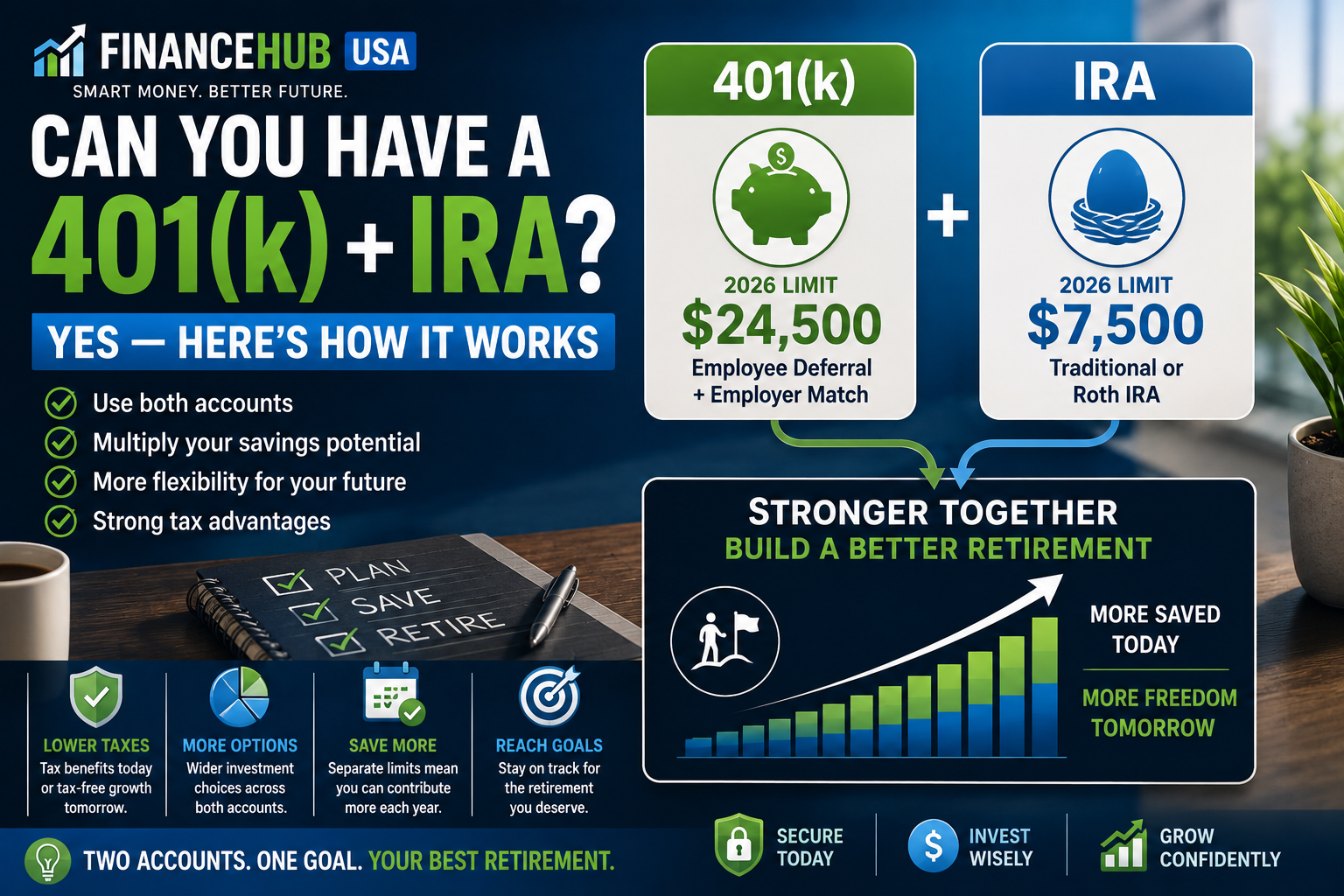
Can You Have a 401(k) and an IRA at the Same Time?

Having a workplace 401(k) does not prevent you from also having an Individual Retirement Account.
In fact, many workers can legally contribute to both a 401(k) and an IRA in the same year, giving them access to separate contribution limits, different investment choices, and potentially different tax benefits.
The rules become more complicated when income, tax deductions, Roth IRA eligibility, employer contributions, and catch-up contributions enter the picture.
For 2026, understanding how these accounts work together can help you build a more deliberate retirement strategy instead of assuming you must choose one account or the other.
Can You Contribute to a 401(k) and an IRA in the Same Year?
Yes.
Participating in an employer-sponsored 401(k) does not automatically prevent you from contributing to either a Traditional IRA or a Roth IRA.
The important distinction is between:
- Being allowed to contribute
- Receiving a tax deduction
- Qualifying for a direct Roth IRA contribution
Those are not always the same thing.
Example
Suppose Emily works for a company offering a 401(k).
She contributes through payroll and receives an employer match.
Emily can also maintain an IRA at a brokerage firm and make eligible contributions to that account.
If she uses a Traditional IRA, however, her income and workplace retirement-plan coverage may affect whether her contribution is deductible.
If she uses a Roth IRA, her income can affect whether she qualifies to contribute directly.
2026 401(k) and IRA Contribution Limits
The 401(k) and IRA contribution limits are separate.
For 2026, the IRS increased the basic employee elective-deferral limit for most 401(k) plans to $24,500.
The combined annual contribution limit across Traditional and Roth IRAs increased to $7,500.
| Account | 2026 Basic Limit | Important Detail |
|---|---|---|
| 401(k) | $24,500 | Employee elective-deferral limit |
| Traditional + Roth IRAs combined | $7,500 | One combined IRA contribution limit |
| Potential personal contributions under age 50 | $32,000 | Assumes maximum eligible contributions to both |
That means an eligible worker under age 50 could potentially contribute:
$24,500 to a 401(k) + $7,500 to an IRA = $32,000
These are separate limits.
The IRA limit does not reduce the amount you can defer into the 401(k), and ordinary 401(k) contributions do not reduce your IRA contribution limit.
The IRA Limit Is Shared Between Traditional and Roth IRAs
This is one of the most common retirement-account mistakes.
You do not receive a separate $7,500 limit for each IRA type.
Example
Suppose you contribute:
- $4,000 to a Roth IRA
- $3,500 to a Traditional IRA
Total:
$4,000 + $3,500 = $7,500
You have generally reached the 2026 IRA contribution limit for someone under age 50, assuming you have sufficient taxable compensation.
You could not normally contribute another $7,500 to the Traditional IRA simply because it is a different account type.
2026 Catch-Up Contribution Limits
Older workers may be eligible to contribute more.
| Account | 2026 Catch-Up | Potential Total |
|---|---|---|
| IRA, age 50+ | $1,100 | $8,600 |
| 401(k), generally age 50+ | $8,000 | $32,500 employee deferral |
| 401(k), eligible ages 60-63 | $11,250 | $35,750 employee deferral |
For 2026, the IRS provides a higher 401(k) catch-up amount for eligible participants ages 60 through 63.
The $24,500 401(k) Limit Is Not the Total Plan Limit
This distinction is extremely important.
The $24,500 limit generally refers to employee elective salary deferrals.
A 401(k) account can potentially receive additional money from sources such as:
- Employer matching contributions
- Employer nonelective contributions
- Certain other employer contributions
- Employee after-tax contributions when the plan permits them
For 2026, the overall defined-contribution plan limit is generally $72,000, not including applicable catch-up contributions.
Example
Suppose an employee contributes the full:
$24,500
The employer contributes another:
$10,000
Total going into the 401(k):
$34,500
The employee has reached the ordinary employee deferral limit, but the account has not necessarily reached the overall plan contribution limit.
Employer Match Does Not Reduce the $24,500 Employee Limit
Another common misconception is that employer matching contributions count against your $24,500 employee deferral limit.
Generally, they do not.
Suppose you contribute:
$24,500
and your employer contributes:
$6,000
The total deposited into the plan becomes:
$30,500
The $6,000 employer contribution does not normally reduce the amount you were allowed to defer from your own salary.
Traditional 401(k) vs. Roth 401(k)
A 401(k) can also have different tax structures.
Traditional 401(k)
Traditional 401(k) employee contributions are generally made on a pre-tax basis for federal income-tax purposes.
Qualified withdrawals in retirement are generally taxable.
Roth 401(k)
Roth 401(k) contributions are made with after-tax dollars.
Qualified distributions can generally be tax-free if applicable requirements are met.
Traditional and Roth 401(k) Contributions Share the Same Deferral Limit
You do not receive a separate $24,500 limit for each.
Example
Suppose you contribute:
- $14,500 to a Traditional 401(k)
- $10,000 to a Roth 401(k)
Total employee deferrals:
$14,500 + $10,000 = $24,500
You have generally reached the 2026 elective-deferral limit.
Traditional IRA When You Already Have a 401(k)

You can generally contribute to a Traditional IRA even if you participate in a 401(k), assuming you meet the compensation requirements.
But whether you can deduct the contribution is another question.
If you are covered by a workplace retirement plan, the deduction may be reduced or eliminated as your modified adjusted gross income rises.
2026 Traditional IRA Deduction Phase-Out
For a taxpayer who participates in a retirement plan at work, the IRS provides the following 2026 phase-out ranges:
| Filing Situation | 2026 Modified AGI Phase-Out |
|---|---|
| Single or head of household covered by workplace plan | $81,000 to $91,000 |
| Married filing jointly, contributor covered by workplace plan | $129,000 to $149,000 |
| Contributor not covered, spouse covered by workplace plan | $242,000 to $252,000 |
| Married filing separately and covered by workplace plan | $0 to $10,000 |
Being above the applicable deduction range does not automatically mean you are prohibited from contributing to a Traditional IRA.
It may instead mean that some or all of the contribution is nondeductible.
Nondeductible Traditional IRA Contributions
A nondeductible contribution does not provide an immediate federal income-tax deduction.
However, keeping accurate tax records becomes especially important because part of the IRA represents after-tax basis.
Taxpayers making nondeductible Traditional IRA contributions may need to report that basis on IRS Form 8606.
Failing to track basis properly can create tax complications later when distributions or conversions occur.
Roth IRA When You Already Have a 401(k)
A workplace 401(k) does not prevent you from contributing to a Roth IRA.
However, direct Roth IRA contributions are subject to income limits.
2026 Roth IRA Income Phase-Out
| Filing Status | 2026 Roth IRA Phase-Out |
|---|---|
| Single or head of household | $153,000 to $168,000 |
| Married filing jointly | $242,000 to $252,000 |
| Married filing separately under applicable rules | $0 to $10,000 |
Within the phase-out range, the maximum direct contribution is gradually reduced.
Above the applicable range, a direct Roth IRA contribution may not be allowed.
Traditional IRA vs. Roth IRA Alongside a 401(k)
| Feature | Traditional IRA | Roth IRA |
|---|---|---|
| 2026 basic contribution limit | $7,500 combined across both IRA types | |
| Immediate tax deduction | May be available | No |
| Income affects contribution? | Generally affects deductibility more than contribution eligibility | Yes, direct contribution eligibility is income-limited |
| Qualified retirement withdrawals | Generally taxable | Generally tax-free |
| Investment choices | Often broad | Often broad |
What If Your Income Is Too High for a Direct Roth IRA Contribution?
Higher-income savers sometimes investigate a strategy commonly called a backdoor Roth IRA.
In simplified terms, the strategy can involve:
- Making an eligible nondeductible contribution to a Traditional IRA
- Converting some or all of that amount to a Roth IRA
However, the tax treatment is not always as simple as contributing $7,500 and immediately moving it tax-free.
The Pro-Rata Rule Matters
If you already hold pre-tax money in Traditional, SEP, or SIMPLE IRAs, the IRS generally looks across those IRA balances when determining the taxable and nontaxable portions of a Roth conversion.
This is commonly known as the pro-rata rule.
That can cause part of a conversion to become taxable even when the newly contributed amount itself was nondeductible.
Backdoor Roth strategies can therefore require careful tax planning and accurate Form 8606 reporting.
Does a 401(k) Balance Count in the IRA Pro-Rata Calculation?
Generally, money held inside a 401(k) is not included in the IRA aggregation used for the traditional IRA conversion pro-rata calculation.
Traditional, SEP, and SIMPLE IRA balances can matter, however.
This difference is one reason high-income savers should understand where their pre-tax retirement money is held before attempting a Roth conversion strategy.
401(k) vs. IRA: Key Differences
| Feature | 401(k) | IRA |
|---|---|---|
| 2026 basic employee contribution limit | $24,500 | $7,500 combined Traditional + Roth |
| Employer match | Possible | No |
| Investment choices | Plan menu | Often broader |
| Payroll deduction | Yes | Usually funded separately |
| Income restrictions | Ordinary employee deferrals generally not restricted by Roth IRA-style income limits | Can affect Roth eligibility or Traditional deduction |
Which Account Should You Fund First?

There is no universal order that works for every household.
But several factors can help determine where the next retirement dollar may be most useful.
Employer Match
If your employer offers a 401(k) match, contributing enough to capture the full available match can be valuable.
Failing to contribute enough may mean leaving part of your employer compensation unused.
Investment Fees
Some workplace plans offer extremely inexpensive institutional funds.
Others have relatively high administrative or investment costs.
An IRA may provide greater control over fund selection and fees.
Investment Choices
A 401(k) limits you to investments selected by the plan.
An IRA at a brokerage may offer access to:
- ETFs
- Mutual funds
- Stocks
- Bonds
- Other permitted investments
Taxes
The choice between Traditional and Roth treatment can affect when taxes are paid.
Convenience
401(k) payroll deductions make automatic investing simple.
Some savers value that convenience enough to continue increasing their workplace-plan contributions rather than managing another account.
A Practical Retirement Savings Order to Evaluate
One possible framework is:
- Maintain appropriate emergency savings.
- Capture an available employer 401(k) match when appropriate.
- Evaluate IRA eligibility and tax treatment.
- Compare IRA and 401(k) investment costs and choices.
- Increase retirement contributions as cash flow permits.
- Review all retirement accounts as one portfolio.
This is a framework rather than a universal formula.
Example: Using a 401(k) and Roth IRA Together
Suppose Daniel is 35 years old and earns $95,000.
His employer offers a 401(k) with a matching contribution, and his income allows him to make a direct Roth IRA contribution based on his filing status.
During 2026, Daniel contributes:
| Account | Contribution |
|---|---|
| 401(k) | $12,000 |
| Roth IRA | $7,500 |
| Total personal retirement contributions | $19,500 |
Any employer match would generally be additional to Daniel's personal $19,500 contribution total.
Daniel does not need to maximize the 401(k) for using both accounts to be worthwhile.
Example: Maximizing Both Under Age 50
An eligible worker under age 50 who contributes the maximum to both could potentially make:
| Account | 2026 Contribution |
|---|---|
| 401(k) | $24,500 |
| IRA | $7,500 |
| Total personal contributions | $32,000 |
Employer contributions could potentially increase the amount deposited into the 401(k) beyond that employee contribution total, subject to applicable plan limits.
What Could Consistent Retirement Contributions Become?
Consider a purely hypothetical example.
Suppose someone invests $19,500 at the end of every year for 30 years and earns an average annual return of 7%.
The future value would be approximately:
$1.84 million
Total contributions:
$19,500 × 30 = $585,000
The remaining amount would represent hypothetical investment growth.
| Year | Total Contributions | Approximate Portfolio at 7% |
|---|---|---|
| 10 | $195,000 | About $269,000 |
| 20 | $390,000 | About $799,000 |
| 30 | $585,000 | About $1.84 million |
This is a hypothetical illustration using a constant 7% annual return and end-of-year contributions. It does not represent guaranteed performance and does not account for inflation, taxes, investment fees, market volatility, or changing contribution amounts.
Can You Have Multiple IRAs?
Yes.
You can have more than one IRA.
For example, you could own:
- A Traditional IRA at Brokerage A
- A Roth IRA at Brokerage B
- Another Traditional IRA from a previous rollover
But multiple accounts do not multiply your annual IRA contribution limit.
The 2026 contribution limit generally applies across your Traditional and Roth IRAs combined.
Can You Have Multiple 401(k)s?
Yes, particularly if you changed employers or work for more than one company.
However, the employee elective-deferral limit generally applies across the relevant plans combined.
Example
Suppose you work for two employers during 2026.
You contribute:
- $15,000 to Employer A's 401(k)
- $9,500 to Employer B's 401(k)
Total:
$24,500
You generally have reached the annual employee elective-deferral limit, even though the money went into two different plans.
Employer Matches From Multiple Jobs
Employer contributions are different from your shared employee elective-deferral limit.
If you participate in more than one employer plan, the details can become more complicated because annual-addition limits can apply separately depending on whether the employers are related and how the plans are structured.
Workers with multiple plans and large contributions should review plan rules or consult a qualified professional.
Can Your Spouse Also Have an IRA?
Yes.
IRAs are individual accounts.
A married couple does not share one $7,500 IRA limit.
Each eligible spouse can potentially make their own IRA contribution.
Example
For spouses under age 50:
| Potential 2026 IRA Contribution | |
|---|---|
| Spouse A | $7,500 |
| Spouse B | $7,500 |
| Combined household IRA contributions | $15,000 |
Eligibility and compensation requirements still apply.
Spousal IRA Rules
A spouse without their own taxable compensation may still potentially contribute to an IRA when filing a joint return with a spouse who has sufficient taxable compensation, subject to IRS requirements.
The account still belongs individually to the spouse whose name is on the IRA.
Should Your 401(k) and IRA Hold the Same Investments?
Not necessarily.
Instead of evaluating each account in isolation, it can be useful to view all retirement accounts as one portfolio.
Example
Suppose your target allocation is:
- 70% U.S. stocks
- 20% international stocks
- 10% bonds
You do not necessarily need each individual account to contain that exact 70/20/10 allocation.
You could hold most bonds in one account and stock funds in another as long as the combined portfolio reflects the intended allocation.
Watch for Investment Overlap
Suppose your 401(k) contains an S&P 500 index fund and your IRA contains another fund tracking nearly the same index.
That is not automatically wrong.
But owning several funds does not necessarily mean you are more diversified if they hold almost identical companies.
Review the underlying holdings and your total asset allocation.
Common Mistakes When Using a 401(k) and IRA Together
- Assuming you must choose one account. Many eligible workers can use both.
- Assuming Traditional and Roth IRAs each receive a separate $7,500 limit. The IRA contribution limit is generally shared.
- Assuming the employer match reduces your $24,500 employee limit. Employer contributions generally operate under the broader plan limit.
- Ignoring Roth IRA income restrictions. Direct contribution eligibility can phase out at higher incomes.
- Assuming Traditional IRA contributions are always deductible. Workplace-plan coverage and income can reduce or eliminate the deduction.
- Ignoring Form 8606 after making nondeductible IRA contributions. Proper basis tracking can prevent future tax problems.
- Attempting a backdoor Roth without understanding the pro-rata rule. Existing pre-tax IRA balances can create taxable conversion income.
- Missing an employer match. Failing to contribute enough may leave employer benefits unused.
- Contributing too much. Excess contributions can create tax complications.
- Ignoring fees and investment overlap. Multiple accounts should work together as one portfolio.
FinanceHub USA Analysis: The Accounts Should Work Together
The biggest advantage of having both a 401(k) and IRA is not simply that you own more accounts.
It is that each account can solve a different retirement-planning problem.
| Retirement Need | Account Feature That May Help |
|---|---|
| Higher contribution capacity | 401(k) |
| Employer matching | 401(k) |
| Broader investment selection | Often IRA |
| Potential current tax deduction | Traditional accounts when eligible |
| Potential qualified tax-free retirement income | Roth accounts |
The goal is to determine how these features fit your taxes, employer benefits, investment preferences, and retirement timeline.
FinanceHub USA Framework: Where Should the Next Dollar Go?
Before increasing retirement contributions, ask:
| Question | Why It Matters |
|---|---|
| Does my employer offer a match? | May add employer money to your retirement savings |
| What are my 401(k) fees? | Costs can affect long-term returns |
| Am I eligible for a Roth IRA? | Income limits apply to direct contributions |
| Would my Traditional IRA contribution be deductible? | Workplace-plan coverage and income matter |
| Do I have sufficient emergency savings? | Retirement funds are designed for long-term use |
| What is my overall asset allocation? | 401(k) and IRA investments should work together |
Final Thoughts
Can you have a 401(k) and an IRA at the same time?
Yes.
For 2026, an eligible worker under age 50 could potentially make up to:
- $24,500 in employee 401(k) elective deferrals
- $7,500 across Traditional and Roth IRAs combined
That represents up to $32,000 of personal retirement contributions before considering employer contributions.
But contribution limits are only part of the decision.
Your income can affect Roth IRA eligibility and Traditional IRA deductibility. Employer matching can change which account deserves priority. Fees and investment choices can also make one account more attractive than another.
For people making nondeductible Traditional IRA contributions or considering Roth conversions, tax rules such as Form 8606 reporting and the pro-rata rule become especially important.
The strongest retirement strategy is not necessarily maximizing every available account immediately.
It is coordinating your 401(k), IRA, emergency savings, taxes, investment allocation, and employer benefits so they support the same long-term goal.
Continue exploring FinanceHub USA for practical guides covering retirement planning, investing, taxes, ETFs, credit, banking, and personal finance.
Related reading: Roth IRA vs Traditional IRA: Which Wins in 2026?
Related reading: Maximize Your 401(k) Contributions in 2026
Sources and Further Reading
Frequently asked questions
Can I contribute to both a 401(k) and an IRA in 2026?
Yes. Participating in a 401(k) generally does not prevent you from contributing to an IRA. However, income and filing status can affect Roth IRA eligibility and the deductibility of Traditional IRA contributions.
How much can I contribute to a 401(k) and IRA in 2026?
For 2026, the basic employee 401(k) contribution limit is $24,500 and the combined Traditional and Roth IRA contribution limit is $7,500. An eligible person under age 50 could therefore potentially contribute $32,000 of their own money across the two account categories.
Can I put $7,500 into a Traditional IRA and another $7,500 into a Roth IRA in 2026?
Generally no. The $7,500 basic IRA contribution limit for 2026 is shared across your Traditional and Roth IRAs. For example, contributing $3,000 to a Traditional IRA would generally leave up to $4,500 available for a Roth IRA, assuming you are otherwise eligible.
Should I max out my 401(k) before contributing to an IRA?
Not necessarily. Some investors first contribute enough to capture their employer's available 401(k) match, then evaluate an IRA, and later increase 401(k) contributions. The best order depends on plan fees, investment options, taxes, income, debt, and financial goals.
Can I have a Roth IRA if my employer offers a 401(k)?
Yes. Access to a workplace 401(k) does not by itself prevent you from having a Roth IRA. Direct Roth IRA contributions are subject to income eligibility rules.
Can I deduct a Traditional IRA contribution if I have a 401(k)?
Possibly. If you or your spouse are covered by a retirement plan at work, the Traditional IRA deduction may be reduced or eliminated at certain income levels. The applicable limits depend on filing status and modified adjusted gross income.
Does an employer 401(k) match count toward the IRA limit?
No. A 401(k) employer contribution does not count toward your separate IRA contribution limit. Different limits and rules apply to workplace retirement plans and IRAs.

