Can You Sell Stock Without a Buyer?
Can you sell stock without a buyer? Learn how stock orders are matched, what happens when liquidity disappears, and why some shares can be hard to sell.
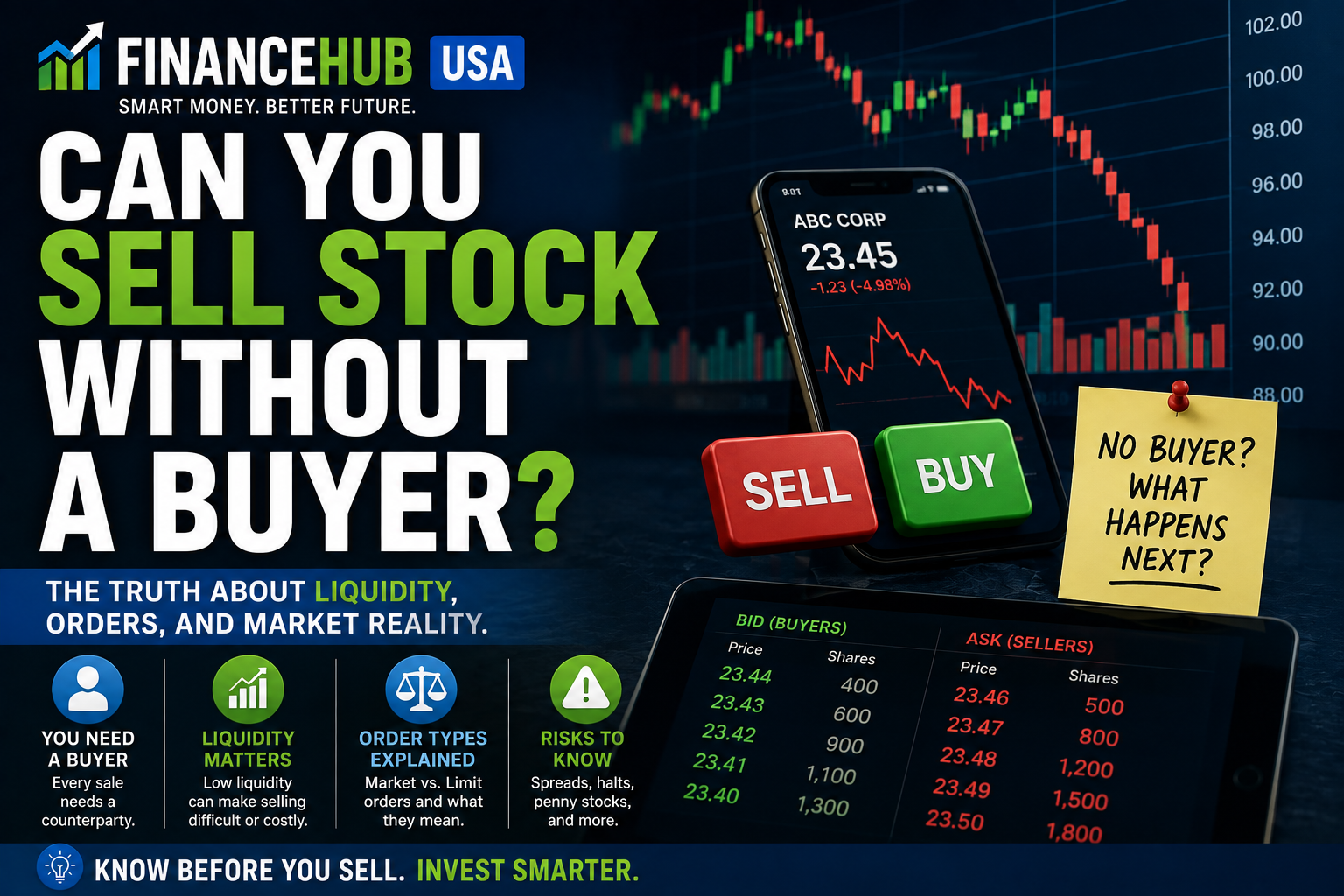

Clicking the Sell button in a brokerage app can make selling stock appear almost instantaneous. Behind that simple action, however, a trade still requires another side. Someone—or a market participant providing liquidity—must be willing to acquire the shares at a price where the transaction can occur.
So, can you sell stock without a buyer? Not in the literal sense of completing a normal stock transaction with nobody on the other side. A completed sale requires a counterparty. In highly liquid stocks, investors rarely notice this because there may be substantial buying interest, active market makers, and thousands or millions of shares changing hands.
In thinly traded securities, however, available buyers may be limited or unwilling to pay the price a seller wants. Your order could remain unfilled, execute only partially, or require accepting a substantially lower price.
Understanding liquidity, bid-ask spreads, market depth, market orders, and limit orders helps explain why owning a stock does not necessarily mean you can instantly convert your entire position into cash at the price displayed on your screen.
Key Takeaways
- A completed stock sale ultimately requires another party to acquire the shares.
- You normally do not need to personally find a buyer because brokers, exchanges, market makers, and electronic trading systems help match orders.
- Highly liquid stocks are generally easier to sell without significantly affecting the market price.
- A stock's last traded price does not guarantee that you can sell your entire position at that price.
- Market orders prioritize execution but do not guarantee the final execution price.
- Limit orders provide greater price control but do not guarantee that your shares will be sold.
- OTC stocks, microcaps, distressed securities, and stocks under trading restrictions can be particularly difficult to sell.
Does Every Stock Sale Need a Buyer?
Yes. For a stock trade to be completed, ownership must ultimately move from one market participant to another. If you sell 100 shares, another party must acquire those shares.
That counterparty does not necessarily have to be another individual investor sitting at home and entering a buy order at exactly the same moment.
Depending on how your broker routes the order, the other side can involve another retail investor, an institutional investor, a market maker, an electronic trading venue, or potentially a broker-dealer handling the transaction according to applicable rules.
Investor.gov explains that brokers can route stock orders to exchanges, market makers, electronic communications networks, or—in some circumstances—another division of the brokerage firm through a process known as internalization.
This market infrastructure is why selling shares of a heavily traded company can feel immediate. Your broker is connected to a market containing many potential counterparties rather than manually searching for one specific person who wants your shares.
What Happens If Nobody Wants to Buy Your Stock?
If there is genuinely no available buyer at a price where your order can execute, your shares cannot simply disappear from your brokerage account in exchange for cash.
Your sell order may remain open, expire, be canceled, fill only partially, or become executable later when sufficient buying interest appears. The exact result depends on the order type, its duration, available liquidity, and market conditions.
The critical phrase is at an acceptable price.
A stock can technically have buyers while still being extremely difficult to sell near the last quoted transaction price.
Example
Imagine a thinly traded stock showing a last transaction price of $10.00. You own 1,000 shares and want to sell, but the highest current bid is only $8.75—and that buyer wants only 100 shares.
The $10.00 price displayed on your brokerage screen does not guarantee someone is currently willing to pay $10.00 for all 1,000 of your shares.
| Market Situation | Possible Result |
|---|---|
| Many buyers near current price | Sale may execute quickly with relatively little price impact |
| Few buyers | Execution may be slower or occur across multiple prices |
| No buyer at your limit price | Limit order may remain unfilled |
| Buyers only at substantially lower prices | Market sell order could execute below the last traded price |
| Trading halted | Normal execution generally must wait until trading resumes |
Why Liquidity Determines How Easily You Can Sell
Liquidity generally describes how easily an asset can be bought or sold without substantially affecting its market price.
Large, actively traded stocks often have substantial trading volume and many market participants. Under normal market conditions, this generally makes it easier to find the other side of a transaction.
Less-liquid securities can behave very differently. These may include certain microcap stocks, OTC securities, newly listed companies, distressed stocks, or securities experiencing unusually low trading activity.
| Characteristic | More Liquid Stock | Less Liquid Stock |
|---|---|---|
| Trading activity | Generally higher | Generally lower |
| Available buyers and sellers | Often numerous | Can be limited |
| Bid-ask spread | Often narrower | Can be wider |
| Large-order price impact | Often lower | Potentially significant |
| Ease of exiting | Generally easier | Potentially difficult |
Liquidity is therefore an investment risk investors should consider alongside potential returns, valuation, earnings, and other fundamental factors.

What Are the Bid and Ask Prices?
The bid and ask provide important information about prices at which market participants are currently willing to trade.
The bid generally represents the highest quoted price a buyer is currently willing to pay, while the ask represents the lowest quoted price at which a seller is currently willing to sell. The difference between them is known as the bid-ask spread.
Suppose a stock displays:
| Quote | Price |
|---|---|
| Bid | $49.95 |
| Ask | $50.05 |
| Bid-Ask Spread | $0.10 |
If you submit a market sell order, the order seeks available buying interest rather than guaranteeing that you will receive the $50.05 ask price or the price of the most recent transaction.
This distinction becomes particularly important when the spread is wide.
A stock might show a last trade of $20 while the best available bid has fallen to $18.50. Selling immediately could therefore produce a materially different result from what an investor expected after looking only at the last-traded price.

Market Order vs. Limit Order When Selling Stock
The type of order you choose can determine whether your priority is obtaining execution or maintaining greater control over the minimum acceptable price.
According to Investor.gov, a market order is an instruction to buy or sell a security immediately. Market orders generally seek execution at or near the current market, but the execution price is not guaranteed.
The last-traded price displayed on a brokerage screen can differ from the price ultimately received, particularly when the market is moving quickly or the security has limited liquidity.
A sell limit order works differently. It can execute only at the specified limit price or higher. This gives the seller more control over the minimum price, but introduces another risk: the order may never execute if buyers are unwilling to meet the limit.
| Order Type | Main Advantage | Main Risk |
|---|---|---|
| Market Sell | Prioritizes execution | Final execution price is not guaranteed |
| Limit Sell | Provides minimum-price control | Order may remain unfilled |
| Stop Order | Can trigger a market order after the stop price is reached | Execution price can differ significantly from the stop price |
| Stop-Limit Order | Combines a trigger with price control | Order may trigger but never execute |
Example: Selling 500 Shares With Limited Buyers
Consider a hypothetical investor who submits a market order to sell 500 shares of XYZ. The most recent transaction occurred at $25, but available buying interest looks like this:
| Available Buyer | Shares Wanted | Bid Price |
|---|---|---|
| Buyer A | 100 | $25.00 |
| Buyer B | 150 | $24.95 |
| Buyer C | 250 | $24.80 |
If these represented the relevant available bids when the market order reached the market, the 500 shares could potentially execute across all three price levels instead of entirely at $25.
- 100 × $25.00 = $2,500
- 150 × $24.95 = $3,742.50
- 250 × $24.80 = $6,200
- Total proceeds before applicable fees or taxes = $12,442.50
If all 500 shares had sold at exactly $25, the proceeds would have been $12,500. The $57.50 difference in this simplified example illustrates how available liquidity across multiple price levels can affect the actual proceeds from a larger order.
With a substantially larger position or a much less liquid security, the difference could be far more significant.
Can a Stock Become Almost Impossible to Sell?
Yes. Certain circumstances can make a security extremely difficult to sell even though you still legally own the shares.
A severely distressed company may experience disappearing liquidity. An OTC security can have very limited trading interest. A stock can also be subject to a trading halt or suspension, while some securities can eventually become effectively worthless or cease having a meaningful market.
Extended-hours trading presents another example. Trading outside regular market hours can involve lower liquidity, wider spreads, increased volatility, and less price competition.
This is why the statement "stocks can always be sold instantly" is misleading.
Highly liquid securities can often be sold rapidly under normal market conditions, but investors should not assume that immediate liquidity at a particular price is guaranteed for every stock and every market environment.
FinanceHub USA Analysis: The Price on Your Screen Is Not Cash Yet
One of the most useful distinctions for investors is the difference between a quoted market value and immediately realizable cash.
If your brokerage account shows 10,000 shares worth $5 each, the platform may display a position value of $50,000. That does not necessarily mean the market currently contains enough buying interest for you to sell all 10,000 shares at exactly $5.
For a highly liquid stock, the difference may be negligible under normal conditions. For an illiquid security, selling a large position can consume the available bids and push subsequent executions progressively lower. This is broadly known as market impact.
Investors evaluating smaller or less-liquid stocks should therefore consider not only potential returns but also exit liquidity: if the investment thesis fails—or even if it succeeds—how easily can the entire position actually be converted into cash without materially affecting the price?
What Happens If Your Limit Sell Order Has No Buyer?
A limit sell order gives you control over the minimum price you are willing to accept, but it does not guarantee your shares will be sold.
If you place a limit order to sell 500 shares at $20 or higher and the highest available buyer is willing to pay only $19.50, the order generally will not execute.
The order can remain open until a buyer is willing to meet your price, or it may expire depending on the duration instructions attached to it.
| Your Sell Limit | Highest Available Bid | Possible Result |
|---|---|---|
| $20.00 | $20.10 | Order may be executable |
| $20.00 | $20.00 | May execute, subject to available liquidity and order priority |
| $20.00 | $19.75 | Order generally remains unfilled |
| $20.00 | No active bid | No immediate execution |
Even when the market reaches your limit price, a full execution is not necessarily guaranteed. Other sell orders may already have priority, and there may not be enough buying interest to fill your entire position.
What Role Do Market Makers Play?
Market makers can help provide liquidity by standing ready to buy and sell particular securities at quoted prices.
This system helps explain why someone selling a heavily traded stock does not normally have to personally locate another investor. Exchanges, broker-dealers, market makers, electronic trading systems, institutions, and other market participants create an infrastructure for matching orders.
However, the presence of a market maker does not guarantee that investors can sell unlimited quantities at the most recent traded price.
Available bid prices and quantities still matter. In a volatile or illiquid security, the price available for an immediate sale can change substantially.
What Happens During a Trading Halt?
A different situation occurs when trading itself has been halted. During a trading halt, normal transactions in the affected security can be temporarily unavailable.
Trading halts can occur for multiple reasons, including pending company news, regulatory issues, listing concerns, or extraordinary volatility. Market-wide circuit breakers can also temporarily halt broad U.S. equity trading after severe market declines.
For an investor trying to sell, willingness to accept a lower price does not necessarily solve the problem. If trading is halted, execution generally must wait until trading resumes.
When trading resumes after significant news or volatility, the stock can reopen at a price substantially above or below where it traded before the halt.
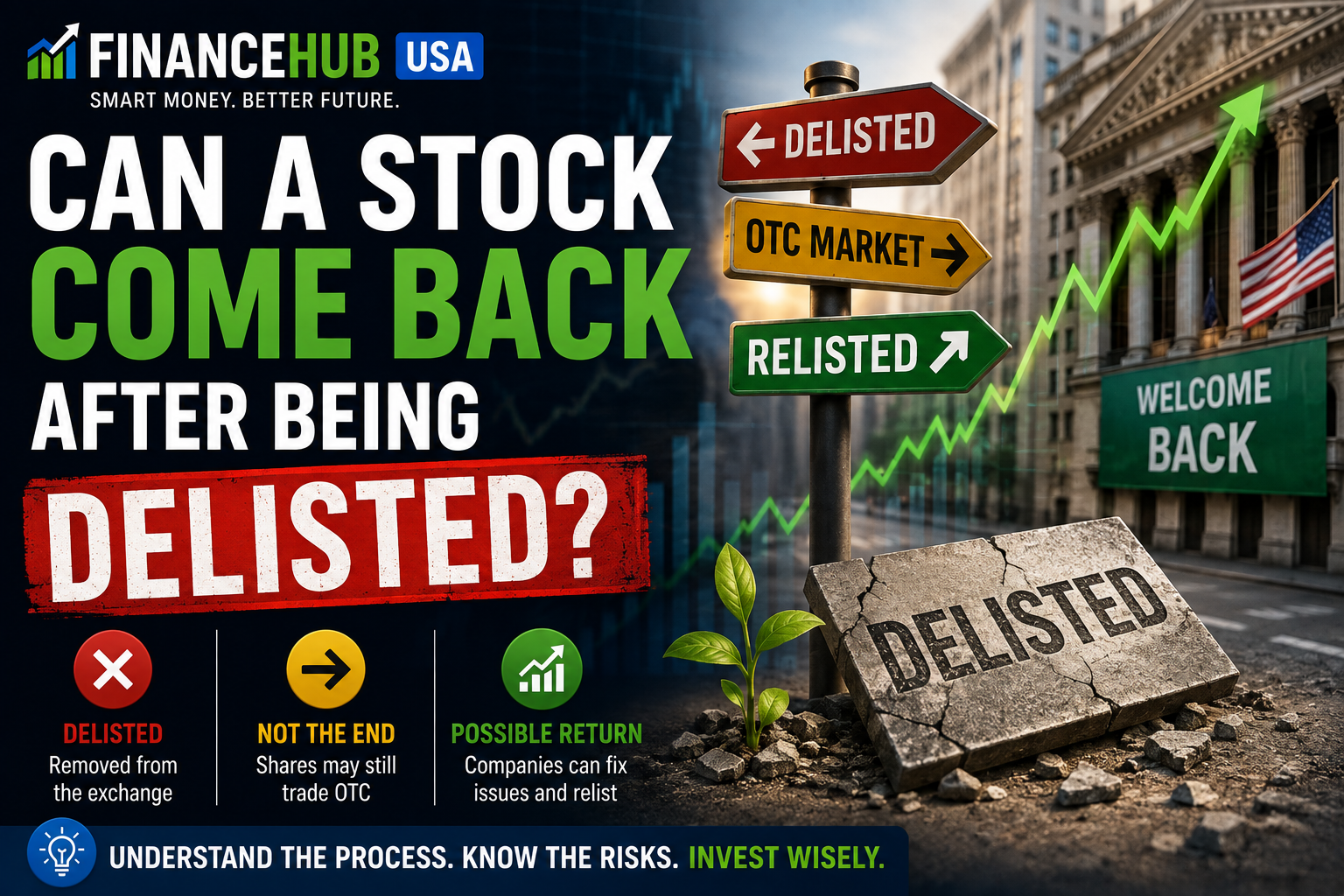
What About Delisted and OTC Stocks?
Liquidity risk can become particularly important when a company is delisted from a national securities exchange.
Some delisted securities may subsequently trade over the counter, but OTC securities can have substantially different liquidity, quotation, disclosure, and broker-access characteristics from actively traded exchange-listed stocks.
For shareholders, the practical concern is straightforward: owning shares does not guarantee that an active market will exist when you want to sell.
| Security Situation | Potential Selling Difficulty |
|---|---|
| Highly traded large-cap stock | Generally lower under normal conditions |
| Small-cap stock with limited volume | Moderate to high |
| Thinly traded OTC stock | Potentially very high |
| Stock under trading halt | Trading temporarily unavailable |
| Security with no meaningful quoted market | May be extremely difficult or practically impossible to sell |
For a deeper explanation of what can happen after a company leaves an exchange, read our related guide: Can a Stock Come Back After Being Delisted?.
Can You Sell a Penny Stock Whenever You Want?
Not necessarily. Low-priced and microcap securities can carry substantial liquidity risk.
A position may appear valuable based on its most recent trade while being difficult to liquidate at anything close to that price if trading volume and available bids are limited.
Example: A $20,000 Position That May Not Be Worth $20,000 in Immediate Cash
Imagine you own 100,000 shares of a speculative stock showing a last price of $0.20. Your brokerage account might display an approximate market value of $20,000.
But suppose available buying interest looks like this:
| Bid | Shares Wanted | Potential Proceeds |
|---|---|---|
| $0.20 | 5,000 | $1,000 |
| $0.18 | 15,000 | $2,700 |
| $0.15 | 30,000 | $4,500 |
| $0.10 | 50,000 | $5,000 |
If those represented the relevant available bids and a market sell order consumed them sequentially, the hypothetical proceeds would total only $13,200 before applicable costs or taxes—even though the last trade implied a $20,000 position value.
That is a $6,800 difference between the value implied by the last transaction and the simplified amount obtainable by selling the entire position into the available bids.
This example illustrates why investors in speculative or thinly traded stocks should examine liquidity and market depth rather than relying exclusively on the last traded price.
How Can You Reduce Liquidity Risk When Selling?
No order strategy can create buyers where none exist, but investors can take steps to better understand and manage execution risk.
- Check the bid and ask. The last traded price alone does not tell you what buyers currently offer.
- Review trading volume. Compare the size of your position with the security's normal trading activity.
- Consider limit orders when price control matters. A limit order can prevent execution below your specified minimum, although execution is not guaranteed.
- Be careful with large market orders. Large orders can consume available liquidity at multiple price levels.
- Understand extended-hours risk. Liquidity and price competition can be lower outside regular trading hours.
- Research OTC securities carefully. Limited liquidity and information can increase investment and execution risks.
- Confirm that your order actually executed. Submitting an order does not necessarily mean the transaction was completed.
Common Mistakes Investors Make When Selling Stocks
| Mistake | Why It Matters |
|---|---|
| Assuming the last price is guaranteed | The next available buyer may offer a different price |
| Using market orders in extremely illiquid stocks without understanding the risk | Execution can occur across substantially lower bids |
| Assuming a limit order guarantees a sale | A limit order controls price but not execution |
| Ignoring position size | A large position can exceed available liquidity near the quoted price |
| Ignoring the bid-ask spread | A wide spread can create an immediate disadvantage when entering or exiting |
| Assuming OTC trading works exactly like a major exchange | Liquidity, quotations, information availability, and broker access can differ |
| Failing to confirm execution | An investor may incorrectly assume an unfilled or partially filled order completed |

FinanceHub USA Analysis: Liquidity Is Part of an Investment's Value
Investors often evaluate stocks using revenue growth, earnings, valuation, dividends, competitive advantages, and future price potential. Liquidity deserves a place on that list as well.
Consider two investments that both show a market value of $50,000. The first is an actively traded stock with substantial buying and selling activity. The second is a microcap security where only a few thousand dollars of shares normally trade each day.
Those positions may display the same $50,000 value on a brokerage screen, but they do not necessarily provide the same ability to convert that value into cash quickly.
This distinction becomes especially important during periods of market stress. Investors often care most about liquidity precisely when many other market participants are also trying to sell.
For that reason, before purchasing a speculative or thinly traded security, investors should ask an additional question:
If I eventually want or need to sell this entire position, how much buying interest is likely to exist without substantially moving the market price?
That question can be just as important as estimating how high the stock might eventually rise.
Final Thoughts
So, can you sell stock without a buyer? A completed stock sale ultimately requires another party willing to acquire the shares.
In liquid markets, exchanges, market makers, electronic trading systems, institutions, broker-dealers, and other investors can create enough activity that finding the other side of a trade happens almost instantly. But that convenience should not be confused with a guarantee that every position can be sold immediately at the last quoted price.
When liquidity falls, a sell order can execute at a worse price, fill only partially, remain unfilled, or—in the case of a trading halt—temporarily become impossible to execute.
Limit orders provide greater control over the minimum acceptable price but cannot guarantee a buyer. Market orders generally prioritize execution but do not guarantee the final price.
Before investing, look beyond the quoted share price and consider trading volume, bid-ask spreads, position size, market depth, and your potential exit strategy.
The number shown beside your position in a brokerage account represents an estimated market value. The amount you can actually turn into cash depends on the market available when you sell.
Continue exploring FinanceHub USA for practical guides covering stocks, ETFs, investing, retirement planning, banking, credit, and personal finance.
Investment Disclaimer: This article is for general educational and informational purposes only and does not constitute investment, financial, tax, or legal advice. Investing involves risk, including the possible loss of principal. Trading conditions, liquidity, order execution, and available prices can change rapidly. Consider your financial situation, investment objectives, time horizon, and risk tolerance before making investment decisions.
Official Investor Resources
Frequently asked questions
Can you sell stock if nobody wants to buy it?
A completed stock sale requires a counterparty. If no buyer is available at an acceptable price, your order may remain unfilled, expire, or require a lower selling price before it can execute.
Does a market order guarantee my stock will sell at the displayed price?
No. A market order prioritizes execution at available prices, but the last-traded or displayed price is not guaranteed.
What happens if nobody buys my limit order?
The order can remain unfilled until sufficient buying interest appears at your limit price or higher, or until the order expires or is canceled.
Can only part of my stock order be sold?
Yes. If there is insufficient buying interest for your entire position at an available price, an order can potentially receive partial fills or execute across multiple price levels.
Who buys stocks when investors sell them?
The counterparty can include another investor, an institution, a market maker, or another eligible market participant depending on how the broker routes and executes the order.
Can a stock become impossible to sell?
A stock can become extremely difficult to sell when liquidity disappears, quotations are unavailable, trading is halted, or there is no meaningful market for the security.
Can I sell stock during a trading halt?
Normal trading in a halted listed stock is generally prohibited until the halt ends and trading resumes.
Are OTC stocks harder to sell?
They can be. Some OTC securities have limited liquidity, fewer quotations, wider spreads, and less current public information than heavily traded exchange-listed stocks.
Why did my stock sell below the price shown on my screen?
The last-traded price is not necessarily the price available when your order reaches the market. Prices can move, and large orders can execute against buyers at several different price levels.
Is a limit order safer than a market order?
A limit order provides greater control over the minimum selling price, but it introduces execution risk because the order may never be filled. Neither order type is universally better for every situation.