How Much Should You Save From Every Paycheck?
How much should you save from each paycheck? Learn how to choose a realistic savings rate based on income, expenses, debt and financial goals.
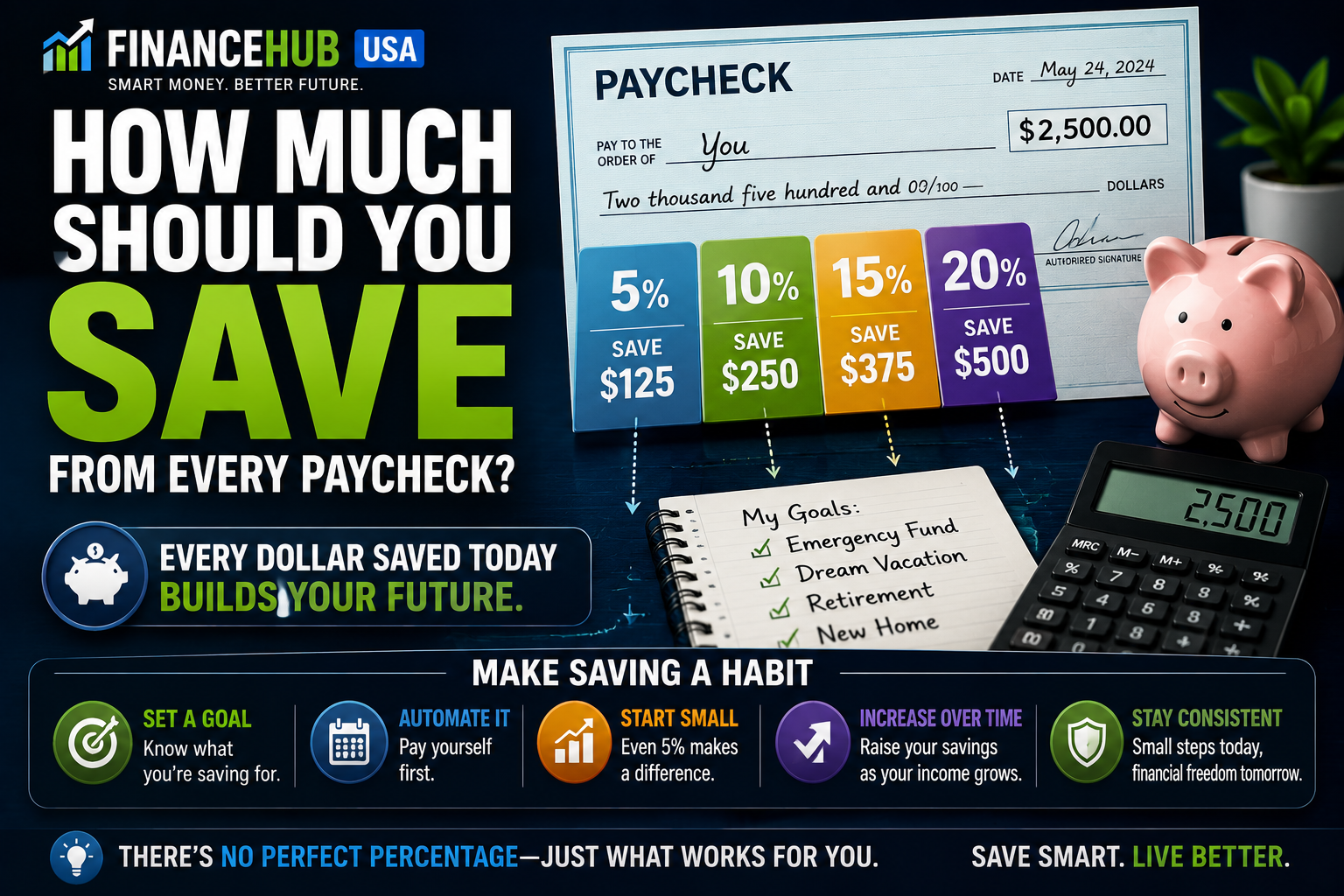

There is no single percentage everyone should save from every paycheck. A useful starting point is to choose an amount you can repeat reliably each payday, then increase it as your cash flow improves. For some households that may be 5% or 10% of take-home pay; others may be able to save 15%, 20%, or more.
The key difference between paycheck saving and general monthly budgeting is timing. Instead of waiting to see what remains at the end of the month, you decide in advance how much of each paycheck belongs to your future.
That approach can make saving more consistent because the contribution happens when income arrives—not after every other expense has had a chance to compete for the same dollars.
How Much Should You Save From Each Paycheck?
Start with your actual take-home pay, not just your salary. Then choose a savings amount that can be maintained while still covering essential expenses and required debt payments.
A 20% savings target can be useful as a long-term benchmark, but it should not be treated as a pass-or-fail rule. If saving 20% forces you to use a credit card before the next payday, the target is too aggressive for your current cash flow.
The Consumer Financial Protection Bureau notes that even a relatively small amount of savings can provide some financial security and recommends building a savings strategy that fits your circumstances.
Consider a worker receiving $2,500 in take-home pay per paycheck:
| Illustrative Savings Rate | Saved Per $2,500 Paycheck | Money Remaining |
|---|---|---|
| 5% | $125 | $2,375 |
| 10% | $250 | $2,250 |
| 15% | $375 | $2,125 |
| 20% | $500 | $2,000 |
The best row is not the one with the highest percentage. It is the one you can maintain consistently without missing bills, creating overdrafts, or repeatedly transferring the money back into checking.

How Pay Frequency Changes Your Savings Plan
Saving from every paycheck becomes much easier to understand when you know how many paychecks you receive during the year.
| Pay Schedule | Typical Paychecks Per Year | Saving $100 Per Paycheck |
|---|---|---|
| Weekly | 52 | $5,200 |
| Biweekly | 26 | $2,600 |
| Twice monthly | 24 | $2,400 |
| Monthly | 12 | $1,200 |
This is why a paycheck-based savings plan should be built around your actual payroll schedule. A person paid biweekly has 26 opportunities to save during a typical 52-week year, while someone paid twice monthly normally has 24.
How Much Does Saving Every Paycheck Add Up To?
Small contributions can look insignificant when viewed one payday at a time. Their impact becomes much clearer over a full year.
Suppose Marcus receives $2,000 every two weeks and saves 10%, or $200, from each paycheck. With 26 biweekly pay periods, he would contribute $5,200 during the year before interest, investment returns, fees, taxes, or withdrawals.
| Amount Saved Per Biweekly Paycheck | Paychecks Per Year | Annual Contributions |
|---|---|---|
| $25 | 26 | $650 |
| $50 | 26 | $1,300 |
| $100 | 26 | $2,600 |
| $200 | 26 | $5,200 |
| $300 | 26 | $7,800 |
| $500 | 26 | $13,000 |
The lesson is simple: consistency can turn a modest per-paycheck contribution into a meaningful annual amount.
FinanceHub USA Framework: Set a Savings Floor, Target, and Bonus
Instead of trying to choose one permanent savings percentage, it can be more useful to define three levels.
| Level | Purpose | How to Use It |
|---|---|---|
| Savings floor | The minimum you can reliably save | Protect this contribution on every payday |
| Target rate | The amount you are working toward | Increase gradually as cash flow improves |
| Bonus savings | Extra contributions beyond the target | Use raises, bonuses, refunds, or unusually strong income periods |
Suppose your current savings floor is 5% of take-home pay and your target is 10%. You can protect the 5% contribution now and increase it by one percentage point after a raise, debt payoff, or recurring expense disappears.
This approach is particularly useful for workers whose pay varies. Instead of committing to a fixed amount that becomes impossible during a slow period, they can protect a manageable minimum and contribute more when income is stronger.
Why Automatic Paycheck Savings Can Be Effective
Automation changes saving from a repeated decision into a default action.
The CFPB recommends automatic recurring transfers as one possible way to make saving consistent. Some employers may also allow employees to split direct deposit between more than one account.
Imagine your plan is to save $250 from every paycheck. If the full paycheck lands in checking first, that $250 can easily become part of your available spending money. If it moves automatically to a designated account shortly after payday, the saving happens before discretionary spending has a chance to absorb it.
Automation still needs supervision. Keep enough cash in checking for upcoming bills and monitor account balances so transfers do not create overdraft or insufficient-fund problems.

What If You Can Only Save a Small Amount?
Starting small is not the same as making no progress. A contribution that can be repeated is more useful than an ambitious target that repeatedly fails.
Example: Starting With $25 Per Paycheck
Suppose Jasmine is paid every two weeks and can currently save only $25 per paycheck.
| Biweekly Savings | After 13 Paychecks | After 26 Paychecks |
|---|---|---|
| $25 | $325 | $650 |
| $50 | $650 | $1,300 |
| $100 | $1,300 | $2,600 |
| $200 | $2,600 | $5,200 |
Jasmine's $25 contribution would add up to $650 over 26 paychecks before interest or investment returns. If her finances improve later, she can increase the contribution.
The objective is not to prove that $25 is the ideal amount. It is to establish a repeatable payday habit that can grow.
What If Your Paycheck Is Already Fully Allocated?
If virtually every paycheck is already needed for housing, food, transportation, insurance, debt payments, and other necessities, forcing an arbitrary savings percentage may create more problems than it solves.
Instead, look specifically at the relationship between your bills and your paydays. A household can have enough annual income but still experience cash shortages because several large bills fall before the next paycheck arrives.
The CFPB has published guidance on managing cash flow and notes that some consumers may be able to work with creditors or service providers to change bill due dates.
Possible first steps include:
- Identifying which bills fall immediately after each payday.
- Creating a very small minimum transfer, even if it is only $10 or $25.
- Using irregular income, refunds, or bonuses to establish an initial cash reserve.
- Increasing the contribution after a debt payment or recurring expense disappears.
- Avoiding an automatic transfer that repeatedly forces money back out of savings.
What Should Your Paycheck Savings Fund First?
The destination of your savings should reflect the job the money needs to perform. Money needed for an emergency next month should not necessarily be treated the same way as money intended for retirement decades from now.
| Goal | Primary Purpose | Typical Time Horizon |
|---|---|---|
| Emergency reserve | Unexpected expenses or income disruption | Immediate |
| Sinking fund | Predictable but irregular expenses | Months to a few years |
| Short-term goal | Planned purchases or expenses | Near term |
| Retirement | Long-term financial security | Long term |
If high-interest debt is competing with your savings goals, see Should You Save Money or Pay Off Debt First?
How to Divide Savings From One Paycheck
Once a contribution becomes sustainable, you can divide it among more than one goal.
Suppose someone takes home $3,000 per paycheck and can comfortably direct $450, or 15%, toward financial goals.
| Illustrative Goal | Amount Per Paycheck | Purpose |
|---|---|---|
| Emergency savings | $150 | Unexpected expenses and income disruptions |
| Retirement | $200 | Long-term financial security |
| Sinking fund or short-term goal | $100 | Planned irregular expenses |
| Total | $450 | 15% of take-home pay |
This is only an illustration. Someone without emergency savings may initially send a larger share toward cash reserves, while someone with stronger reserves may direct more toward retirement or other goals.
Increase Your Savings Rate When Your Paycheck Grows
Raises create an opportunity to increase savings before the entire increase becomes part of your normal lifestyle.
Imagine David takes home $2,400 every two weeks and saves $240, or 10%, from each paycheck. A raise increases his take-home pay to $2,600.
Instead of spending the entire additional $200, suppose David directs $100 of the increase toward savings and keeps the other $100 for additional spending.
| Before Raise | After Raise | |
|---|---|---|
| Take-home paycheck | $2,400 | $2,600 |
| Amount saved | $240 | $340 |
| Approximate savings rate | 10% | 13.1% |
| Available after savings | $2,160 | $2,260 |
If David is paid biweekly, the additional $100 contribution adds $2,600 per year to his planned savings.
A Simple Paycheck Savings Progression
Instead of expecting your savings rate to jump immediately from 0% to 20%, build a progression.
| Stage | Example Savings Rate | Focus |
|---|---|---|
| Starting | 2%–5% | Establish the habit |
| Building | 5%–10% | Strengthen cash reserves and planned goals |
| Growing | 10%–20% | Increase long-term contributions as cash flow allows |
| High capacity | 20%+ | Accelerate long-term goals where appropriate |
FinanceHub USA note: These percentages are planning illustrations, not official savings standards. The appropriate rate depends on income, expenses, debt, household obligations, emergency reserves, and financial goals.
Common Paycheck Savings Mistakes
- Choosing an amount that cannot survive until the next payday. A savings target that repeatedly forces transfers back into checking is not truly sustainable.
- Waiting until the end of the month. If the goal is to save from each paycheck, move the contribution when income arrives rather than hoping the same dollars remain weeks later.
- Ignoring your actual pay schedule. Weekly, biweekly, twice-monthly, and monthly payrolls create different numbers of annual saving opportunities.
- Failing to increase the contribution after a raise. Lifestyle spending can absorb income increases surprisingly quickly.
- Automating too aggressively. Automatic saving works only when checking still has enough money for upcoming obligations.
- Treating every savings goal as the same. Emergency money, sinking funds, and long-term savings can have very different purposes.
- Giving up because 20% is unrealistic. A smaller contribution that happens every payday can still create substantial progress over time.

FinanceHub USA Analysis: Make the Rate Grow With Your Paycheck
The most useful paycheck savings rate is not necessarily the highest percentage you can manage once. It is the amount you can protect repeatedly and increase over time.
A worker beginning at 3% may eventually move to 5%. Someone already at 10% may increase to 12% after a raise. A household with strong cash flow and limited expensive debt may decide that 20% is not a ceiling.
This creates a more useful question than “What percentage is everyone supposed to save?”
What amount can I save from every paycheck today, and what event will trigger my next increase?
That trigger might be a raise, debt payoff, canceled recurring expense, or completion of another financial goal. Connecting increases to specific events makes the plan more actionable than simply hoping to save more someday.
Final Thoughts
So, how much should you save from every paycheck? There is no universal percentage. A 20% target may work for some households, while others need to begin with 5%, $50, $25, or another sustainable amount.
What makes paycheck saving powerful is not a perfect percentage. It is the ability to make the contribution repeatedly when income arrives.
Start with a savings floor you can protect, build toward a target rate, automate the contribution when appropriate, and increase it after improvements in income or cash flow.
Over time, a small contribution that happens every payday can become a much stronger financial habit than an aggressive target that cannot be maintained.
Related reading: Should You Save Money or Pay Off Debt First?
Related reading: Is It Better to Save Weekly or Monthly?
Sources and further reading:
Frequently asked questions
How much should I save from every paycheck?
There is no universal percentage. Your savings amount should reflect your take-home income, essential expenses, debt, emergency savings and financial goals. The key is choosing an amount you can contribute consistently.
Is saving 20% of every paycheck enough?
Twenty percent can be a useful benchmark for some households, but it is not a mandatory or universal rule. Some people may need to start lower, while others with greater disposable income may choose to save more.
Is saving 10% of my paycheck good?
Saving 10% consistently can represent meaningful progress. Whether it is sufficient for your goals depends on factors such as retirement needs, emergency savings, income, expenses and timeline.
What if I can only save $25 per paycheck?
Starting with $25 is still worthwhile. If you are paid every two weeks, saving $25 from 26 paychecks would contribute $650 over a year before interest. You can increase the amount as your finances improve.
Should I save from gross pay or take-home pay?
Budgeting percentages are often easier to manage using take-home pay because that represents the money actually available after payroll deductions. Retirement planning may use different income measures, so be consistent about which number you use.
Should I automatically save money every payday?
Automatic transfers can make saving more consistent. The CFPB recommends recurring transfers as one possible savings strategy, but you should monitor your checking balance to avoid creating overdraft problems.
Where should paycheck savings go?
Savings can be divided among emergency reserves, short-term goals, retirement and other long-term goals. The appropriate allocation depends on your current financial priorities.
Should I increase my savings when I get a raise?
A raise can be a useful opportunity to increase savings because you can redirect part of the additional income before becoming accustomed to spending all of it.
Should I save money if I have credit card debt?
Some emergency savings can help prevent unexpected expenses from creating additional debt, while high-interest credit card balances may also deserve aggressive repayment. The appropriate balance depends on your circumstances.
How can I save if I live paycheck to paycheck?
Start by reviewing cash flow and identifying any sustainable amount, even if it is small. One-time income such as a tax refund can also help establish an initial emergency reserve when regular contributions are difficult.