What Happens to Your Stock If a Company Is Bought?
What happens to your shares when a company is acquired? Learn how cash deals, stock deals, merger prices, taxes, and investor returns can be affected.
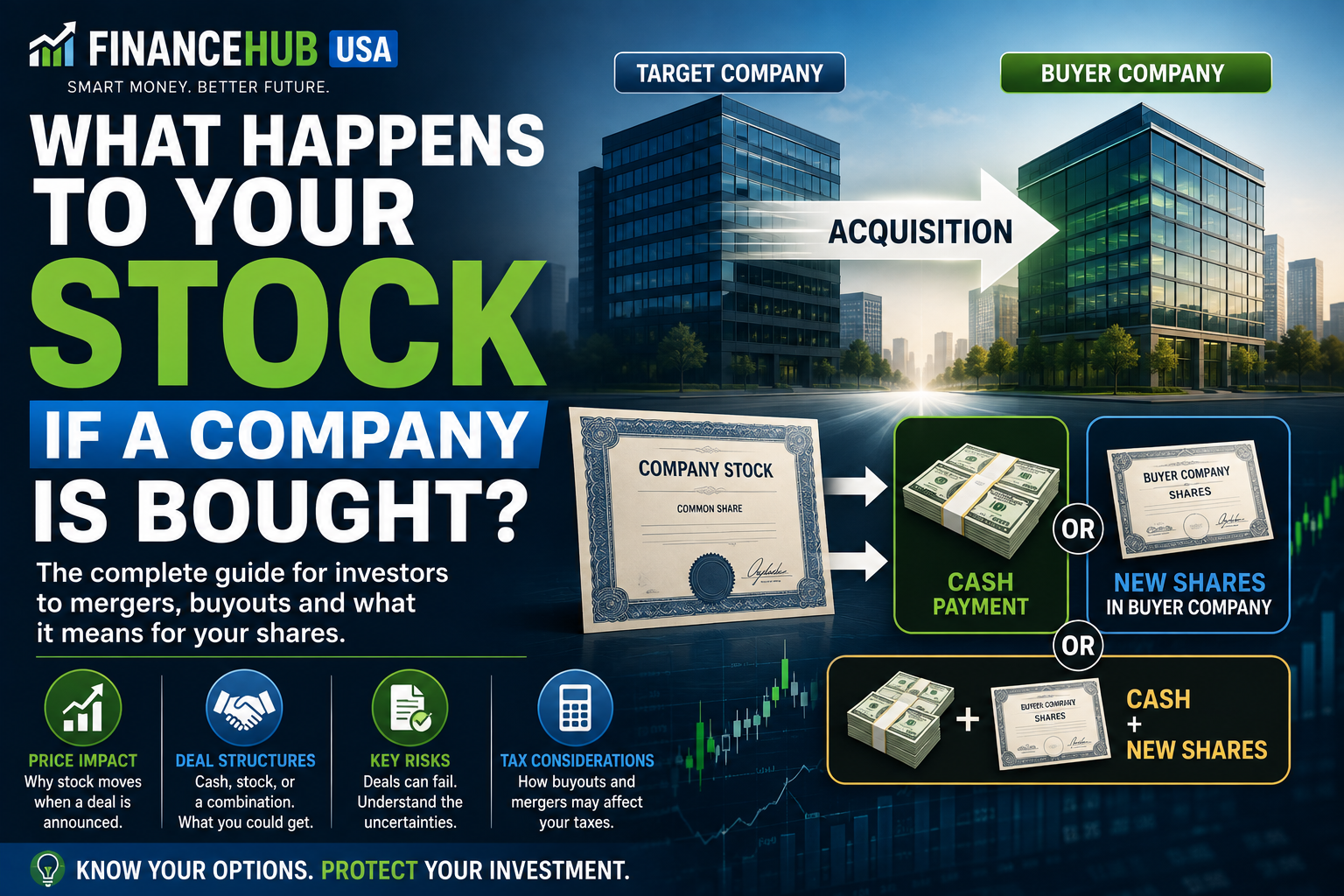
What Happens to Your Stock When a Company Is Bought?

When a company in your portfolio announces that it is being acquired, your shares do not usually disappear immediately.
What ultimately happens depends on how the transaction is structured.
Shareholders may receive:
- Cash
- Shares of the acquiring company
- A combination of cash and stock
Until the acquisition closes, the target company's stock may continue trading publicly. Its market price can move above or below the announced deal value depending on how investors assess the chances that the transaction will be completed.
This guide explains what happens to your stock when a company is bought, how different acquisition structures work, what happens if the deal fails, how merger spreads work, and what investors should consider before deciding whether to sell or wait.
What Happens When a Public Company Is Acquired?
When one public company agrees to acquire another, the buyer and target negotiate a transaction that sets the value and form of consideration shareholders may receive.
An announcement is only the beginning.
Before the deal closes, it may still require:
- Shareholder approval
- Regulatory approval
- Antitrust review
- Financing
- Other contractual closing conditions
During this period, the target company's stock usually continues to trade.
Public companies normally disclose important merger and acquisition information through SEC filings, including merger agreements, proxy statements, tender-offer documents, and other transaction materials.
Your Shares Usually Remain in Your Brokerage Account Until Closing
After an acquisition is announced, your brokerage account may continue showing the same number of target-company shares.
That is normal.
The conversion into cash or acquiring-company stock generally happens only after the transaction is legally completed.
Cash Deal vs. Stock Deal

The most important factor for shareholders is the type of consideration offered.
1. All-Cash Acquisition
In an all-cash acquisition, the buyer agrees to pay a specific amount for each eligible target-company share.
Example
Suppose you own 100 shares of Company A.
Before the acquisition announcement, Company A trades at $40.
Company B agrees to acquire Company A for:
$52 per share in cash
If the deal closes under those terms:
100 shares × $52 = $5,200
Your Company A shares would generally be converted into approximately $5,200 in cash, subject to taxes, fees, and other transaction terms.
After closing, the original Company A shares would normally stop trading independently.
2. Stock-for-Stock Acquisition
Instead of cash, the acquiring company may offer its own shares.
The merger agreement establishes an exchange ratio.
Example
Suppose the agreement provides:
0.50 shares of Company B for every 1 share of Company A
If you own 100 Company A shares:
100 × 0.50 = 50 Company B shares
After closing, your ownership shifts from the target company to the acquiring or combined business.
3. Cash-and-Stock Acquisition
Some acquisitions use a combination of both.
For example, shareholders might receive:
- $20 in cash
- Plus 0.25 shares of the buyer
for each target-company share.
Acquisition Structure Comparison
| Deal Structure | What Shareholders Receive | What Happens to Original Shares |
|---|---|---|
| All-cash acquisition | Cash based on the agreed price | Shares generally convert into cash |
| Stock-for-stock acquisition | Shares of the acquiring company | Shares convert based on the exchange ratio |
| Cash and stock | Combination of cash and new shares | Shares convert under the merger terms |
Why Does the Stock Trade Below the Buyout Price?
This is one of the most important concepts to understand.
Suppose Company A trades at $40 before an announcement.
A buyer agrees to pay:
$52 per share
But the stock immediately starts trading at:
$50
Why not exactly $52?
Because the market is pricing in risk.
The acquisition has been announced but not completed.
What Is the Merger Spread?
The difference between the target's market price and the value expected at closing is commonly called the merger spread.
Example
| Price | |
|---|---|
| Current target stock price | $50 |
| Cash acquisition price | $52 |
| Merger spread | $2 |
The potential return from buying at $50 and receiving $52 would be:
$2 ÷ $50 = 4%
But that 4% is not guaranteed.
Investors accepting the spread are taking on the risk that the transaction may be delayed, renegotiated, blocked, or terminated.
Why the Merger Spread Exists
The spread may reflect risks such as:
- Regulatory objections
- Antitrust concerns
- Shareholder rejection
- Financing problems
- Changing business conditions
- Litigation
- Unexpected delays
A wider spread can sometimes indicate that the market perceives greater risk.
Could the Stock Trade Above the Deal Price?
Yes.
A target stock can sometimes trade above the announced acquisition value.
This may happen if investors expect:
- A competing bidder
- A higher revised offer
- Improved transaction terms
However, speculation about a higher bid is not guaranteed to become reality.
What Happens If the Acquisition Fails?

An acquisition announcement is not the same as a completed transaction.
If the deal fails, you generally continue owning shares of the target company.
The market may then begin valuing the company again as an independent business.
Example
Suppose:
- Stock price before announcement: $40
- Acquisition price: $52
- Post-announcement market price: $50
If regulators block the transaction, the stock could fall back toward its previous valuation or potentially lower.
It does not have to return exactly to $40.
The company may have changed while the acquisition was pending.
Possible Acquisition Outcomes
| Outcome | What Happens to Your Shares |
|---|---|
| Cash deal closes | Shares generally convert into cash |
| Stock deal closes | Shares convert into acquiring-company shares |
| Cash-and-stock deal closes | You receive the agreed combination |
| Deal fails | You generally continue holding the target stock |
What Is a Tender Offer?
Not every acquisition is completed through exactly the same legal process.
One possible structure is a tender offer.
In a tender offer, the acquiring company offers to purchase shares directly from existing shareholders under specified terms.
Shareholders may be given a deadline to tender, or submit, their shares.
Example
A buyer may offer:
$45 per share for all eligible shares tendered before a specified date.
If you choose to tender your shares and the offer is completed, your shares may be purchased according to the offer terms.
Do You Have to Accept a Tender Offer?
Not necessarily.
Shareholders should review:
- The offer price
- The expiration date
- Withdrawal rights
- Conditions of the offer
- What happens if the buyer later completes a merger
Brokerages often send corporate-action notices when action is required.
What Is a Merger Vote?
Some acquisitions require target-company shareholders to vote on the transaction.
Shareholders may receive proxy materials explaining:
- Deal terms
- Board recommendations
- Financial analysis
- Potential conflicts
- Tax considerations
- Voting procedures
If the required shareholder approval is obtained and other conditions are satisfied, the merger can proceed toward closing.
What Happens If You Do Nothing?
In many completed mergers, ordinary shareholders do not need to manually sell their shares.
Once the transaction closes, the brokerage may automatically process the corporate action.
Depending on the deal, you may see:
- Your target-company shares removed
- Cash deposited into your account
- New shares of the buyer added
- A combination of both
Tender offers and other corporate actions can be different, so always read brokerage instructions carefully.
What Happens to Fractional Shares?
Stock deals can create fractional shares.
Example
Suppose you own 75 shares and the exchange ratio is:
0.42 shares of the buyer for each target share
Your calculation would be:
75 × 0.42 = 31.5 shares
The merger agreement determines how the 0.5 fractional share is handled.
Common possibilities include:
- Cash in lieu of the fractional share
- Another treatment specified in the transaction documents
Do not assume your brokerage will automatically issue fractional shares.
What Happens to Stock Options?
If you own exchange-traded options on the target company, the treatment can be different from ordinary shares.
Options contracts may be adjusted to reflect the merger consideration.
Depending on the transaction, adjustments can affect:
- Deliverable securities
- Cash components
- Contract multiplier
- Expiration treatment
Investors holding options should review official adjustment notices from the Options Clearing Corporation and their brokerage.
What Happens to Employee Stock Options?
Employee stock options, restricted stock units, and other equity compensation are governed by separate plan documents and acquisition agreements.
Possible outcomes can include:
- Acceleration of vesting
- Conversion into buyer equity
- Cash payout
- Cancellation of certain awards
The exact result depends on the employment plan and transaction documents.
What Happens to Dividends Before Closing?
Shareholders may continue receiving dividends while a transaction is pending, but that should not be assumed.
The merger agreement can restrict:
- Dividend increases
- Special dividends
- Changes to ordinary distributions
Record dates and closing dates also matter.
Review the actual transaction documents rather than relying only on historical dividend policy.
What Happens to the Target Stock Ticker After Closing?
Once the acquisition is completed, the target company's stock generally stops trading as a separate public security.
The exchange may delist the shares.
The target ticker may then disappear from brokerage accounts and market listings.
Cash Deal
Your target shares generally disappear and cash appears in your account.
Stock Deal
The target shares disappear and are replaced by shares of the acquiring or combined company.
What Does Delisting Mean?
Delisting means the security is no longer traded on the exchange where it was previously listed.
In a completed acquisition, delisting is usually part of the transaction process rather than a sign that shareholders lost their investment.
The merger consideration replaces the old shares according to the agreed terms.
Can an Acquisition Create a Tax Bill?
Yes, depending on the transaction and the account in which the shares are held.
Cash Acquisition
A straightforward cash acquisition in a taxable brokerage account generally resembles a sale of the shares for tax purposes.
A simplified capital gain calculation is:
Amount received − adjusted cost basis = capital gain or loss
Example
Suppose you originally purchased:
100 shares × $30 = $3,000 cost basis
You later receive:
100 shares × $52 = $5,200
Simplified gain:
$5,200 − $3,000 = $2,200
The actual tax result depends on your adjusted basis, holding period, transaction costs, and other tax circumstances.
Short-Term vs. Long-Term Capital Gains
If the acquisition results in a taxable sale, holding period can matter.
Shares held for more than one year may qualify for long-term capital gain treatment under applicable rules.
Shares held for one year or less may be treated as short-term capital gains.
Tax rates and individual circumstances can differ.
Stock-for-Stock Acquisition Tax Treatment
Stock-based mergers can be more complicated.
Some transactions may qualify for tax-deferred treatment under applicable reorganization rules.
That does not mean the investment becomes permanently tax-free.
Your basis may carry over into the new shares, affecting future gain or loss when those shares are eventually sold.
The merger documents normally include a section discussing anticipated U.S. federal income-tax consequences.
Cash-and-Stock Deals Can Be More Complex
If shareholders receive both cash and stock, part of the transaction may have immediate tax consequences while another part may receive different treatment.
These transactions can become complicated quickly.
Investors receiving significant merger consideration should review the official tax disclosure and consider professional tax advice.
What If the Shares Are in an IRA or 401(k)?
The acquisition itself may not create the same immediate taxable event that it would in a regular brokerage account.
Tax-advantaged retirement accounts have their own tax rules.
For example, trading activity inside a Traditional IRA generally does not create current capital gains tax in the same way as a taxable brokerage account.
Withdrawals and distributions follow separate retirement-account tax rules.
Should You Sell After the Acquisition Announcement?
There is no universal answer.
After the announcement, your investment has changed.
Before the acquisition, your return depended largely on the target company's long-term business performance.
After a definitive deal is announced, your remaining return can depend more heavily on:
- Whether the deal closes
- When it closes
- Whether the price changes
- Whether regulators approve it
Example: Sell Now or Wait?
Suppose:
- Current stock price: $50
- Cash acquisition price: $52
- Expected closing time: six months
If you sell now, you receive approximately $50 per share immediately.
If you wait and the deal closes, you may receive $52.
The remaining upside is:
$2 per share
or:
$2 ÷ $50 = 4%
That 4% must be weighed against the risk that the deal fails or takes longer than expected.
Time Matters When Evaluating the Spread
A 4% spread is not the same in every situation.
Consider:
| Potential Spread | Expected Time to Close |
|---|---|
| 4% | 2 months |
| 4% | 12 months |
The annualized return potential is very different.
But annualizing a merger spread should not cause investors to ignore deal-break risk.
What Is Merger Arbitrage?
Merger arbitrage is an investment strategy focused on the difference between a target company's current market price and the value expected if the transaction closes.
Professional investors may:
- Buy target shares
- Hedge acquiring-company exposure
- Analyze regulatory risk
- Estimate closing probability
Despite the word "arbitrage," these trades are not risk-free.
A failed acquisition can generate substantial losses.
FinanceHub USA Analysis: After a Buyout, You Own Deal Risk
An acquisition announcement can fundamentally change the nature of your investment.
Before the announcement, you may have owned the stock because you believed:
- Revenue would grow
- Profit margins would improve
- The company had a competitive advantage
After the acquisition agreement, those factors may become less important to your short-term return.
The critical questions become:
- Will the deal close?
- When will it close?
- Will the original price survive?
- How far could the stock fall if the transaction fails?
Potential Upside vs. Downside
| Scenario | Illustrative Value |
|---|---|
| Current target price | $50 |
| Deal closes | $52 |
| Possible failed-deal value | $38 |
In this hypothetical example:
Potential upside:
$52 − $50 = $2
Potential downside:
$50 − $38 = $12
This illustrates why a small merger spread is not automatically free money.
Regulatory Risk Matters More in Some Deals
Large transactions can attract substantial regulatory scrutiny.
Risks can be higher when:
- The companies are major competitors
- The acquisition significantly changes market concentration
- The industry is heavily regulated
- National security concerns exist
- Multiple countries must approve the transaction
Investors should review official filings for discussion of required approvals.
Could the Acquisition Price Change?
Yes.
A transaction can sometimes be renegotiated.
The buyer and target may agree to:
- A lower acquisition price
- A higher acquisition price
- Different consideration
- Modified closing terms
Investors should not assume that the initial headline price can never change.
What Is a Breakup Fee?
Merger agreements sometimes contain termination or breakup fees.
These fees may become payable under specific circumstances if the transaction does not close.
A breakup fee paid to the target company does not necessarily mean target shareholders directly receive that amount.
Its primary purpose is usually contractual protection related to the transaction.
Can Another Buyer Make a Higher Offer?
Yes.
Some acquisition agreements allow the target board to consider a superior proposal under specified conditions.
This can create bidding competition.
If another buyer submits a higher offer, the target stock can move above the original deal value.
However, investors should not buy solely on the assumption that a bidding war will occur.
How to Research an Acquisition
Rather than relying only on headlines, review official documents.
Useful sources can include:
- SEC Form 8-K filings
- Merger agreements
- Proxy statements
- Tender-offer filings
- Company investor-relations announcements
- Regulatory filings
The SEC's EDGAR database allows investors to search public-company filings.
Questions to Ask After an Acquisition Announcement
- What exactly will I receive?
- Is the deal cash, stock, or mixed?
- What is the current merger spread?
- When is the deal expected to close?
- Which approvals are still required?
- What could the stock be worth if the deal fails?
- What are the tax consequences?
- Could I use the capital elsewhere?
Common Acquisition Investing Mistakes
- Assuming an announced acquisition is guaranteed to close. Deals can fail.
- Assuming the buyout price is immediately available. The consideration is generally paid only after closing.
- Ignoring the merger spread. The difference between market price and deal value reflects important information.
- Ignoring the downside if the deal fails. Target shares can decline sharply.
- Ignoring tax consequences. Cash and stock transactions may be treated differently.
- Assuming fractional shares will automatically be issued. The merger agreement determines the treatment.
- Using only news headlines instead of official filings. Transaction documents contain the actual legal terms.
FinanceHub USA Framework: Hold or Sell?
| Question | Why It Matters |
|---|---|
| How much upside remains? | Measures potential return from waiting |
| How long until closing? | Capital may be tied up for months |
| What is the regulatory risk? | Can materially affect closing probability |
| What happens if the deal fails? | Defines potential downside |
| What are the tax consequences? | Can affect net proceeds |
| What is my opportunity cost? | Money waiting for the deal cannot be used elsewhere |
Final Thoughts
What happens to your stock when a company is bought?
Your shares generally remain in your brokerage account until the acquisition closes.
After closing, they may be:
- Converted into cash
- Exchanged for acquiring-company shares
- Replaced with a combination of cash and stock
The announced acquisition price does not guarantee that the target stock will immediately trade at that value.
The market price reflects:
- The value of the offer
- The time until closing
- Regulatory risk
- Financing risk
- The possibility of renegotiation or failure
Once an acquisition is announced, your investment changes from a straightforward ownership thesis into a transaction-risk decision.
The key question is no longer only whether the company is a good business.
It becomes:
Is the remaining upside worth the risk of waiting for the deal to close?
Review the official transaction documents, understand what you will receive, calculate the merger spread, consider the downside if the deal fails, and review the tax consequences before deciding whether to sell or hold.
Continue exploring FinanceHub USA for practical guides covering stocks, ETFs, mergers, retirement investing, banking, taxes, and personal finance.
Related reading: How Do Stocks Actually Make You Money?
Related reading: Can You Lose More Money Than You Invest in Stocks?
Sources and Further Reading
Frequently asked questions
What happens to my shares when a company is bought?
It depends on the acquisition terms. Your shares may be converted into cash, exchanged for shares of the acquiring company, or converted into a combination of cash and stock when the transaction closes.
Do I automatically make money when my company gets acquired?
No. Acquisitions often include a premium over the target company's pre-announcement stock price, but your personal return depends on what you originally paid for the shares, the final deal terms, and whether the acquisition closes.
Why does a stock trade below the acquisition price?
The difference can reflect the time remaining before closing and the risk that the transaction could be delayed, renegotiated, or terminated. This difference is commonly referred to as the merger spread.
What happens if an acquisition is canceled?
You generally continue owning shares of the target company if the transaction does not close. The stock may decline because the acquisition premium that investors had priced into the shares can disappear.
Do I have to sell my shares when a company is acquired?
You can often sell while the shares continue trading before closing. If you continue holding through a completed transaction, your shares are generally converted according to the acquisition agreement.
Do I pay taxes if my shares are bought for cash?
A taxable cash acquisition can generally create a capital gain or loss based on the consideration received compared with your adjusted cost basis. Your individual tax treatment depends on your circumstances.
What happens in a stock-for-stock merger?
Your shares in the target company are generally exchanged for shares of the acquiring or combined company using an exchange ratio specified in the merger agreement.

