Do You Pay Taxes on Money You Borrow?
Do you pay taxes on borrowed money? Learn why most loan proceeds aren't taxable income and when canceled or forgiven debt can create a tax bill.

Receiving $10,000 or $20,000 in your bank account can look like income, especially when the money comes from a personal loan, auto loan, mortgage, home-equity loan, or another form of financing. But money entering your account is not automatically taxable income. The reason you received it matters.
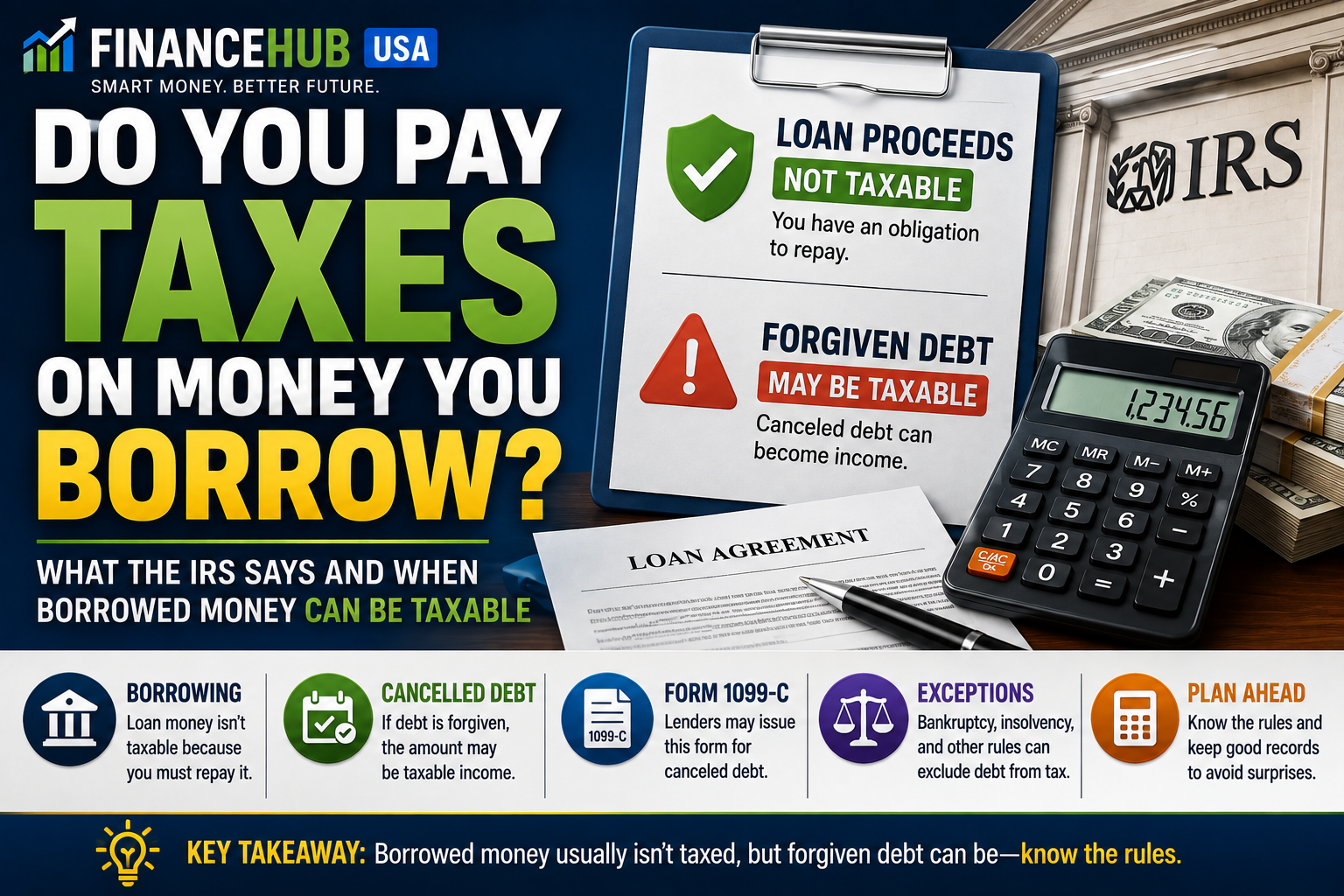
Quick answer: You generally do not pay federal income tax on legitimate loan proceeds when you receive them because you have an obligation to repay the money. The tax situation can change if part of the debt is later canceled or forgiven. Canceled debt may be taxable unless an IRS exception or exclusion applies.
In other words, borrowing increases your available cash, but it also creates a liability. You have not simply earned the amount deposited into your account.
Why Borrowed Money Usually Isn't Taxable Income
The central rule is straightforward: when you legitimately borrow money, you have an obligation to repay it.
The IRS explains that loan proceeds generally are not included in gross income because the borrower must repay the lender. This distinguishes a loan from wages, business revenue, investment income, or other amounts that may represent an economic gain without a corresponding repayment obligation.
Suppose Emma receives a $15,000 personal loan. Her checking-account balance rises by $15,000, but she also owes the lender $15,000 under the loan agreement. Receiving the loan itself generally does not create $15,000 of federal taxable income.
| Money Received | Typical Federal Tax Treatment | Why |
|---|---|---|
| $15,000 personal loan | Generally not taxable when borrowed | Borrower has a repayment obligation |
| $25,000 auto loan | Generally not taxable when borrowed | Loan must be repaid |
| $300,000 mortgage | Generally not taxable when borrowed | Mortgage creates a debt obligation |
| $10,000 business loan | Generally not taxable merely because it was borrowed | Business has a corresponding liability |
| $5,000 of debt later forgiven | Potentially taxable | Repayment obligation may have been eliminated |

Do You Pay Taxes on Personal Loans, Auto Loans, Mortgages, or Business Loans?
The same basic principle generally applies across common forms of legitimate borrowing. Receiving loan principal usually does not create federal taxable income simply because the money reaches your bank account or finances a purchase.
Personal Loans
If you borrow $10,000 and are legally obligated to repay it, the $10,000 generally is not treated as income when you receive it. Interest and fees associated with the loan are separate issues from whether the principal itself is taxable.
Auto Loans
Borrowing $35,000 to purchase a vehicle generally does not mean adding $35,000 to taxable income. The lender financed the purchase, and you owe the principal back under the loan agreement.
Mortgages
The same broad concept applies to a mortgage. A lender providing $400,000 to finance a home purchase does not ordinarily mean the borrower received $400,000 of taxable income.
Business Loans
Borrowed business capital is different from business revenue. If a business borrows $100,000, receiving the loan principal does not automatically mean the business earned $100,000 of taxable profit.
How the borrowed money is later spent, whether interest or expenses may be deductible, and how the transaction affects the business's tax return are separate questions that depend on the facts and applicable tax rules.
When Borrowed Money Can Become a Tax Issue
The major tax issue often appears later, when the borrower no longer has to repay some or all of the debt.
The IRS generally treats debt that is canceled, forgiven, or discharged for less than the amount owed as potential cancellation-of-debt income, unless an exception or exclusion applies.
Consider this simplified example:
| Event | Amount | Simplified Tax Result |
|---|---|---|
| Money originally borrowed | $20,000 | Generally not taxable when received |
| Debt later forgiven | $5,000 | Potential cancellation-of-debt income |
| Debt still owed | $15,000 | Remains a repayment obligation |
The original $20,000 was generally not income because repayment was required. If the lender later permanently eliminates $5,000 of that obligation, the tax analysis changes because the borrower no longer has to repay that portion.

What Is Form 1099-C?
When qualifying debt is canceled, a creditor may issue Form 1099-C, Cancellation of Debt. The form reports information about the canceled debt to the taxpayer and the IRS.
Receiving Form 1099-C means the cancellation should be reviewed carefully, but it does not automatically mean every dollar shown on the form is taxable. An exception or exclusion may change the result.
Likewise, failing to receive a 1099-C does not necessarily eliminate a tax obligation. If canceled debt is taxable under the applicable rules, it may still need to be reported.
If information on Form 1099-C appears incorrect, the IRS recommends contacting the creditor to request a correction.
Is All Forgiven Debt Taxable?
No. Federal tax law provides both exceptions and exclusions that can prevent certain canceled debts from being included in gross income.
| Situation | General Treatment |
|---|---|
| Ordinary loan that still must be repaid | Loan proceeds generally are not taxable income |
| Debt forgiven with no applicable exception or exclusion | Canceled amount may be taxable |
| Qualifying debt canceled in a Title 11 bankruptcy case | May be excluded from income |
| Debt canceled while taxpayer is insolvent | May be excluded up to the extent of insolvency |
| Cancellation that qualifies as a genuine gift | May fall under an exception to cancellation-of-debt income |
| Certain qualifying debts under special tax provisions | Special rules may apply |
Two of the most important consumer exclusions involve debt canceled in a qualifying Title 11 bankruptcy case and debt canceled while the taxpayer is insolvent.
How Does the Insolvency Exclusion Work?
The IRS generally defines insolvency for this purpose as a situation where your total liabilities exceed the fair market value of your total assets immediately before the debt cancellation.
Consider a simplified example. Immediately before a lender cancels $8,000 of debt, you have $30,000 of liabilities and assets worth $25,000.
| Financial Position Before Cancellation | Amount |
|---|---|
| Total liabilities | $30,000 |
| Fair market value of total assets | $25,000 |
| Extent of insolvency | $5,000 |
| Debt canceled | $8,000 |
| Potential amount excluded under insolvency rule | Up to $5,000 |
| Remaining canceled debt | $3,000 |
In this simplified example, the insolvency exclusion could potentially apply to $5,000 because liabilities exceeded assets by that amount immediately before the cancellation. The remaining $3,000 may still be taxable unless another exception or exclusion applies.
The IRS provides an insolvency worksheet in Publication 4681. The calculation can involve assets and liabilities that taxpayers may overlook, so it should not be estimated casually.
What Happens When Debt Is Canceled in Bankruptcy?
Debt discharged in a qualifying Title 11 bankruptcy case can generally be excluded from gross income under the bankruptcy exclusion.
That does not necessarily mean the transaction has no tax consequences. The IRS generally requires taxpayers using the bankruptcy exclusion to report the exclusion on Form 982, and certain tax attributes may need to be reduced.
In other words, excluding canceled debt from current taxable income can still affect other parts of the taxpayer's tax position.
When Do You Need Form 982?
Form 982, Reduction of Tax Attributes Due to Discharge of Indebtedness, is commonly relevant when a taxpayer excludes qualifying canceled debt because of bankruptcy, insolvency, or certain other provisions.
For example, a taxpayer claiming the insolvency exclusion generally uses Form 982 to identify the exclusion and the amount being excluded.
Because the form can also affect tax attributes, substantial debt cancellation can be more complicated than simply subtracting one number from taxable income.

Important Rule for Mortgage Debt Forgiven After 2025
Borrowers researching mortgage-debt forgiveness in 2026 should be careful with older articles.
IRS Publication 4681 states that the exclusion for qualified principal residence indebtedness generally does not apply to discharges completed after December 31, 2025, unless the discharge occurred under an arrangement that was entered into and evidenced in writing before January 1, 2026.
That means older articles describing the principal-residence exclusion as broadly available may be outdated for debt canceled in 2026.
Bankruptcy, insolvency, and other provisions may still be relevant depending on the circumstances, so the expiration of the residence-debt exclusion does not automatically mean every mortgage cancellation is taxable.
Student Loan Debt After 2025
Student-loan cancellation has its own rules and should not be grouped automatically with ordinary personal-loan or credit-card forgiveness.
IRS Publication 4681 notes a rule for debt discharged after December 31, 2025 because of the student's death or total and permanent disability. Qualifying debt may be nontaxable, subject to the applicable requirements, including an SSN reporting rule.
Because student-loan provisions have changed over time, taxpayers should verify the rule that applies to the particular type and year of discharge.
What About Loans From Family or Friends?
Borrowing money from a relative or friend does not automatically turn the amount received into taxable income. What matters is whether the arrangement is genuinely a loan with an obligation to repay rather than an outright gift.
Suppose your parents transfer $20,000 to you under an agreement requiring repayment over four years. If the arrangement is legitimately structured as debt, receiving the $20,000 is fundamentally different from receiving an unconditional $20,000 gift.
Documentation becomes especially important with larger family loans. A written agreement can identify the principal, repayment schedule, interest rate, due dates, and other terms.
Federal below-market-loan rules can also become relevant when loans between individuals charge little or no interest, so substantial family arrangements may warrant professional tax advice.
What If Someone Else Pays Off Your Loan?
Having another person pay your debt is not necessarily the same thing as having the creditor forgive it. The tax result depends on who made the payment and why.
| Situation | Potential Tax Issue |
|---|---|
| You receive a legitimate loan | Loan proceeds generally are not taxable when borrowed |
| Creditor forgives part of the debt | Cancellation-of-debt income may apply |
| Relative pays your debt as a genuine gift | Gift-tax rules may become relevant to the donor |
| Employer pays your personal debt as compensation | Payment may potentially be taxable compensation |
| Debt is discharged in qualifying bankruptcy | Bankruptcy exclusion may apply |
The broader lesson is that tax treatment depends on the substance of the transaction, not simply on the fact that a balance disappeared.
FinanceHub USA Analysis: Cash Flow Is Not the Same as Income
One of the easiest mistakes is looking only at the checking-account balance.
If $25,000 appears in your account after a personal loan closes, your available cash increased by $25,000. But your net financial position did not improve by the same amount because you simultaneously assumed a liability.
The same distinction applies to other borrowing. A $40,000 auto loan can provide a vehicle, while also creating $40,000 of debt. A mortgage can provide the financing needed to purchase a home, while the repayment obligation remains on the balance sheet.
Separate three questions:
- Did I receive cash? Borrowing can certainly increase your available cash or purchasing power.
- Did I earn taxable income? Legitimate loan proceeds generally are not taxable merely because you received them.
- Do I still have to repay the money? If that obligation disappears, cancellation-of-debt rules may become relevant.
A Simple Borrowing vs. Forgiveness Decision Guide
| What Happened? | Typical Question to Ask | Potential Tax Direction |
|---|---|---|
| You borrowed money and still owe it | Is there a genuine repayment obligation? | Proceeds generally are not taxable |
| Lender forgave part of the balance | Does an exception or exclusion apply? | Canceled amount may be taxable |
| You were insolvent before cancellation | By how much did liabilities exceed assets? | Insolvency exclusion may apply |
| Debt was discharged in bankruptcy | Was it a qualifying Title 11 case? | Bankruptcy exclusion may apply |
| You received Form 1099-C | Is the amount accurate and is it taxable? | Review the cancellation carefully |
Common Mistakes About Loans and Taxes
- Assuming every bank deposit is taxable income. Legitimate loan proceeds generally are not income merely because cash entered your account.
- Confusing borrowing with earning. A loan increases cash while simultaneously creating a repayment obligation.
- Ignoring forgiven debt. Debt that was not taxable when borrowed can create a tax issue if the repayment obligation later disappears.
- Ignoring Form 1099-C. A cancellation-of-debt form should be reviewed rather than treated like an ordinary loan statement.
- Assuming no Form 1099-C means no tax obligation. Taxable canceled debt may still need to be reported even when the form is not received.
- Assuming all canceled debt is taxable. Bankruptcy, insolvency, and other exceptions or exclusions can change the result.
- Using outdated mortgage-forgiveness information. The principal-residence debt exclusion changed for discharges after 2025.
- Treating a family transfer as a loan without documenting it. Larger family transactions can raise separate loan, gift, and interest issues.
Final Thoughts
So, do you pay taxes on money you borrow? Generally, no. A legitimate personal loan, auto loan, mortgage, or other debt normally does not create federal taxable income when you receive the proceeds because you have an obligation to repay the money.
The important tax event can occur later. If a lender cancels, settles, or forgives part of what you owe, the canceled amount may become taxable unless an exception or exclusion applies.
Bankruptcy, insolvency, certain student-loan provisions, and other circumstances can materially change the result. Form 1099-C and Form 982 may also become relevant.
Because cancellation-of-debt rules can change from year to year—and some important rules changed after 2025—verify the rules that apply to the year of cancellation. Significant debt forgiveness may also warrant guidance from a qualified tax professional.
Related reading: What Happens If You Overpay a Loan?
Sources and Further Reading
Frequently asked questions
Do you pay taxes on money you borrow?
Generally, no. Legitimate loan proceeds normally aren't included in federal gross income because the borrower has an obligation to repay the money.
Is a personal loan considered taxable income?
Generally not when you receive it. A personal loan creates a repayment obligation rather than ordinary earned income.
Do you pay taxes on an auto loan?
Receiving auto-loan financing generally does not create taxable income because the borrowed amount must be repaid according to the loan agreement.
Is mortgage money taxable income?
Mortgage proceeds generally aren't taxable income to the borrower simply because a lender financed the home purchase.
Do you pay taxes if a lender forgives your debt?
Potentially. Canceled or forgiven debt is generally taxable unless an exception or exclusion applies.
What is cancellation-of-debt income?
Cancellation-of-debt income can arise when a creditor permanently cancels an amount you were legally obligated to repay. The canceled amount may need to be included in taxable income unless an exception or exclusion applies.
What is Form 1099-C?
Form 1099-C, Cancellation of Debt, is used by applicable creditors to report certain canceled debts. Receiving one means you should determine whether the canceled amount is taxable or qualifies for an exception or exclusion.
What does insolvency mean for canceled debt?
For this purpose, insolvency generally means your total liabilities exceeded the fair market value of your total assets immediately before the debt was canceled. The insolvency exclusion can be limited to the amount by which you were insolvent.
Is debt discharged in bankruptcy taxable?
Debt canceled in a qualifying Title 11 bankruptcy case may generally be excluded from gross income, but Form 982 and reductions of certain tax attributes may be required.
Do I need Form 982 for forgiven debt?
Form 982 is generally used when claiming certain exclusions for canceled debt, including qualifying bankruptcy and insolvency exclusions. The exact filing requirements depend on the circumstances.
Are loans from family members taxable?
A genuine family loan with an obligation to repay generally isn't taxable income merely because you receive the money. However, below-market interest, forgiveness, or transactions that are actually gifts can create separate tax considerations.
Did the mortgage debt forgiveness rules change in 2026?
Yes. IRS Publication 4681 states that qualified principal residence indebtedness cannot be excluded under that specific provision for discharges completed or discharge agreements entered into after December 31, 2025.