What Happens If You Overpay a Loan?
What happens if you overpay a loan? Learn how extra payments may reduce principal, lower interest costs, shorten repayment time, and affect your balance.
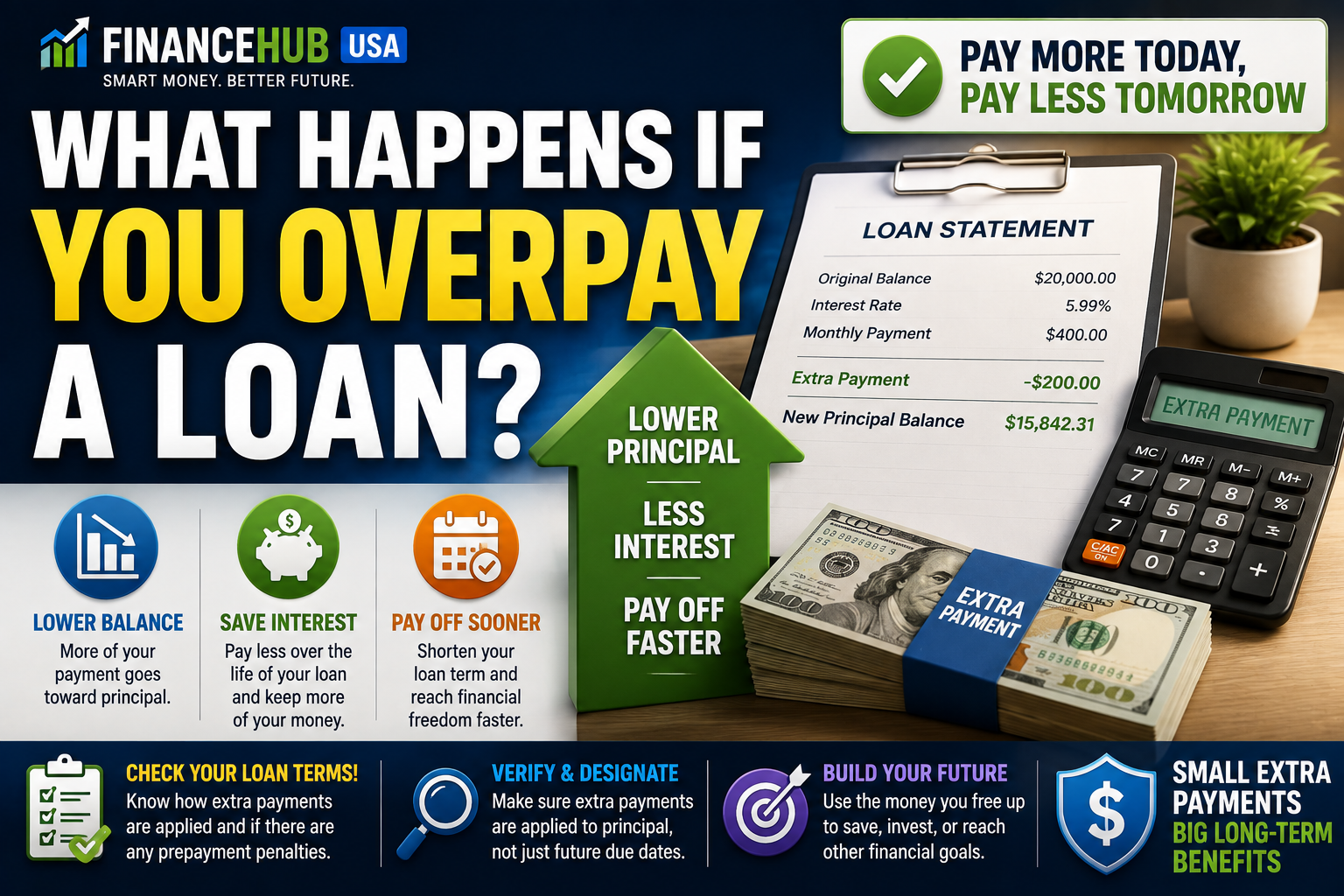

Your loan payment is $400, but this month you have an extra $200 available. Sending $600 instead of the required amount seems straightforward: more money goes toward the debt, the balance falls faster, and you may eventually pay less interest.
Quick answer: Overpaying a loan can help you reduce principal, shorten the repayment period, and potentially save money on interest. However, the result depends on how your lender applies the extra payment and on the terms of your loan. Extra money may reduce principal, cover accrued interest or fees, advance your next payment due date, or be handled differently. Always verify how additional payments are processed before assuming every extra dollar will reduce your balance immediately.
What Does It Mean to Overpay a Loan?
Overpaying a loan generally means paying more than the amount currently required under your normal repayment schedule.
If your monthly payment is $400 and you send $500, you have made an additional payment of $100.
That is different from accidentally paying more than the amount required to completely satisfy the debt. If your official payoff amount is $900 and you mistakenly send $1,000, you may create an excess payment that the lender has to reconcile according to its procedures.
| Payment Situation | Example | Possible Result |
|---|---|---|
| Regular scheduled payment | $400 due, $400 paid | Loan follows the normal repayment schedule |
| Additional monthly payment | $400 due, $500 paid | Additional $100 may reduce principal depending on how it is applied |
| Large additional payment | $400 due, $2,000 paid | Could significantly reduce principal if properly applied |
| Full early payoff | Official payoff amount paid | Loan may be completely satisfied ahead of schedule |
| Payment above payoff amount | $900 payoff, $1,000 sent | Lender may need to return or reconcile the excess |
Does Extra Money Automatically Go Toward Principal?
Not necessarily. This is one of the most important details to verify before making repeated additional payments.
A normal installment payment can include principal, interest, and sometimes fees. Principal is the amount you still owe, while interest represents the cost of borrowing the money.
When additional money is applied directly to principal, the outstanding balance falls sooner. With many loans that charge interest based on the remaining balance, reducing principal earlier can also reduce the amount of future interest you pay.
However, lenders and loan servicers can have different procedures. An additional payment may:
- Reduce principal immediately.
- Pay accrued interest or applicable fees first.
- Advance the date of your next required payment.
- Be allocated according to the terms of your loan agreement.
Before making repeated additional payments, check your loan documents, review your account portal, or contact your lender to confirm exactly how the money will be applied.
Why Reducing Principal Matters
Suppose you owe $10,000 and an additional $1,000 is properly applied to principal. Your balance may fall to approximately $9,000 before accounting for any other activity on the account.
If interest is calculated using the outstanding principal balance, reducing that balance sooner can decrease future interest charges.

Can Overpaying a Loan Save You Money on Interest?
It often can when the loan allows early principal reduction and does not impose a significant penalty for paying ahead of schedule.
The exact benefit depends on several factors:
- Your outstanding principal balance.
- The annual percentage rate, or APR.
- The remaining repayment period.
- The method used to calculate interest.
- The timing of the additional payment.
- How the lender applies the additional money.
The Consumer Financial Protection Bureau explains that paying an auto loan early can potentially reduce borrowing costs, but the result depends on the contract, the method used to calculate interest, and whether a penalty for early repayment applies.
The broader principle can also be useful when evaluating other installment loans: do not judge an additional payment strategy only by the size of the payment.
Example: Paying an Extra $200 Every Month
Imagine Olivia has an installment loan with a required payment of $400 per month. Her budget improves and she can now afford to send another $200 every month.
If the lender applies the additional $200 to principal and the loan permits repayment ahead of schedule without a relevant penalty, Olivia's balance can fall faster than it would under the original repayment schedule.
As the balance declines, less principal remains to generate future interest when the loan calculates interest based on the outstanding balance.
| Required Payment | Additional Amount | Total Sent |
|---|---|---|
| $400 | $0 | $400 |
| $400 | $50 | $450 |
| $400 | $100 | $500 |
| $400 | $200 | $600 |
This table does not claim a specific amount of interest savings. An accurate calculation would require the actual APR, current balance, remaining term, method used to calculate interest, timing of payments, and the lender's allocation rules.
Once the debt is eventually eliminated, the full $600 Olivia had been sending toward the loan becomes available for another financial goal.
She could redirect that money toward:
- Emergency savings.
- Debt with a higher interest rate.
- Retirement contributions.
- A home or another major purchase.
- Investments for future financial goals.
Additional Payments and Payments Applied Directly to Principal
An additional payment and a payment specifically directed toward principal are not always processed in exactly the same way.
The Consumer Financial Protection Bureau explains that with many auto loans, payments may generally be applied first to applicable fees, then to accrued interest, and finally to principal.
Some lenders provide borrowers with a specific option that allows additional money to be applied directly to principal. Others may require special instructions.
| Payment Type | Illustrative Amount | Potential Effect |
|---|---|---|
| Required payment | $400 | Satisfies the scheduled obligation |
| Required payment plus $100 | $500 | May accelerate principal reduction |
| Required payment plus $200 | $600 | May shorten the repayment period further |
| Payment directed toward principal | $200 additional | Intended to reduce principal when permitted by the lender |
The safest approach is to verify your lender's terminology and payment procedures instead of assuming that all additional payments are processed in the same way.
Simple Interest and Precomputed Interest
Not every loan responds to additional payments in the same way. One important reason is that lenders can use different methods to calculate interest.
| Loan Structure | How Interest Generally Works | Potential Effect of Additional Payments |
|---|---|---|
| Simple interest | Interest is based on the outstanding balance | Earlier principal reduction can reduce future interest |
| Precomputed interest | Interest is calculated in advance and incorporated into repayment | Additional payments may provide different or smaller interest savings |
The CFPB explains that simple interest auto loans calculate interest based on the outstanding balance. Reducing principal faster can therefore reduce the balance used to calculate future interest.
Loans that use precomputed interest work differently. Additional payments may not reduce principal and interest in the same way. Depending on the contract and applicable rules, paying the loan completely ahead of schedule may involve different calculations.
This is why general advice such as "just pay an extra $200 every month" can be incomplete without understanding how the loan actually works.
Can a Lender Charge a Penalty for Paying Early?
Some loans can contain penalties or contractual restrictions related to early repayment. Borrowers should not assume that paying a loan ahead of schedule is always free of additional costs.
The CFPB advises auto loan borrowers to review the contract and applicable state law when determining whether a penalty for early repayment may apply.
Mortgage rules are different. Federal regulations restrict these penalties in many residential mortgage situations, although certain loans may still permit them under limited circumstances.
Personal loan terms can also vary considerably from one lender to another.
Before making a large additional payment, check:
- Does the loan allow additional payments toward principal?
- Is there a penalty for paying the loan ahead of schedule?
- How are payments above the scheduled amount allocated?
- Will the additional amount reduce principal immediately?
- Will the lender simply advance the next payment due date?
- Can you specifically request that additional money reduce principal?
- How does the loan calculate interest?

Why You Should Request a Payoff Quote
If you intend to eliminate the loan completely, do not assume that the balance displayed online is the exact amount required to close the account.
The payoff amount can differ from the current principal balance because it may include interest through the payoff date, unpaid fees, or other amounts permitted under the contract.
| Amount | What It Generally Represents |
|---|---|
| Current balance | Outstanding balance shown at a particular point in time |
| Monthly payment | Amount scheduled for the current billing period |
| Additional payment | Voluntary amount paid above the scheduled payment |
| Payoff amount | Amount required to completely satisfy the loan as of a specified date |
For mortgages secured by a dwelling, the CFPB explains that servicers must provide an accurate payoff statement after a proper borrower request, subject to applicable federal rules.
What If You Accidentally Pay More Than the Payoff Amount?
Accidentally paying more than the official payoff amount is different from intentionally making an additional monthly payment.
Suppose your lender provides a payoff amount of $2,480 and you accidentally send $2,600. That could create a $120 excess payment.
If this happens:
- Check your account after the payment has been processed.
- Confirm that the loan is marked as paid in full.
- Ask whether a credit balance remains on the account.
- Ask how and when any excess amount will be returned.
Do not rely only on the principal balance when attempting to completely pay off a loan.
When Paying Extra May Not Be Your Best Move
Becoming debt free faster can be attractive, but sending every spare dollar toward one loan is not automatically the strongest financial decision.
You Have Debt With a Higher Interest Rate
Suppose your personal loan charges 7%, but your credit card carries a 24% APR. Directing additional cash toward the more expensive credit card debt may potentially produce greater interest savings, depending on the balances and other terms.
You Have Little or No Emergency Savings
Paying off a loan with a relatively low interest rate using your last $5,000 of cash could leave you without money for a car repair, medical bill, or temporary loss of income.
If an emergency then forces you to borrow at a much higher interest rate, paying the original loan early may not have improved your overall financial position.
The Loan Has Unfavorable Terms for Early Repayment
Review the contract before making a major lump sum payment. A penalty or unfavorable interest structure can change the financial benefit of paying ahead of schedule.
You Are Giving Up Another Valuable Financial Benefit
Additional loan payments should also be compared with other uses of your money. For example, someone receiving an employer retirement match may want to understand the value of that benefit before directing every available dollar toward debt with a relatively low interest rate.

FinanceHub USA Analysis: Make Every Extra Dollar Work Harder
The most important question is not simply whether your lender allows you to pay more than the required amount.
A better question is: Is this the best place for my next extra dollar, and will the lender apply it the way I expect?
Paying an additional $200 toward a loan with a high interest rate can have a very different financial impact from sending the same $200 toward a loan with a relatively low rate while carrying more expensive credit card debt.
Liquidity also matters. Sending your final emergency savings toward inexpensive debt can make one account balance look better while leaving your household more vulnerable to the next unexpected expense.
Before increasing your loan payments, consider:
- The APR on the loan.
- Your outstanding balance.
- The method used to calculate interest.
- Any penalties or restrictions related to early repayment.
- The remaining repayment period.
- Other debts with higher interest rates.
- Your emergency savings.
- Your other financial priorities.
Common Mistakes When Overpaying a Loan
- Assuming additional money automatically reduces principal. Verify exactly how your lender applies payments above the required amount.
- Ignoring the method used to calculate interest. Different loan structures can respond differently to additional payments.
- Ignoring penalties for early repayment. Review your agreement before making a large additional payment.
- Using the current balance as the payoff quote. The actual amount required to completely close the loan may be different.
- Draining your emergency savings. Faster debt repayment should be balanced with maintaining enough accessible cash for unexpected expenses.
- Ignoring debt with a higher interest rate. Additional payments toward inexpensive debt may not be the strongest use of your available cash.
- Stopping payments because your due date moved. Continue following your lender's instructions until the debt is officially satisfied.
- Failing to review your statements. Confirm that every additional payment was applied the way you expected.
Final Thoughts
So, what happens if you overpay a loan? When additional money is properly applied to principal on a loan that benefits from early principal reduction, your balance may fall faster, your repayment period may become shorter, and the total amount of interest you pay may decline.
However, the result depends on your actual loan contract, the method used to calculate interest, the lender's procedures, and any terms related to paying ahead of schedule.
Before sending a large additional payment, confirm exactly how the lender will allocate it. If you intend to eliminate the debt completely, request an official payoff quote instead of relying only on the balance displayed online.
Most importantly, compare the additional payment with your broader financial priorities. Paying a loan faster can be valuable, but the strongest decision is the one that improves your overall financial position rather than simply making one account balance disappear sooner.
Continue exploring FinanceHub USA for practical guides covering loans, debt, credit, saving, banking, investing, and everyday financial decisions.
Related reading: Does Paying a Loan Early Save Interest?
Related reading: Should You Save Money or Pay Off Debt First?
Sources and Further Reading
Frequently asked questions
What happens if you pay more than your loan payment?
The additional amount may reduce your principal and help repay the loan faster, but how it is applied depends on the lender, loan agreement, outstanding fees and interest, and payment instructions.
Does overpaying a loan reduce interest?
It can. On many simple-interest loans, reducing principal earlier lowers the outstanding balance used to calculate future interest. Other loan structures, including precomputed-interest loans, can work differently.
Does an extra loan payment automatically go toward principal?
Not always. Payments may first be applied to applicable fees and accrued interest before principal. Check your loan documents and lender procedures to understand how additional payments are allocated.
What is a principal-only payment?
A principal-only payment is an additional payment specifically designated to reduce the outstanding principal when the lender permits that option. Procedures vary by lender.
Can you overpay a loan every month?
Many loans permit additional payments, but borrowers should review their contracts for payment-allocation rules and any prepayment restrictions or penalties.
What happens if I accidentally pay more than the payoff amount?
Contact the lender after the payment posts and ask how the excess will be reconciled. Procedures for returning or applying an excess payment can vary.
Is a payoff amount the same as my current balance?
Not necessarily. A payoff amount can include interest through the intended payoff date, unpaid fees, and potentially other contractual amounts, so it can differ from the balance displayed on your account.
Can a lender charge a penalty for paying a loan early?
Some loan agreements may contain prepayment penalties. Whether one can apply depends on the loan type, contract, and applicable law.
Should I overpay my loan or save the extra money?
It depends on your interest rate, emergency savings, other debts and financial goals. Maintaining adequate liquidity and addressing substantially higher-interest debt may sometimes deserve priority.
Is it better to make extra loan payments early in the loan?
For many simple-interest or amortizing loans, reducing principal earlier can provide more time for interest savings to accumulate. The actual benefit depends on the specific loan terms and interest calculation method.`