What Happens If You Pay More Than Your Loan Minimum?
Paying more than your loan minimum can reduce debt faster and may save interest. See how extra payments work and what to check before paying more.
What Happens If You Pay More Than the Minimum on a Loan?

Your loan statement says $405 is due this month, but your budget leaves you with an extra $100. Should you send $505 instead?
For many borrowers, paying more than the minimum required loan payment can reduce the balance faster, shorten the repayment period, and potentially lower the total interest paid.
But there is an important detail. Sending additional money does not automatically guarantee that every extra dollar will reduce your principal exactly when or how you expect.
The result depends on your loan agreement, the type of interest calculation used, and how your lender or loan servicer processes additional payments.
Understanding those mechanics can help make sure an extra $50, $100, or $500 actually moves you closer to becoming debt free.
What Usually Happens When You Pay Extra on a Loan?
With many installment loans, each required monthly payment contains two basic components:
- Principal: The amount that reduces what you owe.
- Interest: The cost charged for borrowing the money.
When additional money is properly applied toward principal, your outstanding balance falls faster.
For loans where future interest depends on the remaining balance, lowering principal sooner can also reduce the amount of interest that accumulates later.
Your scheduled payment keeps the loan on its original repayment timeline. Additional payments that reduce principal can move the payoff date forward.
Example: Paying an Extra $100 Every Month

Consider a simplified example involving a $20,000 personal loan with:
- 8% annual percentage rate
- Five year repayment period
- Standard monthly amortization
- No additional fees
The scheduled monthly payment would be approximately:
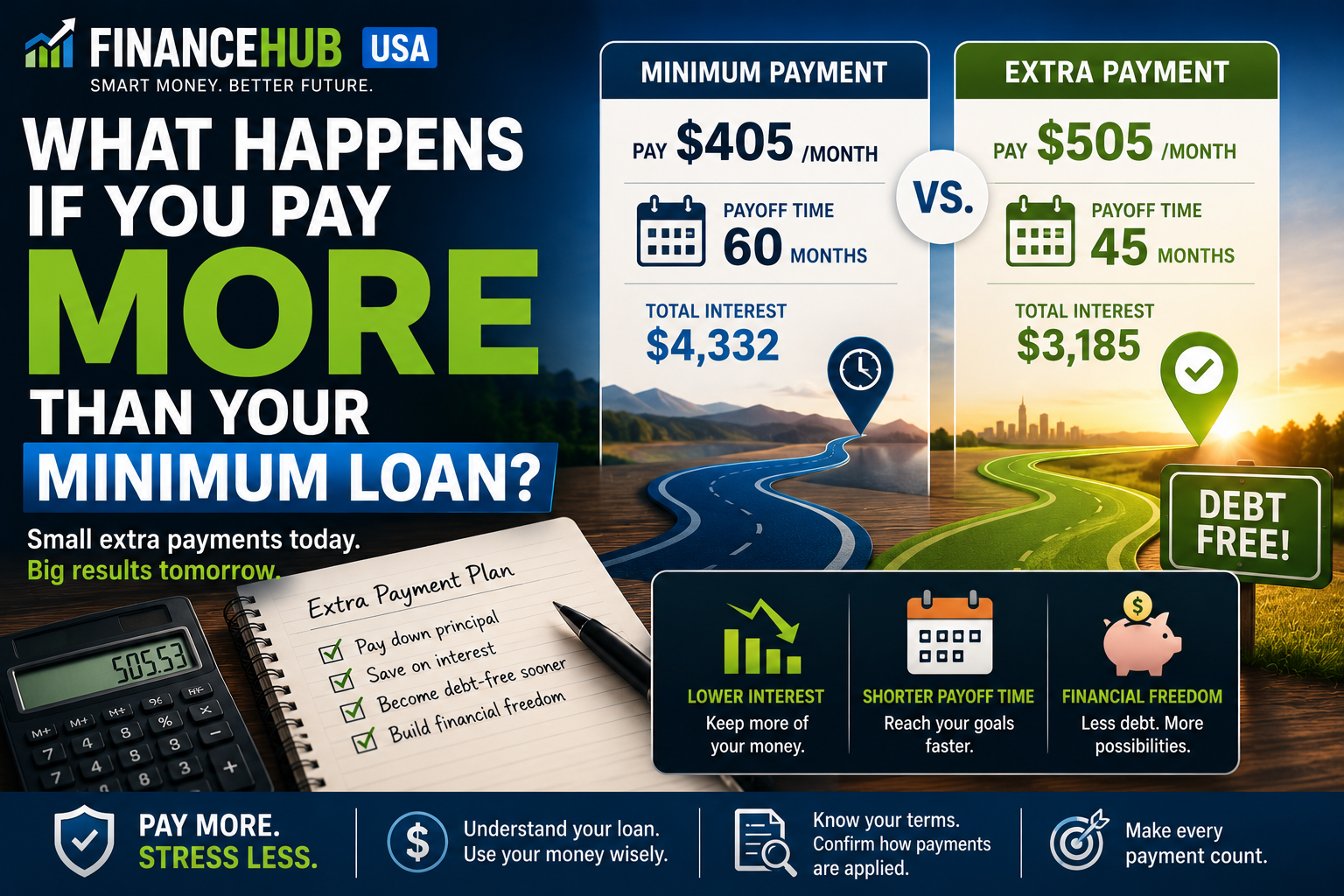
$405.53
If the borrower follows the original 60 month schedule, total payments would be approximately:
$24,332
That means approximately:
$4,332
would represent interest.
Now Add $100 Every Month
Instead of paying approximately $405.53, the borrower pays:
$505.53 per month
If the additional $100 consistently reduces the loan balance as intended, the payoff period could fall to roughly 45 months under this simplified example.
Total interest could decline to approximately $3,185.
| Illustrative Scenario | Monthly Payment | Approximate Payoff | Approximate Interest |
|---|---|---|---|
| Original schedule | $405.53 | 60 months | $4,332 |
| $100 extra each month | $505.53 | About 45 months | About $3,185 |
| Illustrative difference | +$100 monthly | About 15 months sooner | About $1,147 less |
These figures are illustrations rather than guaranteed loan results.
Actual savings depend on:
- Payment timing
- Interest calculation method
- Fees
- Loan structure
- How the lender applies additional money
Still, the example demonstrates an important principle: an extra payment can potentially provide two benefits at the same time.
- The balance declines faster.
- Less future interest may accumulate.
Make Sure Extra Payments Actually Reduce the Balance
This is one of the most important steps.
Do not assume that sending more than the required amount automatically produces the exact result you intended.
After making an additional payment, review your account or statement.
Check:
- Outstanding principal
- Interest charged
- Total amount credited
- Next payment due date
- How the additional amount was categorized
If the balance did not decline as expected, contact the lender and ask how the payment was processed.
What Does an Extra Principal Payment Mean?
An extra principal payment generally refers to money sent beyond the required payment that is directed toward reducing the outstanding loan balance.
Suppose your normal monthly payment is:
$450
You decide to send:
$650
The additional amount is:
$650 − $450 = $200
If that additional $200 reduces principal as intended, the balance on which future interest may be calculated becomes smaller.
Before making this a regular strategy, confirm:
- How your lender applies extra payments
- Whether special instructions are required
- Whether automatic payments can include additional principal
- Whether the next payment date changes
- Whether any early repayment fees apply
What Does Paid Ahead Mean?
Some borrowers become confused after making an extra payment because their account suddenly says the next payment is not due for another month or even several months.
This can happen when a loan servicer places the account into what is sometimes called paid ahead status.
Example
Suppose your required payment is $400.
You send:
$800
Instead of treating all of the extra money as an immediate reduction of principal in the way you expected, the servicing system may treat part of the payment as satisfying a future required installment.
Your account might then show that no payment is due the following month.
That does not necessarily mean you should stop paying if your goal is faster debt repayment.
Why Paid Ahead Status Can Cause Confusion
Imagine your original payment schedule requires $400 every month.
You make an $800 payment in January.
Your online account now says:
Next payment due: March
If your goal is simply staying current, that may be useful.
But if your goal is eliminating the debt as quickly as possible, you need to understand whether the extra payment actually reduced principal immediately or merely advanced your payment schedule.
The Consumer Financial Protection Bureau has specifically discussed this issue in connection with some student loan servicing practices.
Do Not Stop Making Payments Without Understanding Your Account
If your lender advances the due date after an extra payment, do not automatically assume skipping the next scheduled month is the best strategy.
For accelerated payoff, continue following the payment approach you intended unless the lender or loan agreement specifies otherwise.
Always confirm how future interest will be calculated.
Simple Interest Loans
Many personal loans and auto loans use a simple interest structure.
With these loans, interest generally depends on the outstanding principal balance and the amount of time the money remains borrowed.
A simplified illustration is:
Interest = Principal × Rate × Time
Example
If the outstanding balance is $10,000 and a simplified annual rate is 8%:
$10,000 × 8% = $800
If the balance is reduced to $6,000:
$6,000 × 8% = $480
The smaller balance creates less interest exposure.
Real loans may calculate interest daily or using other contractual methods, so this example is intended only to demonstrate the principle.
Precomputed Interest Loans Can Work Differently
Not every installment loan calculates interest from the declining balance in the same way.
Some loans may use a precomputed interest structure.
With precomputed interest, interest may be calculated in advance and incorporated into the repayment schedule.
Early repayment can still affect the total cost, but the savings may be calculated differently from a simple interest loan.
Before assuming that an additional payment will save a specific amount, review:
- The loan agreement
- Truth in Lending disclosures
- Interest calculation method
- Early repayment provisions
Can a Loan Have a Prepayment Penalty?
Some loan agreements can impose fees or other conditions when debt is repaid ahead of schedule.
This is called a prepayment penalty.
Not every loan has one.
Before making a large payment, check your contract.
Example
Suppose paying a loan early could save:
$1,500 in future interest
But the agreement requires a:
$400 prepayment fee
Simplified net savings:
$1,500 − $400 = $1,100
The early payoff may still be beneficial, but the penalty changes the economics.
How Much Can Small Extra Payments Add Up?
You do not necessarily need hundreds of extra dollars every month to accelerate repayment.
| Extra Monthly Payment | Additional Amount Paid Each Year |
|---|---|
| $25 | $300 |
| $50 | $600 |
| $100 | $1,200 |
| $200 | $2,400 |
| $500 | $6,000 |
If those amounts consistently reduce principal, they can materially shorten a loan over time.
$100 Monthly vs. a $1,200 Lump Sum

Suppose you expect to have $1,200 of extra cash available during the next year.
You could:
- Pay an additional $100 each month
- Save the money and send $1,200 near the end of the year
On a loan where interest depends on the remaining principal balance, paying the money earlier will generally reduce principal sooner.
That gives future interest less principal on which to accumulate.
| Strategy | Potential Advantage | Potential Drawback |
|---|---|---|
| $100 extra monthly | Balance may decline throughout the year | Requires consistent monthly cash flow |
| $1,200 lump sum later | Useful for bonuses or irregular income | Balance remains higher until payment is made |
| Combination | Provides flexibility | Requires more tracking |
The exact financial difference depends on the loan's interest calculation and payment timing.
Should You Use a Tax Refund or Bonus to Pay Extra?
One time income can be useful for debt reduction because it does not require permanently increasing your monthly payment.
Examples include:
- Tax refunds
- Work bonuses
- Commissions
- Cash gifts
- Other unexpected income
You also do not necessarily need to use the entire amount.
Example: $3,000 Bonus
| Use | Illustrative Allocation |
|---|---|
| Extra loan payment | $1,500 |
| Emergency savings | $1,000 |
| Upcoming expenses | $500 |
This can reduce debt while still preserving liquidity.
FinanceHub USA Analysis: Paying More Is Not Always Priority Number One
Paying off debt faster can feel like an obvious financial win.
But every extra dollar can only be used once.
Before sending additional money toward a loan, compare what else that money could accomplish.
Example: Personal Loan vs. Credit Card
Suppose you have:
| Debt | Balance | APR |
|---|---|---|
| Personal loan | $8,000 | 7% |
| Credit card | $5,000 | 24% |
If you have an additional $300, sending it toward the 24% credit card may reduce a substantially more expensive borrowing cost.
The personal loan can still be paid according to schedule while the higher cost debt receives the additional cash.
Emergency Savings Matter Too
Consider two borrowers with the same loan.
| Borrower A | Borrower B | |
|---|---|---|
| Extra cash available | $500 | $500 |
| Emergency savings | $15,000 | $300 |
The same $500 extra payment creates very different financial risks for these borrowers.
Borrower B could become debt free slightly faster but then have no cash available for a car repair, medical expense, or other emergency.
If that emergency ends up on a high interest credit card, aggressively paying the lower rate loan may have weakened the household's overall financial position.
When Paying More Than the Minimum May Make Sense
Additional loan payments may deserve stronger consideration when:
- The loan carries a relatively high interest rate
- You already have adequate emergency savings
- You do not carry substantially more expensive debt
- No significant prepayment penalty applies
- The additional payment reduces principal as intended
- The loan has enough time remaining for meaningful interest to accumulate
- Eliminating the payment would materially improve monthly cash flow
When Extra Payments May Be a Lower Priority
Paying more than required may deserve less priority when:
- You have almost no emergency savings
- You carry much higher interest credit card debt
- The loan has a very low interest rate
- A significant prepayment fee applies
- You need the money for an unavoidable near term expense
- You would give up valuable employer retirement benefits
Employer Retirement Match Can Matter
Suppose your employer matches part of your 401(k) contribution.
Stopping retirement contributions completely so you can accelerate a relatively low rate loan could mean giving up part of an employer benefit.
The appropriate decision depends on your:
- Loan rate
- Employer matching formula
- Emergency savings
- Other debts
- Retirement goals
What About Your Credit Score?
Paying more than the minimum does not guarantee your credit score will immediately increase.
Credit scores evaluate multiple pieces of information.
These can include:
- Payment history
- Amounts owed
- Credit utilization
- Age of accounts
- Account types
- Recent credit activity
The most important rule while accelerating repayment is simple:
Do not miss required payments on your other obligations.
What Happens When the Loan Is Finally Paid Off?
Once the remaining balance has been fully satisfied, the account will generally be reported as paid or closed according to the lender's reporting process.
Your credit score may:
- Increase
- Remain similar
- Temporarily decline
The result depends on your overall credit profile and the scoring model.
You generally should not continue paying unnecessary interest solely because you are worried that closing an installment loan could affect your score.
Related reading: Does Paying Off a Loan Improve Your Credit Score?
Extra Payments on Auto Loans
Many auto loans can benefit from faster principal reduction, particularly when they use simple interest.
Before increasing payments, verify:
- How interest is calculated
- Whether extra payments reduce principal
- Whether the loan can enter paid ahead status
- Whether early repayment fees exist
Extra Payments on Personal Loans
Personal loans vary by lender.
Some use simple interest and allow additional payments without penalty.
Others can have different contract structures.
Review the loan agreement rather than assuming every personal loan operates identically.
Extra Payments on Student Loans
Student loan servicing can require additional attention because servicers may apply payments according to specific rules.
For some student loans, paying more than required may advance the next due date.
If you want to accelerate repayment, verify:
- How the payment was allocated
- Which loan received the extra amount
- Whether accrued interest was satisfied first
- Whether the due date was advanced
Extra Payments on Mortgages
Additional mortgage payments can also reduce principal and potentially shorten the loan term on many mortgage structures.
However, mortgages can involve:
- Principal
- Interest
- Property taxes
- Homeowners insurance
- Escrow
- Mortgage insurance
Make sure additional payments are applied according to your intended purpose rather than assuming the entire amount reduces principal.
How Paying Off a Loan Improves Monthly Cash Flow
Interest savings are not the only potential benefit.
Eliminating the required payment also creates more flexibility in your monthly budget.
Example
Suppose your loan payment is:
$405 per month
After the loan is eliminated, annual cash flow previously committed to that payment equals approximately:
$405 × 12 = $4,860
That does not mean paying off the loan created a $4,860 investment return.
But it does mean your monthly budget now has approximately $405 of additional flexibility.
That money could potentially be redirected toward:
- Emergency savings
- Retirement
- Higher interest debt
- Investments
- Future purchases
Common Mistakes When Making Extra Loan Payments
- Assuming every extra dollar automatically reduces principal. Verify how your lender processes additional payments.
- Ignoring paid ahead status. An advanced due date does not necessarily mean the loan is being reduced the way you intended.
- Stopping payments because the account shows nothing due. This can slow an accelerated payoff strategy.
- Draining emergency savings. A faster payoff is less useful if the next emergency forces you to borrow again.
- Ignoring higher interest debt. Compare borrowing costs before deciding where extra money should go.
- Ignoring prepayment terms. Review the contract before making large additional payments.
- Failing to check the next statement. Verify that principal declined as expected.
- Assuming every loan calculates interest the same way. Simple interest and precomputed interest loans can behave differently.
FinanceHub USA Framework: Five Questions Before Paying Extra
| Question | Why It Matters |
|---|---|
| How does my loan calculate interest? | Determines how additional payments can affect future interest |
| How will the extra payment be applied? | Confirms whether principal falls as expected |
| Do I have more expensive debt? | Higher rate debt may deserve the extra money first |
| Do I have adequate emergency savings? | Protects against borrowing again after an unexpected expense |
| Does the loan have an early repayment fee? | Can reduce the financial benefit |
A Practical Extra Payment Checklist
- Review your current loan balance.
- Check the interest rate.
- Read the payment application rules.
- Review prepayment terms.
- Compare higher interest debts.
- Protect appropriate emergency savings.
- Make the additional payment.
- Review your next statement.
- Confirm the principal declined as expected.
- Continue required payments according to your payoff strategy.
Final Thoughts
What happens if you pay more than the minimum on a loan?
When additional money properly reduces the principal on a loan whose interest depends on the outstanding balance, you can potentially:
- Pay off the loan sooner
- Reduce future interest
- Lower the total cost of borrowing
- Free up monthly cash flow earlier
But an extra payment should not be made blindly.
First determine:
- How your loan calculates interest
- How additional payments are applied
- Whether paid ahead rules could affect your strategy
- Whether early repayment fees exist
- Whether more expensive debt deserves priority
- Whether you have adequate emergency savings
The smartest additional payment is not necessarily the largest amount you can send today.
It is an amount that consistently reduces debt while keeping the rest of your financial foundation stable.
Check your loan terms, monitor your statements, and make sure every additional dollar is accomplishing the job you intended.
Continue exploring FinanceHub USA for practical guides covering loans, debt payoff, credit, banking, investing, insurance, taxes, and personal finance.
Related reading: Does Paying a Loan Early Save Interest?
Related reading: Should You Save Money or Pay Off Debt First?
Sources and Further Reading
Frequently asked questions
What happens if I pay more than the minimum on my loan?
If the extra amount is applied toward principal, it can reduce your outstanding balance faster and may reduce future interest. The exact result depends on your loan terms and how the lender processes additional payments.
Does paying extra on a loan reduce interest?
It can. On many simple-interest loans, reducing principal sooner lowers the balance used to calculate future interest. Other loan structures can work differently, so review your contract.
Is it better to pay extra every month or make one large payment?
On loans where interest depends on the outstanding balance, reducing principal earlier can generally provide more benefit than waiting to make the same extra payment later. However, actual savings depend on the loan's terms and interest calculation.
Should extra loan payments go toward principal?
If your goal is faster payoff and lower interest, you generally want the additional amount to reduce the loan balance as intended. Check your lender's instructions and verify the transaction on your statement.
Can paying extra move my next payment due date?
It can with some loan servicers. For example, the CFPB notes that some student loan servicers may place borrowers into paid-ahead status after receiving additional money. Check how your particular lender handles extra payments.
Does paying more than the minimum improve my credit score?
It does not guarantee a particular credit-score increase. Credit scoring models consider multiple factors, including payment history, outstanding debt, account history and other information in your credit reports.
Should I pay extra on my loan or save the money?
Compare the loan's interest rate with your other debts and financial priorities. Maintaining adequate emergency savings may be more important than aggressively paying down a low-rate loan if doing so would leave you without accessible cash.
Can I be charged a penalty for paying extra?
Some loan agreements can contain prepayment penalties or related restrictions. Whether one applies depends on the type of loan, contract and applicable law, so review your agreement before making a large early payment.