Is It Bad to Keep Too Much Money in Checking?
Keeping too much money in checking can cost you interest and growth. Learn how much cash you may need and where excess money could work harder.
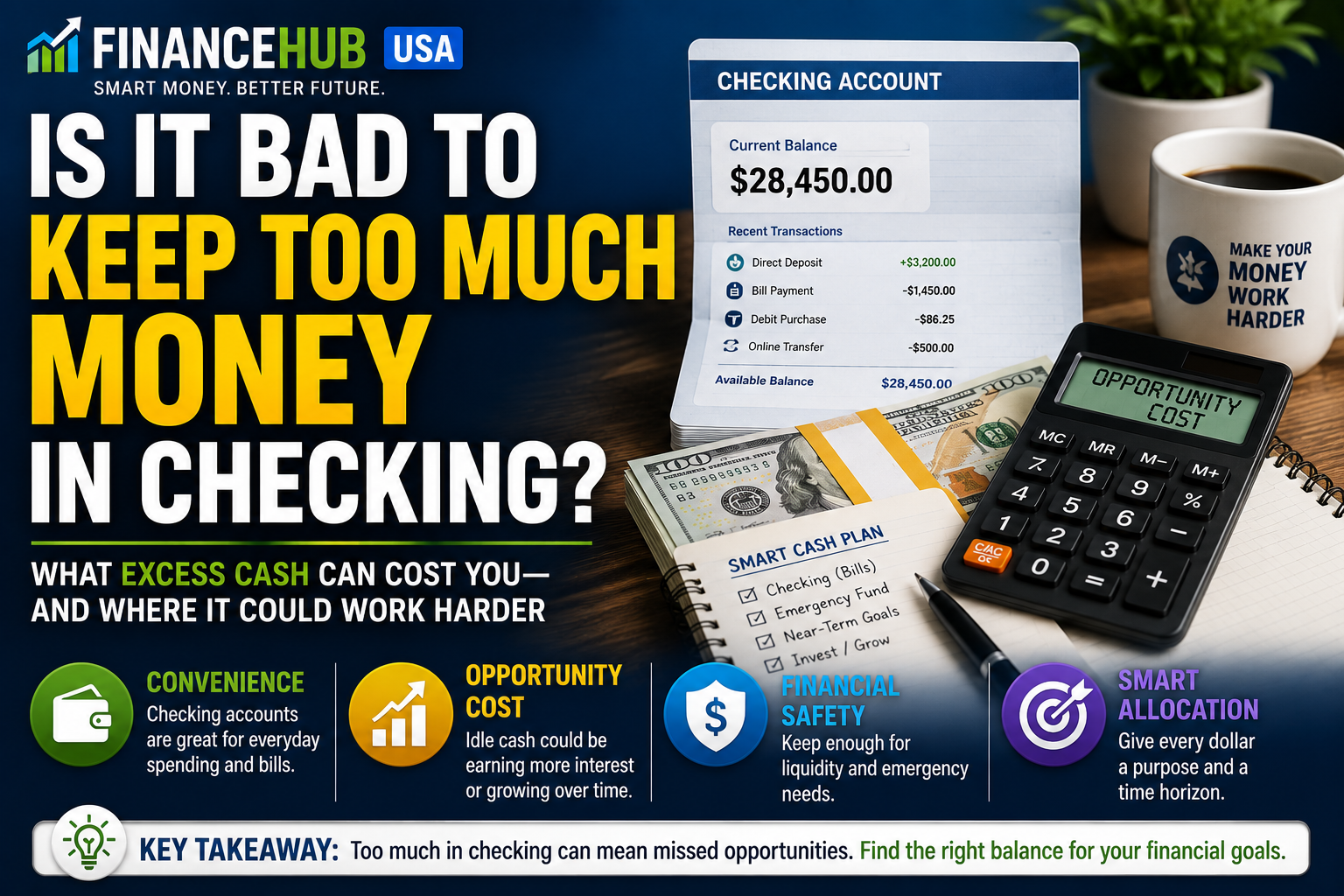

Seeing a large checking-account balance can feel reassuring. Your rent or mortgage is covered, upcoming bills are easy to pay, and unexpected expenses seem less threatening. But once the balance grows far beyond what you realistically need for regular spending and near-term obligations, convenience can come with an opportunity cost.
So, is it bad to keep too much money in checking? Not necessarily—but it can be financially inefficient. Checking accounts are designed primarily for transactions and liquidity, not necessarily for maximizing returns. Money that you will not need soon might potentially earn more in an interest-bearing savings product or serve longer-term goals elsewhere. At the same time, moving too much out of checking can create its own problems, including overdrafts and difficulty covering bills.
Quick answer: Keeping a large checking balance is not automatically bad. The potential problem is keeping substantially more cash than you need for bills, near-term expenses, and a reasonable buffer in an account earning little or no interest. The right checking balance depends on your spending, income stability, upcoming expenses, and need for liquidity.
How Much Money Should You Keep in Checking?
There is no universal dollar amount that everyone should maintain in a checking account. A household spending $2,500 per month has very different liquidity needs from one spending $9,000.
A practical starting point is to keep enough to cover regular bills, normal spending, upcoming withdrawals, and a reasonable buffer against timing mistakes or unexpected expenses. Some people may prefer approximately one month of routine expenses plus a cushion, while others may want more because their income fluctuates or their bills are less predictable.
For example, consider a household with approximately $4,000 in recurring monthly expenses:
| Checking Need | Illustrative Amount |
|---|---|
| Monthly bills and spending | $4,000 |
| Checking buffer | $1,000 |
| Illustrative checking target | $5,000 |
If that household has $30,000 sitting in checking and no major purchase is approaching, it may be worth asking whether the remaining $25,000 needs to remain in the same transactional account.
That does not mean $5,000 is the correct amount for everyone. Someone with irregular self-employment income, large automatic payments, or upcoming expenses may reasonably maintain a substantially larger balance.
The Biggest Problem: Opportunity Cost
Holding excess money in checking is not necessarily dangerous. The more common concern is what the unused cash could have been doing elsewhere.
If a checking account pays little or no interest while an appropriate savings product pays interest, maintaining a large unnecessary checking balance can mean giving up potential interest income.
Consider a purely hypothetical example involving $20,000 that you do not expect to need for regular transactions:
| Account | Illustrative APY | Approximate Value After One Year* |
|---|---|---|
| Non-interest checking | 0.00% | $20,000 |
| Interest-bearing savings | 3.00% | About $20,600 |
| Interest-bearing savings | 4.00% | About $20,800 |
*Simplified illustration assuming the stated annual yield for a full year and ignoring taxes, rate changes, withdrawals, fees, and other factors. It is not a representation of current market rates.
The difference may appear modest over one year, but opportunity costs can accumulate when large balances remain idle for long periods.

Checking Accounts Still Serve an Important Purpose
Moving every unnecessary dollar out of checking would be an overcorrection. Liquidity has value.
Checking accounts make it convenient to handle rent or mortgage payments, utilities, credit-card payments, subscriptions, debit-card purchases, transfers, and other routine transactions. Maintaining an appropriate buffer can also reduce the risk that an automatic withdrawal arrives before a paycheck or transfer.
According to the Federal Reserve's Economic Well-Being of U.S. Households in 2025 report, released in May 2026, 63% of adults said they could cover a hypothetical $400 emergency expense using cash or its equivalent. The report also found that 59% of adults experienced at least one type of major unexpected expense during the previous 12 months.
Those findings reinforce an important distinction: optimizing cash does not mean eliminating cash. The goal is to maintain sufficient liquidity while avoiding unnecessarily large balances in accounts that may provide little return.
Should Your Emergency Fund Stay in Checking?
Your emergency fund needs to be accessible, but accessibility does not necessarily require keeping the entire amount in your everyday checking account.
Emergency savings can help households manage income disruptions and unexpected expenses. Depending on the account, keeping emergency reserves separate from everyday spending money may also make it easier to avoid using those funds for routine purchases.
One possible structure is to separate everyday spending from emergency reserves:
| Money | Possible Purpose |
|---|---|
| Checking balance | Bills, spending, automatic payments and short-term buffer |
| Emergency savings | Unexpected repairs, temporary income loss and other emergencies |
| Near-term savings | Known purchases or expenses expected relatively soon |
| Long-term money | Retirement, investing or other longer-term objectives depending on risk tolerance |
Separating emergency reserves can also create a useful behavioral barrier. When every dollar sits in checking beside your debit-card spending money, it can be harder to distinguish money available for discretionary purchases from cash reserved for genuine emergencies.

What About FDIC Insurance?
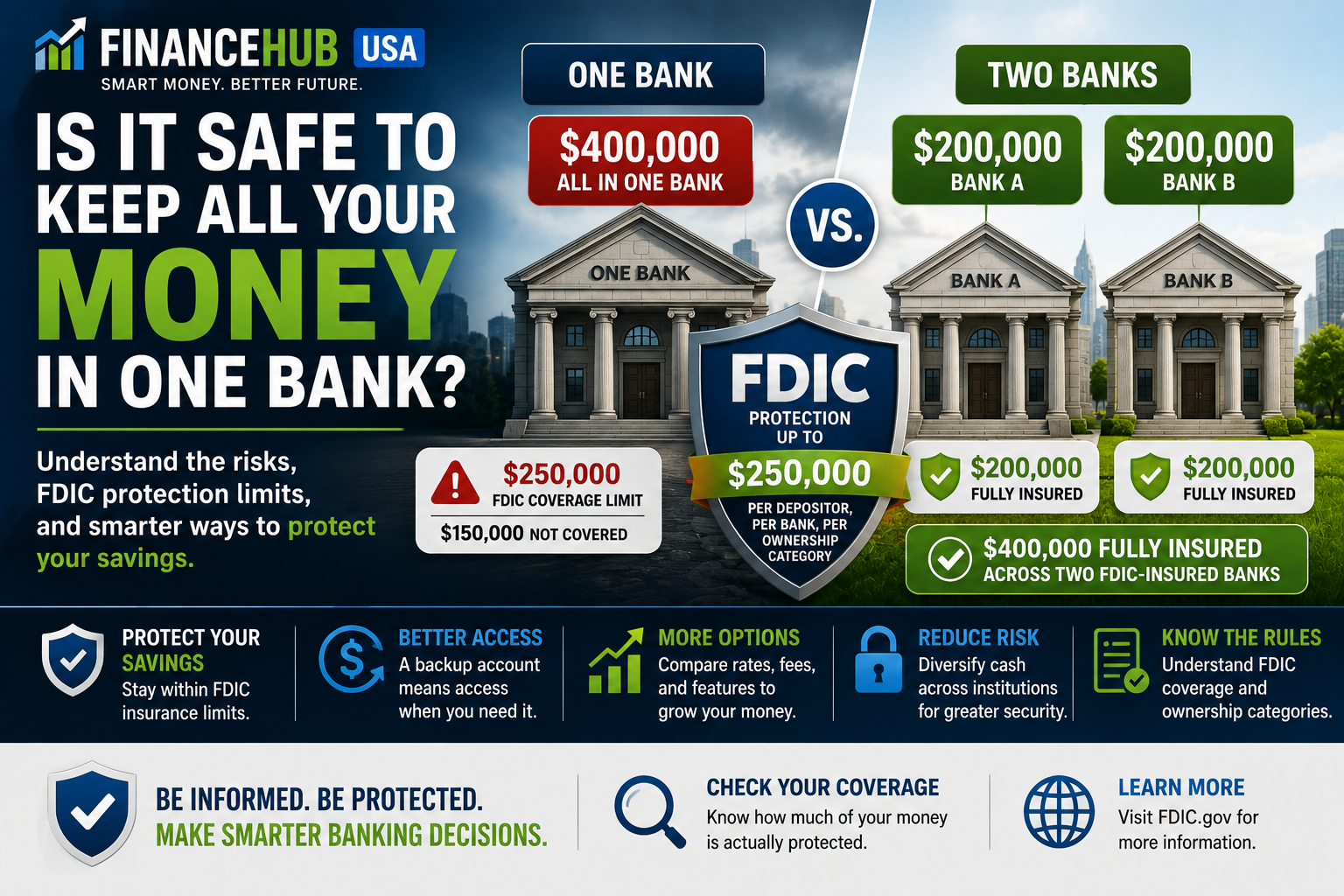
For very large balances, deposit-insurance limits become another consideration. The FDIC standard insurance amount is $250,000 per depositor, per insured bank, for each account ownership category, assuming the applicable requirements are satisfied.
Importantly, opening several single-owner deposit accounts at the same insured bank does not automatically multiply your coverage. The FDIC generally combines deposits held by the same person in the same ownership category at the same insured institution when determining coverage.
For example:
| Single-Owner Deposits at Same Insured Bank | Balance |
|---|---|
| Checking account | $100,000 |
| Savings account | $100,000 |
| CD | $100,000 |
| Total | $300,000 |
If all three accounts belong to one person and qualify in the same single-account ownership category, simply splitting the $300,000 among checking, savings, and a CD at that bank does not create $750,000 of coverage. The balances are generally aggregated within that ownership category.
Different ownership categories can potentially provide separate coverage when FDIC requirements are met. Consumers with deposits approaching or exceeding insurance limits should verify their exact structure rather than assuming all balances are automatically insured.
For more information about protecting substantial bank balances, read our FinanceHub USA guide: Is It Safe to Keep All Your Money in One Bank?.
Example: What Could You Do With $30,000 in Checking?
Imagine Daniel has $30,000 in checking. His normal monthly expenses are about $4,000, he has stable employment, and he has no major purchase scheduled during the next several months.
Instead of asking whether $30,000 is objectively “too much,” Daniel could divide the money according to purpose:
| Purpose | Illustrative Allocation |
|---|---|
| Checking for bills + buffer | $5,000 |
| Emergency savings | $15,000 |
| Other financial goals | $10,000 |
| Total | $30,000 |
The final $10,000 does not automatically belong in the stock market. Daniel might need it for a down payment, taxes, a vehicle, high-interest debt, retirement contributions, or another objective. The appropriate destination depends on his timeline and willingness to accept risk.
FinanceHub USA Analysis: Give Every Dollar a Time Horizon
Instead of asking only whether your checking balance is too large, classify your cash according to when you expect to need it.
Money needed this month should generally prioritize accessibility. Emergency reserves also need liquidity and stability. Money reserved for a purchase next year should be treated differently from retirement money that may remain untouched for decades.
This approach can help prevent two opposite mistakes: leaving long-term money permanently idle because cash feels safe, and investing short-term money so aggressively that a market decline could interfere with an upcoming expense.
A simple framework is:
- Spend soon: prioritize liquidity.
- Emergency reserve: prioritize accessibility and preservation.
- Near-term goal: avoid taking risk you cannot afford on the required timeline.
- Long-term goal: evaluate investments consistent with your objectives and risk tolerance.
The optimal checking balance is therefore not a magic number. It is the amount that allows your financial system to operate reliably without leaving substantially more cash idle than your circumstances require.
Checking Account vs. High-Yield Savings Account
Checking and savings accounts can both hold cash, but they generally serve different purposes. A checking account is primarily built for transactions: receiving income, paying bills, making debit-card purchases, and handling recurring withdrawals. A savings account is generally better suited to money that needs to remain accessible but does not need to move every day.
For that reason, someone with substantially more cash than necessary for monthly expenses may want to compare the interest rate or APY on the checking account with alternatives available to them. Some checking accounts do pay competitive interest, so moving money solely because an account is labeled “checking” is not automatically beneficial.
| Feature | Checking Account | High-Yield Savings Account |
|---|---|---|
| Primary purpose | Everyday transactions | Holding savings while earning interest |
| Bill payments | Typically convenient | Not usually the primary purpose |
| Debit-card access | Common | Varies by institution |
| Potential interest | Varies widely | Can be higher, depending on institution and market conditions |
| Best use | Near-term spending and bills | Emergency reserves and other appropriate cash savings |
Rates, fees, transfer times, minimum balances, withdrawal features, and deposit insurance should all be compared before moving money. An attractive advertised APY alone does not determine whether an account is appropriate.
When Keeping a Large Checking Balance Can Make Sense
A large checking balance is not automatically evidence of poor money management. There are situations where additional liquidity has a clear purpose.
For example, imagine you normally keep $5,000 in checking but are preparing to make a $20,000 home-renovation payment next week. Temporarily maintaining $25,000 or more in checking may be completely reasonable.
Other situations can include:
- A large mortgage, rent, tuition, tax, or insurance payment is approaching.
- Your income is irregular or seasonal.
- You operate a business with substantial near-term expenses.
- You recently sold an asset and have not yet allocated the proceeds.
- You are preparing for a major purchase.
- Your household has unusually volatile monthly expenses.
- You intentionally maintain a larger buffer to prevent overdrafts or payment failures.
The difference is whether the cash has a defined near-term purpose. Keeping $40,000 in checking for a $35,000 payment next month is fundamentally different from allowing $40,000 to remain there for years simply because you never developed a plan for it.
How Inflation Affects Cash Sitting in Checking
Another consideration is purchasing power. Even if the dollar balance in your account never declines, inflation can reduce what those dollars can buy over time.
Consider a simplified example in which $25,000 remains in a checking account earning no interest while consumer prices hypothetically rise 3% over a year. The account still displays $25,000, but goods and services have become more expensive.
| Scenario | Starting Cash | Account Return | Illustrative Inflation | General Effect |
|---|---|---|---|---|
| Cash earning 0% | $25,000 | 0% | 3% | Purchasing power declines |
| Cash earning 2% | $25,000 | 2% | 3% | Return offsets part, but not all, of the assumed inflation |
| Cash earning 4% | $25,000 | 4% | 3% | Nominal return exceeds the illustrative inflation rate before taxes and other considerations |
This is a hypothetical educational example, not a forecast of inflation or current deposit rates. APYs can change, and interest income may be taxable.
This does not mean emergency money should automatically be invested in stocks to fight inflation. Emergency funds serve a different purpose: reliability and accessibility. The point is that cash beyond your liquidity needs should be evaluated rather than ignored.
5 Signs You May Have Too Much Money in Checking
- Your balance continually grows without a purpose. After bills and normal spending, thousands of dollars accumulate month after month without being assigned to a goal.
- Your checking account earns little interest while appropriate alternatives pay more. The difference represents potential opportunity cost.
- You already have a separate emergency fund. If emergency reserves are adequately funded elsewhere, an unusually large checking balance may be unnecessary.
- You have no major short-term expense planned. Money that will not be needed for a long time may deserve a different strategy.
- Your deposits approach insurance limits. Large balances should be reviewed according to FDIC ownership-category rules rather than assuming every account at one bank receives a separate $250,000 limit.
A Simple System for Managing Excess Checking Cash
Instead of repeatedly deciding what to do whenever your balance increases, you can establish a personal checking threshold.
Suppose your household normally spends $4,000 each month and you decide that $5,500 provides enough money for expenses plus a comfortable buffer. You could review the account after each paycheck or at the end of every month and evaluate cash above that threshold.
| Step | Illustrative Action |
|---|---|
| 1. Estimate monthly spending | $4,000 |
| 2. Choose checking buffer | $1,500 |
| 3. Establish target | $5,500 |
| 4. Current balance | $8,500 |
| 5. Amount above target | $3,000 |
| 6. Assign excess cash | Emergency savings, debt, near-term goal, retirement or another appropriate objective |
Automatic transfers can make this system easier, but they should leave enough room for irregular bills and withdrawals. A checking threshold should be a flexible planning tool, not a rigid rule that creates cash-flow problems.
Where Should Excess Checking Money Go?
The answer depends on why you are saving the money and when you will need it.
A possible order of evaluation is:
- Maintain sufficient checking liquidity. Make sure scheduled payments and ordinary spending are covered.
- Build an emergency reserve. Keep emergency money accessible and appropriate for its purpose.
- Review expensive debt. High-interest debt can represent a significant ongoing financial cost.
- Fund known short-term goals. Money for taxes, tuition, a vehicle, home repairs, or a down payment may need to remain relatively stable.
- Consider retirement and long-term investing. Money that truly has a long time horizon can be evaluated differently from emergency cash.
The goal is not to maximize the return on every dollar regardless of risk. It is to match each dollar with an appropriate combination of liquidity, safety, return potential, and time horizon.
Common Mistakes With Checking Accounts
- Keeping every dollar in checking because it feels safer. Safety and liquidity matter, but excess cash can have an opportunity cost.
- Moving too much out of checking. An aggressive transfer can cause failed payments or cash-flow problems.
- Investing an emergency fund too aggressively. Money needed unexpectedly should not depend on favorable market conditions.
- Chasing APY without reading the account terms. Fees, minimum balances, transfer restrictions, and changing rates matter.
- Assuming savings accounts are always FDIC-insured. Verify that the institution and deposit product qualify for applicable deposit insurance.
- Assuming every account gets a separate $250,000 FDIC limit. Coverage is determined by depositor, insured bank, and ownership category—not simply by the number of accounts.
- Leaving long-term money unplanned. Cash intended for decades from now should be evaluated differently from next month's rent.

Final Thoughts
So, is it bad to keep too much money in checking? Not inherently. A large balance can be appropriate when you have substantial upcoming expenses, irregular income, or simply need a larger cash-flow buffer. The problem begins when money remains there indefinitely without a purpose while potentially earning little and missing opportunities elsewhere.
Start by estimating how much you need for bills, spending, and a comfortable buffer. Keep emergency savings accessible, then assign additional cash according to its timeline and purpose. If your bank balances are substantial, also verify that your deposits fall within applicable FDIC insurance limits.
The goal is not to keep as little cash as possible. It is to keep the right amount of cash in the right place for the right reason.
Continue exploring FinanceHub USA for practical guides on banking, saving, credit, investing, insurance, and everyday money decisions.
Related reading: Is It Safe to Keep All Your Money in One Bank?
Related reading: How Much Money Should You Have Left After Bills?
Sources and Further Reading
Frequently asked questions
Is it bad to keep too much money in a checking account?
Not necessarily, but keeping substantially more than you need for spending, bills, and a reasonable buffer can create an opportunity cost if the account earns little interest.
How much money should I keep in checking?
There is no universal amount. A practical balance should cover your normal expenses, scheduled withdrawals, and a buffer appropriate for your income and spending patterns.
Should I keep one month of expenses in checking?
Some households may find roughly one month of expenses plus a buffer convenient, but people with irregular income, large payments, or unpredictable expenses may reasonably keep more.
Should my emergency fund be in checking or savings?
Emergency money should prioritize accessibility and stability. It does not necessarily need to remain in your everyday checking account an appropriate savings account can help separate emergency reserves from spending money.
Is a high-yield savings account better than checking?
They serve different purposes. Checking is generally designed for frequent transactions, while a competitive savings account may be better suited to cash you want accessible but do not need for daily spending.
Does money in checking lose value to inflation?
If the return on your checking balance remains below inflation, the purchasing power of that money can decline over time even though the nominal account balance does not fall.
Is checking money FDIC-insured?
Eligible checking deposits at an FDIC-insured bank are covered subject to FDIC rules. The standard amount is $250,000 per depositor, per insured bank, for each account ownership category.
Does opening checking and savings at the same bank double FDIC coverage?
Not automatically. Deposits owned by the same depositor in the same ownership category at the same insured bank are generally added together when calculating FDIC coverage.
What should I do with extra money in checking?
After maintaining enough for bills and a buffer, evaluate emergency savings, high-interest debt, short-term goals, retirement contributions, and long-term investing according to your circumstances.
Should I invest money instead of leaving it in checking?
Only money appropriate for the investment's risk and time horizon should be considered. Cash needed for bills, emergencies, or near-term expenses generally has different priorities from long-term investment money.
Can I keep more than $250,000 in one bank?
You can, but whether the entire amount is FDIC-insured depends on the bank, depositor, account ownership categories, and how the deposits are structured.
How often should I move excess cash out of checking?
There is no required schedule. Some people review their balance after each paycheck or monthly and transfer amounts above a predetermined checking target when appropriate.