Is It Safe to Keep All Your Money in One Bank?
Keeping money in one bank can be safe, but FDIC limits and access risks matter. Learn when using multiple banks may offer better protection and flexibility.
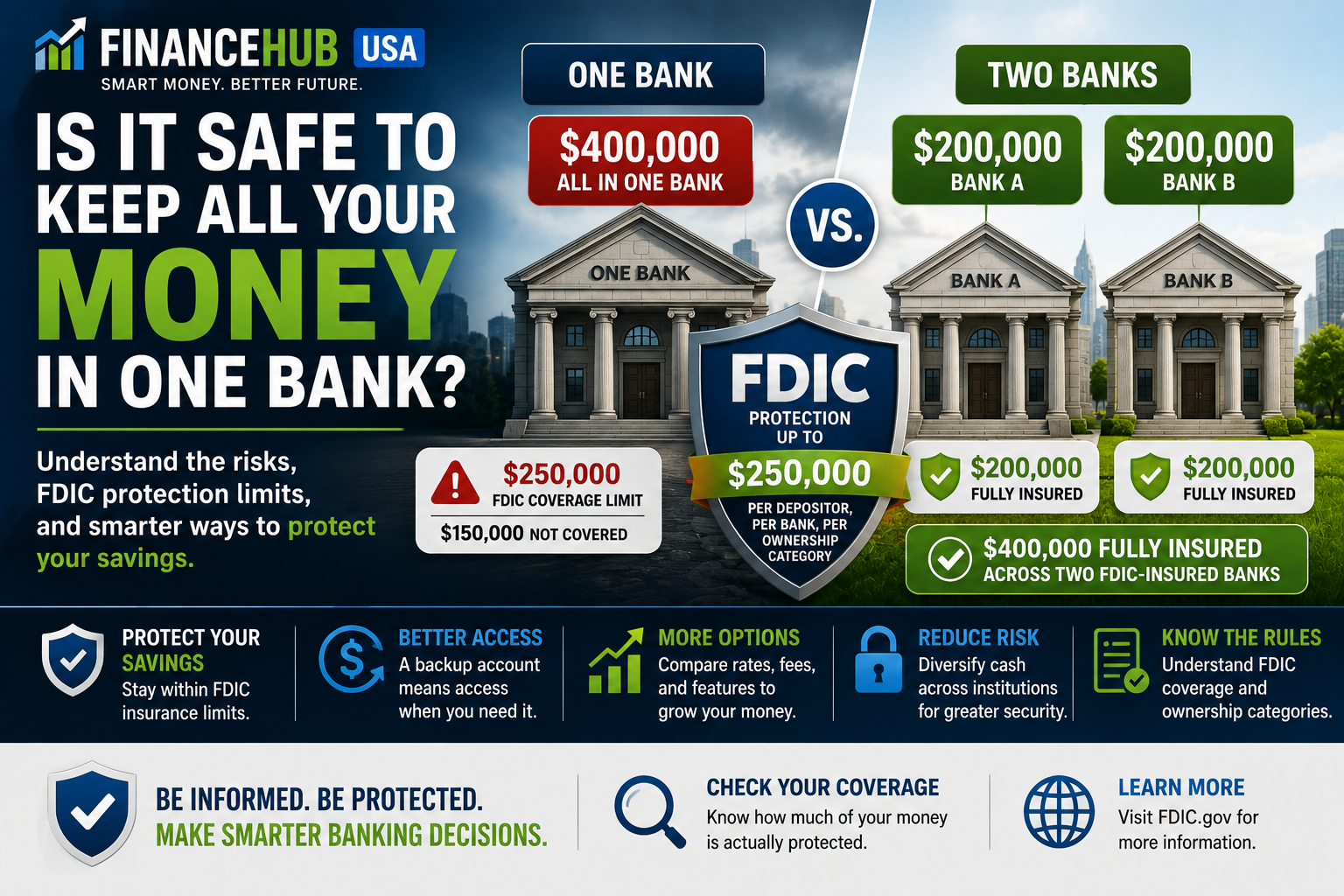
Is It Safe to Keep All Your Money in One Bank?

Keeping all your cash at one bank can make financial life much simpler.
Your checking account, emergency fund, savings, and certificates of deposit can all appear under one login, making it easier to monitor balances, move money, and pay bills.
But convenience raises an important question:
Is it actually safe to keep all your money in one bank?
For many people, the answer can be yes, especially when eligible deposits are held at an FDIC insured bank and remain within applicable deposit insurance limits.
However, bank safety involves more than the possibility of an institution failing.
Temporary account restrictions, fraud investigations, debit card problems, online banking outages, and other disruptions can leave you without immediate access to money even when your deposits themselves remain safe.
The better question is not simply whether one bank is safe. It is whether one bank gives your household enough insurance protection, liquidity, accessibility, and flexibility.
How Much Money Does the FDIC Protect?
The Federal Deposit Insurance Corporation protects eligible deposits at FDIC insured banks when an insured institution fails.
The standard insurance amount is generally:
$250,000 per depositor, per FDIC insured bank, for each account ownership category.
This is one of the most important rules to understand before deciding whether one bank is enough for your cash.
What Bank Products Are FDIC Insured?
Eligible deposit products generally include:
- Checking accounts
- Savings accounts
- Money market deposit accounts
- Certificates of deposit
- Certain other deposit accounts
However, not everything sold through a bank receives FDIC insurance.
| Financial Product | Generally FDIC Insured? | Important Point |
|---|---|---|
| Checking account | Yes, at an insured bank | Subject to applicable insurance limits |
| Savings account | Yes, at an insured bank | Combined with deposits in the same ownership category |
| Money market deposit account | Yes, at an insured bank | Different from a money market mutual fund |
| Certificate of deposit | Yes, at an insured bank | Subject to insurance limits |
| Stocks | No | Investment products are not bank deposits |
| Bonds | No | Not protected by FDIC deposit insurance |
| Mutual funds | No | Can fluctuate in market value |
| ETFs | No | Market investments are not insured deposits |
| Crypto assets | No | Not covered by FDIC deposit insurance |
A Bank Account and an Investment Account Are Not the Same Thing
This distinction matters because many financial institutions offer both deposit products and investment services.
Suppose you see the following under the same banking login:
- $50,000 savings account
- $50,000 invested in mutual funds
The two balances do not necessarily receive the same type of protection.
The savings balance may qualify for FDIC coverage.
The mutual funds are investments and can rise or fall in value.
Does Having Several Accounts at One Bank Increase FDIC Coverage?

Not automatically.
Opening several deposit accounts at the same bank does not necessarily create a new $250,000 insurance limit for each account.
Example
Suppose James has:
| Account | Balance |
|---|---|
| Savings | $150,000 |
| Certificate of deposit | $100,000 |
| Checking | $50,000 |
| Total | $300,000 |
If all three accounts belong to James individually at the same FDIC insured bank and fall within the same ownership category, they are generally aggregated for deposit insurance purposes.
A simplified result could be:
- $250,000 within the standard insurance limit
- $50,000 above the standard insurance limit
Different Bank Branches Do Not Create Separate Coverage
Opening accounts at different branches of the same insured institution does not generally create separate FDIC insurance limits.
The relevant institution is the insured bank itself, not the individual branch location.
For example:
- $150,000 at Branch A
- $150,000 at Branch B
If both branches belong to the same insured bank and the deposits are in the same ownership category, the deposits are generally considered together.
What Are FDIC Ownership Categories?
The phrase ownership category is extremely important because qualifying categories can receive separate insurance treatment.
Common categories include:
- Single accounts
- Joint accounts
- Certain retirement accounts
- Trust accounts
- Business accounts
- Certain government accounts
The exact coverage depends on how the account is titled and whether FDIC requirements are satisfied.
Can You Have More Than $250,000 at One Bank and Still Be Fully Insured?
Yes, in some circumstances.
The $250,000 figure is not necessarily a universal maximum for every household at one bank.
Separate qualifying ownership categories can potentially provide additional insurance protection.
Example: Single and Joint Accounts
Suppose Alex has:
- $250,000 in a qualifying individual account
- A qualifying joint account with another owner
The joint account may receive separate insurance treatment from Alex's individual account, subject to applicable FDIC rules.
This is why someone with a large balance should calculate actual insurance instead of assuming either that everything above $250,000 is uninsured or that every separate account receives another $250,000.
How Joint Accounts Can Increase Coverage
Qualifying joint accounts generally receive insurance based on each co-owner's share.
Example
Suppose two people jointly own a qualifying account containing:
$500,000
A simplified equal ownership structure could potentially provide:
- $250,000 of coverage for Owner A
- $250,000 of coverage for Owner B
This assumes applicable requirements are satisfied and other joint deposits at the same institution do not alter the calculation.
Trust Accounts Have More Complicated Rules
Trust accounts can qualify for separate insurance treatment, but the calculations can be more complicated because coverage can depend on:
- Account owners
- Eligible beneficiaries
- Account structure
- Applicable FDIC rules
Households with substantial trust deposits should calculate coverage carefully rather than assuming each beneficiary automatically creates unlimited protection.
Does Interest Count Toward the FDIC Limit?
Yes, eligible principal and accrued interest can count toward your total insured balance.
Example
Suppose you keep:
$249,000
in an eligible savings account.
If interest increases the balance above $250,000 and everything is held in the same ownership category, part of the balance could exceed the standard limit.
This is one reason people maintaining balances close to the insurance threshold should monitor accumulated interest.
Would Using Two Banks Make $400,000 Safer?

Consider Maria, who has $400,000 in cash savings held individually.
Scenario 1: All $400,000 at One Bank
| Bank | Balance | Illustrative Coverage Position |
|---|---|---|
| Bank A | $400,000 | $250,000 within standard single account limit |
Approximately $150,000 would sit above the standard limit in this simplified example.
Scenario 2: Split Between Two Separately Insured Banks
| Bank | Balance | Illustrative Coverage Position |
|---|---|---|
| Bank A | $200,000 | Within standard single account limit |
| Bank B | $200,000 | Within standard single account limit |
If both institutions are independently FDIC insured and Maria has no other relevant deposits at either bank, both balances could generally fall within the standard limits.
Using Multiple Banks Can Solve Two Different Problems
There are two main reasons someone might use more than one bank.
1. Deposit Insurance Diversification
Large balances can be distributed among independently insured institutions to keep more cash within standard insurance limits.
2. Access Diversification
A secondary bank can provide access to money if your primary institution temporarily becomes unavailable.
These are different risks.
Bank Failure Is Not the Only Risk
Suppose you keep $20,000 in eligible deposits at an FDIC insured bank.
Your balance is comfortably below the standard insurance limit.
Splitting that money among five different banks purely because you are afraid of bank failure may add complexity without providing much additional deposit insurance benefit.
But there is another issue:
temporary loss of access.
What Is Access Risk?
Access risk means your money can still belong to you while temporarily being difficult to use.
Examples include:
- Your debit card is temporarily locked after suspicious activity
- An account is restricted during a fraud investigation
- Online banking experiences an outage
- Your phone containing authentication credentials is lost
- A bank transfer is temporarily delayed
- A security issue prevents normal account access
Deposit insurance does not eliminate these inconveniences.
Example: Safe Money That Is Temporarily Inaccessible
Suppose Olivia has:
$20,000
at one insured bank.
Her deposits are within the standard FDIC limit.
But the bank detects suspicious debit card activity and temporarily blocks access while investigating.
Olivia needs $1,500 immediately for an emergency car repair.
Her money may still be safe, but she cannot conveniently use it at that moment.
If she had $2,000 at another institution, she would have an alternative source of liquidity.
One Bank vs. Two Banks
| One Bank | Multiple Banks |
|---|---|
| Fewer accounts to monitor | Backup access to money |
| One login | More than one banking relationship |
| Easier internal transfers | Potentially more FDIC coverage |
| Simpler recordkeeping | Opportunity to compare savings rates |
| Greater dependence on one institution | More accounts and passwords to manage |
Should Everyone Have Two Banks?
No.
There is no financial rule requiring every household to maintain accounts at multiple banks.
For someone with:
- Modest cash balances
- Strong account security
- Reliable credit card access
- Balances comfortably below insurance limits
one well established insured institution may be sufficient.
A second bank becomes more attractive when:
- Cash balances are large
- You want backup liquidity
- Another bank offers meaningfully better rates
- You want separation between spending and emergency savings
What Happens If Your Bank Fails?
If an FDIC insured bank fails, eligible insured deposits do not simply disappear.
The FDIC steps in to resolve the failed institution.
A common outcome is that another insured bank acquires the deposits.
Customers may then gain access to their funds through the acquiring institution.
If another institution does not assume the deposits, the FDIC can pay insured depositors directly.
How Fast Can You Get Insured Deposits Back?
In many bank failures, customers receive access to insured funds very quickly.
The exact timing can depend on:
- The resolution structure
- Account ownership
- Documentation requirements
- Complex account arrangements
Simple insured deposit accounts may be easier to resolve than complicated ownership structures.
What Happens to Money Above FDIC Limits?
An amount above applicable FDIC coverage limits is generally considered an uninsured deposit.
That does not automatically mean the entire uninsured amount disappears.
Uninsured depositors may receive a claim against the failed institution's receivership and may recover some or all of the money as assets are sold.
However, recovery may be delayed and is not guaranteed to equal the full uninsured amount.
Example
Suppose you have:
$300,000
in one qualifying single ownership category at one FDIC insured bank.
| Amount | |
|---|---|
| Total deposits | $300,000 |
| Within standard insurance limit | $250,000 |
| Potential uninsured amount | $50,000 |
The $50,000 excess could become a receivership claim if the bank failed.
What About Credit Unions?
The FDIC generally insures eligible deposits at banks.
Federally insured credit unions use a different federal insurance system.
The National Credit Union Share Insurance Fund, administered by the National Credit Union Administration, provides insurance protection for qualifying credit union deposits.
| Institution | Primary Federal Insurance System |
|---|---|
| FDIC insured bank | Federal Deposit Insurance Corporation |
| Federally insured credit union | National Credit Union Share Insurance Fund |
The standard federal insurance framework for credit unions is generally similar to the $250,000 structure, although the rules and terminology are administered separately.
What About Online Banks?
An online bank can be just as eligible for FDIC insurance as a traditional bank with physical branches.
The important question is not whether the bank has a building near you.
The question is:
Is the institution itself FDIC insured?
Consumers can verify this using the FDIC's official BankFind tool.
Fintech Apps Require Extra Attention
Some financial apps are not banks themselves.
Instead, they may place customer funds at one or more partner banks.
This can potentially provide FDIC insurance through those partner institutions, but the structure matters.
Before keeping a large amount in a fintech account, identify:
- The actual bank holding your funds
- Whether that bank is FDIC insured
- How your account is titled
- Whether pass through insurance requirements apply
- Whether you already hold money at that same partner bank
Why Existing Deposits at a Partner Bank Matter
Suppose a fintech platform places:
$200,000
of your money at Bank A.
You independently already keep:
$100,000
at Bank A in the same ownership category.
Your relevant combined balance could become:
$200,000 + $100,000 = $300,000
That could leave part of the total above the standard insurance limit.
What Is a Bank Sweep Program?
Some banks and brokerages offer programs that distribute cash among multiple partner banks.
This can potentially increase the amount of cash eligible for FDIC insurance because the deposits are spread across separately insured institutions.
However, review:
- Participating banks
- Interest rates
- Program fees
- Withdrawal rules
- Your existing deposits at partner institutions
Do Not Assume a Sweep Program Automatically Makes Everything Insured
If you already hold deposits at one of the program's partner banks, those balances can affect available insurance capacity.
Consumers with large cash balances should know which institutions actually hold their funds.
Should Your Emergency Fund Be at a Different Bank?
It can be useful, but it is not mandatory.
One strategy is to keep:
- Everyday checking at Bank A
- Most emergency savings at Bank B
This can create both behavioral and operational benefits.
Your emergency money becomes slightly separated from daily spending while remaining available if your main bank experiences an access problem.
A Practical Two Bank Setup
| Purpose | Possible Account | Main Goal |
|---|---|---|
| Everyday spending | Primary checking | Bill payment and normal purchases |
| Short term savings | Primary or secondary savings | Upcoming expenses |
| Emergency fund | High yield savings | Liquidity and interest |
| Backup cash | Second institution | Alternative access |
What About Large Business Bank Balances?
Business owners may hold much larger temporary cash balances than ordinary households.
Examples include money reserved for:
- Payroll
- Taxes
- Vendor payments
- Equipment purchases
- Real estate transactions
Businesses should understand how their accounts are titled and how deposit insurance applies to their legal entity.
Keeping very large operating balances at one institution without reviewing coverage can create unnecessary concentration risk.
Do You Need to Keep Every Dollar in Cash?
No.
Bank diversification and investment diversification solve different problems.
Money needed for:
- Monthly expenses
- Emergency savings
- Short term goals
may appropriately remain in liquid bank deposits.
Money intended for retirement or goals decades away may have a different purpose.
Cash Has Inflation Risk
A bank deposit can protect principal in ways that market investments cannot.
But cash can lose purchasing power over time when inflation exceeds the interest earned.
This means keeping all financial assets in cash purely because bank deposits feel safe can introduce another long term risk.
Safety should therefore be evaluated relative to the goal of the money.
FinanceHub USA Analysis: Separate Safety From Accessibility
Many people use the word "safe" to describe two different questions:
- Could I lose the money?
- Could I access the money when I need it?
These are not the same problem.
| Risk | Possible Protection |
|---|---|
| Bank failure | FDIC insurance within applicable limits |
| Account restriction | Backup financial institution |
| Debit card compromised | Second payment method or account |
| Online banking outage | Alternative access to cash |
| Large uninsured cash balance | Multiple institutions or qualifying ownership categories |
A household can therefore be fully insured but still overly dependent on one institution for immediate access.
When One Bank May Be Enough
Using one bank may be reasonable when:
- Your eligible deposits remain comfortably below applicable FDIC limits
- The bank offers competitive rates and low fees
- You have reliable alternative payment methods
- You value simplicity
- You do not have large temporary cash balances
When Multiple Banks May Make More Sense
Using more than one institution may deserve consideration when:
- Your cash exceeds standard insurance limits
- You want backup access during temporary restrictions
- A second bank offers materially better savings rates
- You want to separate emergency savings from daily spending
- You operate a business with large cash balances
Do Not Spread Small Balances Across Too Many Banks
More accounts do not automatically mean better financial management.
Having too many banks can create:
- More passwords
- More statements
- More tax documents
- More accounts to monitor for fraud
- More complicated beneficiary and estate planning records
If your balances are modest and fully insured, excessive banking complexity may provide little additional benefit.
How to Verify Whether a Bank Is FDIC Insured
Do not rely only on a logo displayed in an advertisement.
Verify the institution using the FDIC's official resources.
This is particularly important when using:
- Online financial platforms
- Fintech apps
- Cash management accounts
- Banking brands owned by larger institutions
Common Mistakes When Keeping Money at One Bank
- Assuming every account receives a separate $250,000 limit. Deposits in the same ownership category at one bank are generally combined.
- Opening accounts at different branches and assuming coverage multiplies. Branches of the same insured institution do not generally receive separate limits.
- Confusing investment products with insured deposits. Stocks, ETFs, mutual funds, and crypto assets are not FDIC insured deposits.
- Ignoring accumulated interest. Interest can push a deposit balance above an insurance threshold.
- Keeping large uninsured balances without calculating coverage. Review ownership categories before assuming the full amount is protected.
- Keeping no backup access to money. Insurance protection and immediate access are different concerns.
- Assuming a fintech company is itself an insured bank. Identify the actual institution holding your deposits.
- Using too many banks without a clear purpose. Additional complexity is not automatically diversification.
FinanceHub USA Framework: Four Questions to Ask
| Question | Why It Matters |
|---|---|
| Is the institution federally insured? | Establishes the first layer of deposit protection |
| How much do I have in each ownership category? | Determines insurance exposure |
| Could I access money if this bank were temporarily unavailable? | Tests operational resilience |
| Does every dollar need to remain in cash? | Helps separate short term liquidity from long term investing goals |
A Practical Bank Safety Checklist
- Verify that your bank is FDIC insured.
- Add up all deposits held in the same ownership category.
- Check whether interest could push balances above insurance limits.
- Review joint, trust, and retirement accounts separately.
- Identify the actual bank behind any fintech account.
- Determine whether you need backup access to emergency cash.
- Compare rates and fees at other institutions.
- Avoid opening unnecessary accounts without a clear purpose.
- Review large cash balances periodically.
Final Thoughts
So, is it safe to keep all your money in one bank?
For many people, yes.
If your eligible deposits are held at an FDIC insured bank and remain within applicable insurance limits, there may be no strong deposit insurance reason to split a modest balance among multiple banks.
But safety involves more than deposit insurance.
You should also consider:
- Temporary account restrictions
- Fraud investigations
- Technical outages
- Backup access to emergency cash
- Savings rates and fees
- Large balances above standard insurance limits
For households with substantial cash, using more than one separately insured institution can increase the amount of deposits that remain within standard insurance limits.
For households with smaller balances, a second institution may still be useful for access diversification rather than deposit insurance.
The goal is not to scatter money randomly across as many banks as possible.
The goal is to understand exactly where your cash is held, how much is protected, and how you would access it if your primary bank became temporarily unavailable.
Continue exploring FinanceHub USA for practical guides covering banking, saving, investing, credit, insurance, taxes, and personal finance.
Related reading: What Happens to Your Money If a Bank Fails?
Sources and Further Reading
Frequently asked questions
Is it safe to keep all your money in one bank?
It can be, particularly when eligible deposits are held at an FDIC-insured bank and remain within applicable insurance limits. However, some consumers use a second institution for backup access or additional deposit-insurance capacity.
How much money is FDIC insured at one bank?
The standard insurance amount is $250,000 per depositor, per FDIC-insured bank, for each account ownership category.
Does each bank account receive $250,000 of FDIC insurance?
Not necessarily. Deposits held in the same ownership category at the same FDIC-insured bank are generally added together when determining coverage.
Can I get more FDIC coverage by using two different banks?
Yes. Eligible deposits at separately insured banks receive separate coverage under FDIC rules. For example, an eligible single account at Bank A and another at an unrelated FDIC-insured Bank B can each qualify for the applicable limit.
Can I have more than $250,000 at one bank and still be fully insured?
Yes. Deposits that properly qualify under different FDIC ownership categories can receive separate insurance coverage. The exact amount depends on how the accounts are owned and structured.
What happens to insured money when a bank fails?
The FDIC generally protects insured deposits by transferring them to another insured institution or paying insured depositors directly. Historically, access to insured deposits is often restored within a few days and usually by the next business day.
What happens to money above the FDIC insurance limit?
Funds above applicable insurance limits are uninsured. If a bank fails, a depositor may receive a claim against the bank's receivership and could recover some uninsured money as assets are liquidated, but full recovery is not guaranteed.
Are stocks and mutual funds purchased through my bank FDIC insured?
No. FDIC insurance protects eligible deposit products such as checking accounts, savings accounts, money market deposit accounts and CDs at insured banks. Investment products such as stocks and mutual funds are not FDIC-insured deposits.
Is it better to have one bank or two?
There is no universal answer. One bank can be simpler, while two institutions can provide backup access, additional insurance capacity for large eligible deposits, and opportunities to compare rates and features.