What Happens to Your Money If a Bank Fails?
What happens to your money when a bank fails? Learn how FDIC insurance works, what the $250,000 limit means, and how to protect your savings.

What Happens to Your Money If a Bank Fails?

A bank failure can sound alarming, especially if you keep your emergency fund, home down payment, business cash, or other major savings in one institution.
But if your money is held in eligible deposit accounts at an FDIC-insured bank, federal deposit insurance can protect your funds within applicable limits.
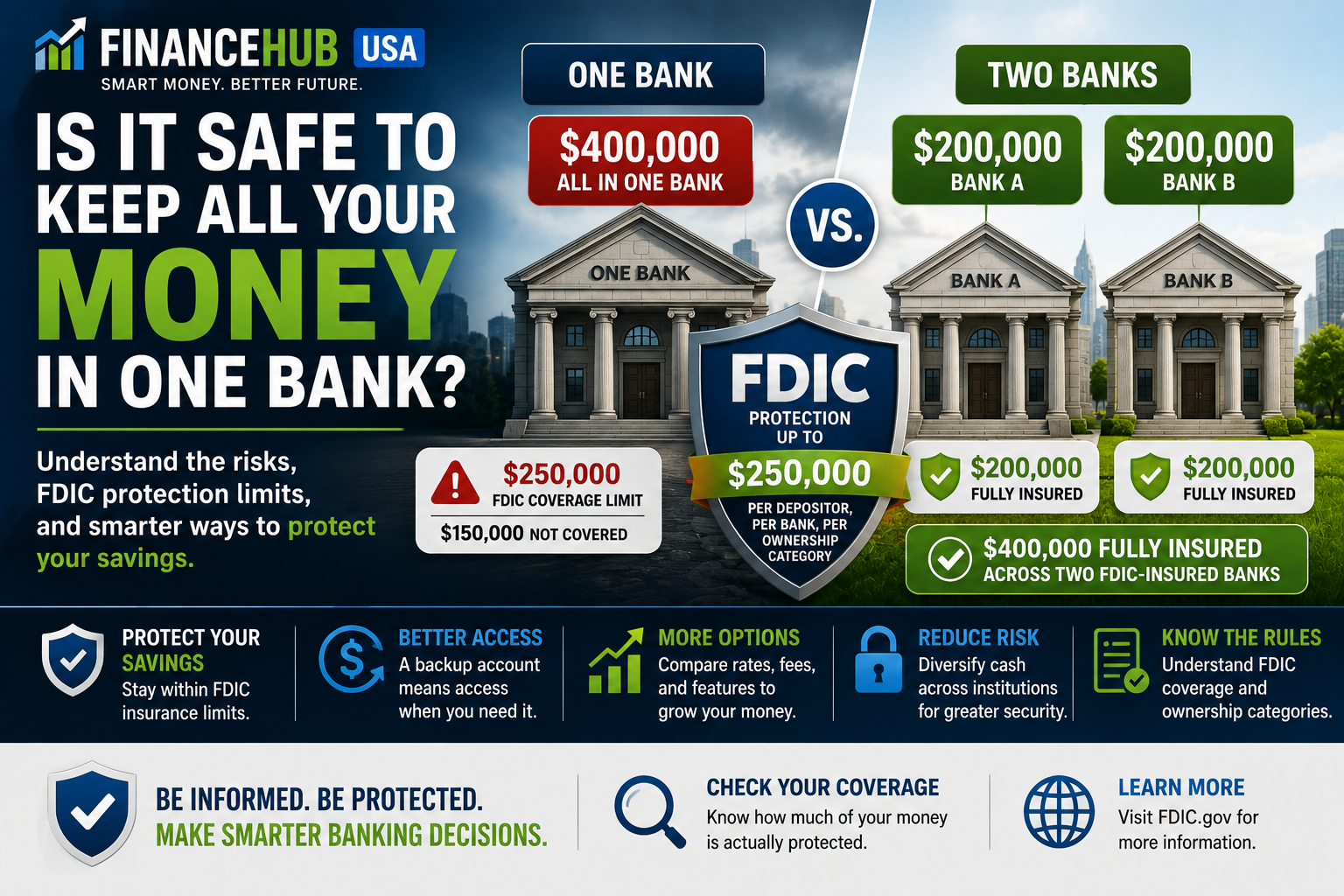
The standard FDIC insurance amount is generally $250,000 per depositor, per insured bank, for each account ownership category.
That does not mean every dollar connected to a bank is automatically protected. Stocks, mutual funds, crypto assets, annuities, and other investments are not covered by FDIC deposit insurance simply because they were purchased through a bank.
This guide explains what happens when a bank fails, how FDIC insurance works, what happens to balances above the insurance limit, and how depositors can structure larger cash balances more carefully.
What Actually Happens When a Bank Fails?
A bank failure occurs when regulators determine that a financial institution can no longer continue operating safely or meet its obligations.
For customers of an FDIC-insured bank, a failure does not normally mean insured deposits simply disappear.
The Federal Deposit Insurance Corporation steps in to resolve the failed bank.
One common outcome is that another healthy financial institution assumes the failed bank's deposits and certain other assets.
Customers may then access their insured deposits through the acquiring institution.
If another bank does not immediately assume the deposits, the FDIC can pay insured depositors directly.
How Quickly Can You Access Your Money?
The FDIC states that its goal is to provide depositors access to insured funds as quickly as possible after an insured bank fails.
In many failures, customers experience little interruption because deposits are transferred to another institution over a weekend and normal banking access resumes shortly afterward.
The exact timing depends on how the failure is resolved.
Possible outcomes include:
- Your accounts are transferred to another insured bank.
- You receive access through the acquiring institution.
- The FDIC sends payment for insured deposits if no acquiring bank assumes them.
Checks, debit cards, automatic payments, and online banking access can also be affected temporarily depending on the resolution.
How Much Does the FDIC Insure?
The standard insurance amount is:
$250,000 per depositor, per FDIC-insured bank, for each ownership category.
The phrase ownership category is especially important.
The limit is not necessarily a simple $250,000 maximum across every account a person has at the institution.
Common FDIC Ownership Categories
| Ownership Category | General Coverage |
|---|---|
| Single accounts | Up to $250,000 per owner |
| Joint accounts | Generally up to $250,000 per co-owner |
| Certain retirement accounts | Generally up to $250,000 per owner |
| Trust accounts | Coverage depends on owners, beneficiaries, and FDIC rules |
| Business accounts | Separate rules can apply depending on legal ownership |
Different ownership categories may receive separate insurance treatment when all FDIC requirements are satisfied.
Multiple Accounts Do Not Automatically Multiply Coverage
Opening several checking or savings accounts at the same bank does not automatically create a separate $250,000 limit for each account.
Accounts held by the same depositor in the same ownership category at the same insured bank are generally combined when FDIC coverage is calculated.
Example: Three Accounts at One Bank
Suppose one person has:
| Account | Balance |
|---|---|
| Checking account | $75,000 |
| Savings account | $125,000 |
| Certificate of deposit | $100,000 |
| Total | $300,000 |
If all three accounts are owned individually by the same person at the same FDIC-insured bank, they would generally be combined within the same single-account ownership category.
A simplified result would be:
- $250,000 insured
- $50,000 above the standard insurance limit
Does FDIC Insurance Cover Interest?
FDIC insurance generally includes eligible principal and accrued interest through the date the insured bank fails, subject to applicable insurance limits.
This means that interest credited or accrued on an insured deposit can count toward the total insured amount.
Example
Suppose you have $249,000 in a savings account and accrued interest pushes the balance to $251,000.
If everything is held in the same ownership category at one insured bank, part of the balance could exceed the standard $250,000 insurance limit.
This is why depositors with balances near the limit should monitor interest growth as well as deposits.
What Types of Accounts Are FDIC-Insured?

FDIC deposit insurance generally covers eligible deposit products at insured banks.
Common Covered Deposit Products
- Checking accounts
- Savings accounts
- Certificates of deposit
- Money market deposit accounts
- Certain other bank deposit products
What Does FDIC Insurance Not Cover?
FDIC insurance does not protect every financial product sold by or through a bank.
Examples that are generally not FDIC-insured include:
- Stocks
- Bonds
- Mutual funds
- Exchange-traded funds
- Crypto assets
- Annuities
- Life insurance policies
- Municipal securities
- U.S. Treasury securities themselves, although they are backed differently by the federal government
The fact that an investment appears inside a bank's investment platform does not transform it into an insured deposit.
Safe Deposit Boxes Are Not FDIC-Insured
The contents of a safe deposit box are not protected by FDIC deposit insurance.
If you store jewelry, documents, collectibles, cash, or other property in a safe deposit box, the protection depends on the bank agreement and any separate insurance you maintain.
What Happens If You Have More Than $250,000?
Having more than $250,000 at a bank does not automatically mean the excess will be lost.
It means the amount above applicable insurance limits is classified as an uninsured deposit.
Uninsured depositors may receive a portion of their money as the FDIC liquidates assets or resolves the failed institution.
However, recovery is not guaranteed to equal the full uninsured amount.
Example: $300,000 in One Ownership Category
Suppose Michael holds $300,000 in single-owner deposit accounts at one FDIC-insured bank.
| Amount | |
|---|---|
| Total deposits | $300,000 |
| Standard insured amount | $250,000 |
| Potential uninsured amount | $50,000 |
If the bank fails, the insured $250,000 generally receives FDIC protection.
The remaining $50,000 becomes an uninsured claim against the failed institution.
Michael may recover some or all of that amount depending on the resolution and the value recovered from the bank's assets, but the excess does not carry the same federal insurance guarantee.
Do Joint Accounts Increase FDIC Coverage?
Joint accounts can qualify for separate coverage from single accounts when FDIC requirements are satisfied.
Example: Two Owners
Suppose a qualifying joint account contains $500,000 and has two equal co-owners.
A simplified FDIC calculation could provide:
- $250,000 coverage for Owner A
- $250,000 coverage for Owner B
That could result in the full $500,000 being insured within the joint ownership category, assuming all applicable rules are met and neither owner has additional joint deposits at that same institution that affect the calculation.
Single and Joint Accounts Can Have Separate Coverage
Suppose the same person has:
- $250,000 in a qualifying single account
- $250,000 attributed to that person in qualifying joint accounts
Those deposits may receive separate insurance treatment because they belong to different ownership categories.
This is why the phrase "per ownership category" matters so much.
Trust Accounts Have Special Rules
Trust accounts can qualify for additional insurance coverage based on the number of eligible beneficiaries and other FDIC requirements.
However, trust rules are more complex than ordinary single or joint accounts.
Depositors should not move large sums into trust accounts solely because they assume each beneficiary automatically creates another $250,000 of insurance.
Use the FDIC's official tools or seek professional guidance when trust balances are substantial.
What About Retirement Accounts?
Certain self-directed retirement deposit accounts can receive separate FDIC insurance coverage from ordinary single accounts.
Examples may include qualifying:
- Traditional IRA deposit accounts
- Roth IRA deposit accounts
- Certain self-directed retirement plan deposits
The insurance protects eligible bank deposits held inside the retirement arrangement.
It does not transform stocks, ETFs, mutual funds, or other investments inside a retirement account into FDIC-insured assets.
What Happens to a CD If the Bank Fails?
A certificate of deposit at an FDIC-insured bank is generally an insured deposit product within applicable limits.
If another bank assumes the failed institution's deposits, the CD may be transferred to the acquiring institution.
The acquiring bank may have rights regarding the interest rate or terms according to applicable resolution rules and disclosures.
Depositors should review communications from the FDIC and acquiring institution after a failure.
What Happens to Direct Deposits and Automatic Payments?
When another bank assumes the deposits, customers may often continue using existing checks, debit cards, direct deposits, and automatic payments for a transition period.
However, exact procedures vary.
After a bank failure, monitor:
- Payroll direct deposits
- Social Security payments
- Mortgage or rent payments
- Utility autopay
- Credit card payments
- Business payments
Follow official instructions from the FDIC and acquiring bank rather than relying on social-media reports.
How to Verify Whether Your Bank Is FDIC-Insured
Do not assume every financial company offering a savings product is itself an FDIC-insured bank.
You can verify coverage using the FDIC's official BankFind Suite.
Consumers should identify the actual insured bank holding the deposit, especially when using:
- Fintech apps
- Cash management platforms
- Online financial services
- Brokerage cash sweep programs
A financial technology company may partner with one or more insured banks without being a bank itself.
Fintech Apps Require Extra Attention
Some fintech products advertise that customer funds may be eligible for FDIC insurance through partner banks.
That arrangement can be legitimate, but the structure matters.
Consumers should understand:
- Which bank actually holds the money
- Whether that bank is FDIC-insured
- How accounts are titled
- Whether pass-through insurance requirements are satisfied
- Whether other deposits at the same partner bank affect total coverage
The presence of an FDIC logo or statement should not replace understanding where the deposit actually sits.
What About Credit Unions?
FDIC insurance applies to insured banks.
Federally insured credit unions generally receive deposit protection through the National Credit Union Share Insurance Fund, administered by the National Credit Union Administration, or NCUA.
The standard federal share insurance amount is generally similar to the FDIC's $250,000 structure, although the rules and terminology are administered separately.
| Institution | Federal Insurance System |
|---|---|
| FDIC-insured bank | Federal Deposit Insurance Corporation |
| Federally insured credit union | National Credit Union Share Insurance Fund / NCUA |
How to Protect More Than $250,000

People and businesses with large cash balances have several ways to potentially increase insured coverage.
Use More Than One FDIC-Insured Bank
The insurance limit applies separately at different insured institutions.
Suppose you hold $400,000 entirely in single-owner deposits.
One Bank
| Bank | Balance | General Insurance Position |
|---|---|---|
| Bank A | $400,000 | $250,000 insured, $150,000 potentially uninsured |
Two Banks
| Bank | Balance | General Insurance Position |
|---|---|---|
| Bank A | $200,000 | Within standard single-account limit |
| Bank B | $200,000 | Within standard single-account limit |
Assuming the depositor has no additional deposits in that ownership category at either institution, both balances could generally be fully insured.
Review Ownership Categories
Different qualifying ownership categories can provide separate insurance coverage at the same bank.
Examples include:
- Single accounts
- Joint accounts
- Certain retirement accounts
- Trust accounts
- Other recognized ownership categories
Do not rearrange ownership purely to increase insurance without understanding the legal and FDIC requirements.
Deposit Sweep Programs Can Spread Cash Across Banks
Some banks, brokerages, and financial platforms offer deposit sweep or reciprocal deposit programs that distribute cash among multiple insured banks.
This can potentially increase aggregate FDIC insurance because deposits are spread among separate institutions.
However, depositors should review:
- Which banks participate
- Whether they already hold deposits at those institutions
- Program fees
- Withdrawal rules
- Interest rates
- How insurance eligibility is structured
Why Existing Deposits at Partner Banks Matter
Suppose a cash sweep program places $200,000 of your money at Bank A.
If you independently already have $100,000 in the same ownership category at Bank A, your total relevant balance there may become:
$200,000 + $100,000 = $300,000
That could leave part of the combined balance above the standard insurance limit.
This is why depositors with large balances should understand the actual institutions holding their funds.
What Is the FDIC Electronic Deposit Insurance Estimator?
The FDIC provides an online tool called the Electronic Deposit Insurance Estimator, commonly known as EDIE.
It can help consumers estimate insurance coverage across different ownership categories.
The tool can be especially useful for households with:
- Large balances
- Joint accounts
- Trust accounts
- Retirement deposits
- Multiple account types
Do You Need to Apply for FDIC Insurance?
No.
Eligible deposits at an FDIC-insured bank are automatically insured according to federal rules.
Consumers do not normally purchase a separate FDIC insurance policy or file an application for standard coverage.
Does FDIC Insurance Cost Depositors Money?
Consumers do not pay a separate FDIC insurance premium on each checking or savings account.
Insured banks fund the Deposit Insurance Fund through assessments paid by financial institutions.
FinanceHub USA Analysis: Bank Safety Is About Structure, Not Panic
A bank failure should not automatically cause consumers to withdraw all of their money from the banking system.
The more useful question is whether the deposits are structured within applicable insurance limits.
Consider three households:
| Household | Cash Balance | Primary Risk Question |
|---|---|---|
| A | $25,000 | Is the bank FDIC-insured? |
| B | $245,000 | Could interest or new deposits push the balance above the limit? |
| C | $700,000 | How should deposits be distributed across banks or ownership categories? |
The appropriate response becomes more important as cash balances grow.
Large Business Balances Require Additional Planning
Businesses can temporarily hold cash far above $250,000 for:
- Payroll
- Taxes
- Vendor payments
- Operating expenses
- Real estate transactions
A business owner should understand how the business account is titled and how FDIC ownership rules apply to the legal entity.
Keeping millions of dollars in one operating account without understanding deposit insurance can create avoidable concentration risk.
Bank Failure vs. Investment Loss
It is important to separate two different risks.
Bank Failure Risk
FDIC insurance can protect eligible deposits within applicable limits when an insured bank fails.
Market Risk
Stocks, bonds, mutual funds, and ETFs can lose value because of market movements even when the financial institution holding the account remains healthy.
FDIC insurance does not reimburse investors for market losses.
Bank Account vs. Brokerage Account
A bank deposit and a brokerage investment account are not the same thing.
| Asset | Primary Protection |
|---|---|
| Eligible deposit at FDIC-insured bank | FDIC insurance within applicable limits |
| Stocks held at brokerage | Not FDIC-insured |
| Mutual funds or ETFs | Not FDIC-insured |
Brokerage customers may have other protections, such as Securities Investor Protection Corporation coverage under qualifying circumstances, but SIPC does not protect against normal investment losses.
Common FDIC Insurance Mistakes
- Assuming every account gets its own $250,000 limit. Accounts in the same ownership category at the same bank are generally aggregated.
- Assuming everything sold by a bank is FDIC-insured. Investment products are different from bank deposits.
- Ignoring accrued interest. Interest can push a balance above an insurance limit.
- Assuming a fintech app itself is an FDIC-insured bank. Verify the actual institution holding the funds.
- Keeping large business balances at one bank without reviewing coverage. Large operational balances can exceed insurance limits quickly.
- Changing ownership categories without understanding the rules. Joint, trust, and retirement accounts have specific requirements.
- Assuming uninsured deposits are automatically lost. Depositors may recover part or all of uninsured amounts, but recovery is not guaranteed.
A Simple Bank Safety Checklist
Before keeping a large cash balance at one institution, ask:
- Is this bank FDIC-insured?
- How much money do I have at this bank?
- Which ownership categories apply?
- Do I have multiple accounts that will be aggregated?
- Could accrued interest push the balance above a limit?
- Do I already have money at partner banks used by a sweep program?
- Would spreading cash across multiple insured institutions reduce uninsured exposure?
FinanceHub USA Framework: Protect the Cash Before You Need It
| Cash Situation | Practical Step |
|---|---|
| Balance well below $250,000 | Verify that the institution is FDIC-insured |
| Balance approaching $250,000 | Monitor interest and new deposits |
| Balance above $250,000 | Review multiple banks and ownership categories |
| Complex joint or trust structure | Use FDIC tools or qualified professional guidance |
| Fintech or cash management account | Identify the actual insured bank holding the deposit |
Final Thoughts
What happens to your money if a bank fails?
If your funds are held in eligible deposit accounts at an FDIC-insured bank and remain within applicable insurance limits, federal deposit insurance generally protects those deposits.
The standard limit is generally $250,000 per depositor, per insured bank, for each ownership category.
The situation becomes more complicated when:
- Your balance exceeds applicable limits
- You have several accounts in the same ownership category
- You use joint or trust accounts
- You hold money through fintech platforms
- You confuse investment products with insured deposits
Amounts above FDIC limits are not automatically lost, but they do not receive the same guaranteed federal protection as insured deposits.
The best time to think about deposit insurance is before a bank experiences trouble.
Verify that your institution is insured, understand how your accounts are titled, monitor large balances, and use multiple insured institutions or appropriate ownership structures when necessary.
Bank failures are difficult to predict. Deposit structure is something you can control.
Continue exploring FinanceHub USA for practical guides covering banking, saving, investing, insurance, taxes, credit, and personal finance.
Related reading: How to Create a Budget That Actually Works
Related reading: How Much Should You Save From Every Paycheck?
Sources and Further Reading
Frequently asked questions
Do you lose your money if your bank fails?
Not necessarily. Eligible deposits at an FDIC-insured bank are automatically protected up to applicable insurance limits. The standard amount is $250,000 per depositor, per insured bank, for each account ownership category.
What happens if I have more than $250,000 in one bank?
The amount above $250,000 is not automatically uninsured because coverage depends on ownership categories. However, money exceeding the applicable FDIC limit becomes an uninsured deposit and may be exposed to loss if the bank fails.
How quickly do you get your money after a bank fails?
The FDIC says its goal is to make insured deposits available promptly after a bank failure. This commonly happens by transferring deposits to another insured bank or by paying depositors directly.
Can I get more than $250,000 of FDIC insurance?
Yes. Separate FDIC-insured banks and qualifying ownership categories can provide additional coverage. The exact amount depends on how accounts are owned and structured.
Are stocks and mutual funds purchased at a bank FDIC-insured?
No. Stocks, bonds, mutual funds, crypto assets, annuities and other investment products are not protected by FDIC deposit insurance simply because they were purchased through a bank.
Are checking and savings accounts FDIC-insured?
Eligible checking accounts, savings accounts, money market deposit accounts and certificates of deposit are generally covered when held at an FDIC-insured bank and within applicable insurance limits.