Maximize Your 401(k) Contributions in 2026
Learn how to maximize your 401(k) contributions in 2026 with smart retirement strategies, employer matching, and tax-saving tips.

How to Maximize Your 401(k) Contributions in 2026

A 401(k) can be one of the most valuable retirement savings tools available to U.S. workers, especially when an employer contributes matching dollars.
But maximizing a 401(k) does not necessarily mean immediately contributing the legal maximum.
A stronger strategy is to understand the 2026 contribution limits, capture available employer benefits, choose between traditional and Roth contributions appropriately, increase your savings rate over time, and avoid creating cash flow problems outside the retirement account.
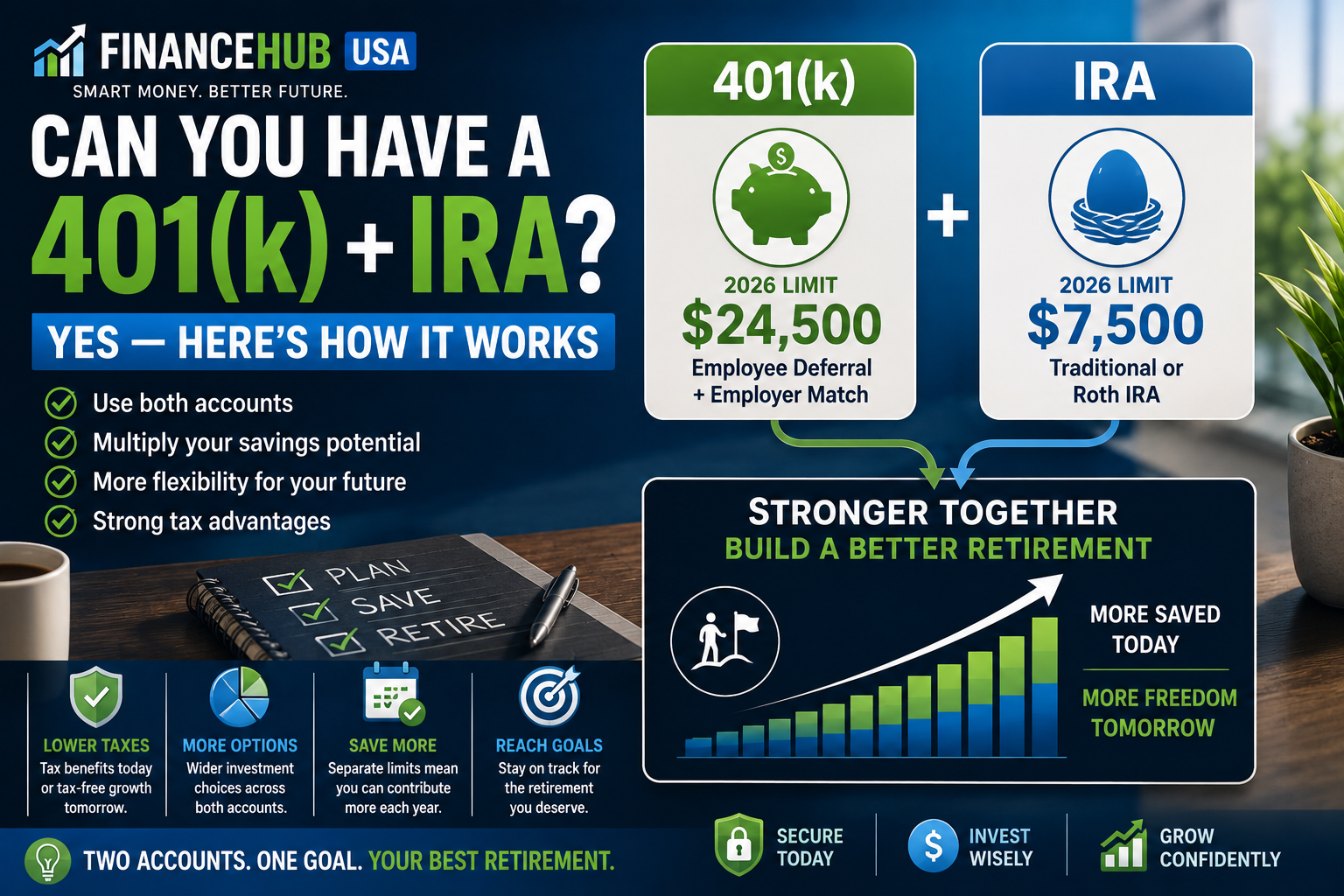
For 2026, the IRS increased the employee elective deferral limit for most 401(k) plans to $24,500.
Workers age 50 and older may be eligible for additional catch-up contributions, while employees who turn 60, 61, 62 or 63 during 2026 can qualify for an even larger catch-up amount.
This guide explains the limits, the new Roth catch-up rule, employer matching, contribution timing, investment choices, and practical ways to increase retirement savings without treating one contribution percentage as appropriate for everyone.
2026 401(k) Contribution Limits
The Internal Revenue Service establishes annual limits on how much employees can defer into workplace retirement plans.
For 2026, the basic employee contribution limit for most 401(k) plans is:
$24,500
This limit generally applies to the combined amount of traditional pre-tax and Roth 401(k) elective deferrals.
| 2026 401(k) Contribution Category | Limit |
|---|---|
| Standard employee elective deferral | $24,500 |
| Age 50+ general catch-up | $8,000 |
| Age 60-63 special catch-up | $11,250 |
| Total standard limit including age 50+ catch-up | $32,500 |
| Total standard limit including age 60-63 catch-up | $35,750 |
The age 60-63 catch-up replaces the regular $8,000 catch-up for eligible participants during those years. It is not added on top of the $8,000 amount.
The Overall 401(k) Limit Is Higher Than $24,500
The $24,500 limit applies primarily to employee elective deferrals.
A separate annual additions limit applies when employer contributions and certain other plan contributions are included.
For 2026, total annual additions to a participant's defined contribution plan generally cannot exceed the lesser of:
- 100% of the participant's compensation, or
- $72,000.
Catch-up contributions can be made above that $72,000 limit when permitted.
| 2026 Maximum | Amount |
|---|---|
| Annual additions limit before catch-up | $72,000 |
| Possible total with standard age 50+ catch-up | $80,000 |
| Possible total for age 60-63 with special catch-up | $83,250 |
Employer matching contributions generally do not reduce the employee's $24,500 elective deferral limit, although they do count toward the broader annual additions limit.
Why Maximizing Your 401(k) Can Matter

A 401(k) combines automated payroll contributions with tax advantages and potentially employer contributions.
Depending on the plan and contribution type, benefits can include:
- Automatic contributions from each paycheck
- Potential employer matching contributions
- Tax-deferred growth inside a traditional 401(k)
- Potential tax-free qualified withdrawals from a Roth 401(k)
- Higher annual contribution limits than an IRA
- Long-term compounding
The account's tax treatment depends on whether contributions are traditional or Roth.
Traditional 401(k) vs. Roth 401(k)
A traditional 401(k) and a Roth 401(k) can hold similar investments, but their tax treatment differs.
| Feature | Traditional 401(k) | Roth 401(k) |
|---|---|---|
| Employee contribution | Generally pre-tax for federal income tax purposes | Made with after-tax dollars |
| Investment growth | Tax deferred | Potentially tax free if withdrawal requirements are met |
| Qualified retirement withdrawals | Generally taxable as ordinary income | Generally federal income tax free |
The better choice depends on factors such as your current tax rate, expected future tax situation, retirement income sources, and plan features.
You may also be able to divide contributions between traditional and Roth options, but the combined elective deferrals generally remain subject to the same $24,500 employee limit for 2026.
A Major 2026 Change: Roth Catch-Up Contributions for Some High Earners
SECURE 2.0 introduced an important rule affecting certain workers making catch-up contributions beginning in 2026.
If your prior-year wages from the employer sponsoring the plan exceeded $150,000, catch-up contributions made to an applicable plan in 2026 generally must be designated as Roth contributions when the plan offers the required Roth feature.
For 2026, the prior-year wage test looks at compensation from 2025.
This rule applies to catch-up contributions, not automatically to the first $24,500 of regular elective deferrals.
Workers affected by the rule should review their plan documents and payroll elections because implementation can differ depending on the plan.
Never Ignore the Employer Match
An employer match is part of the compensation package offered by some workplaces.
Suppose an employer matches 100% of employee contributions up to 5% of salary.
A worker earning $80,000 who contributes at least 5% would contribute:
$80,000 × 5% = $4,000
If the employer provides a dollar-for-dollar match up to that amount, another $4,000 could be deposited into the retirement plan under the plan's rules.
| Example | Amount |
|---|---|
| Annual salary | $80,000 |
| Employee contribution at 5% | $4,000 |
| Illustrative 100% employer match | $4,000 |
| Total contribution | $8,000 |
Actual matching formulas vary significantly by employer.
Some companies match only part of each dollar contributed. Others have different contribution caps, vesting schedules, or true-up provisions.
Understand Your Vesting Schedule
Your own 401(k) contributions are generally yours.
Employer contributions may be subject to a vesting schedule.
Vesting determines how much of certain employer contributions you keep if you leave the company.
A plan may provide:
- Immediate vesting
- Gradual vesting over several years
- Cliff vesting after a specified service period
Before making employment decisions based partly on retirement benefits, review the plan's Summary Plan Description and current vesting status.
How Much Per Paycheck Would Maxing Out Require?
If your goal is to contribute the full $24,500 employee limit in 2026, the amount per paycheck depends on your payroll schedule.
| Pay Frequency | Typical Paychecks | Approximate Contribution Per Paycheck to Reach $24,500 |
|---|---|---|
| Weekly | 52 | $471.15 |
| Biweekly | 26 | $942.31 |
| Twice monthly | 24 | $1,020.83 |
| Monthly | 12 | $2,041.67 |
Amounts are rounded and assume contributions begin with the first paycheck of the calendar year. Payroll timing and plan rules can produce slightly different results.
Be Careful About Maxing Out Too Early
Contributing the maximum as quickly as possible can sound attractive, but it can create a problem in plans where employer matching contributions are calculated paycheck by paycheck.
Suppose your employer matches contributions only during pay periods in which you make an employee contribution.
If you reach the annual limit in September and cannot contribute during the remaining pay periods, you could potentially miss some employer matching contributions.
Some plans prevent this problem with a true-up contribution, which recalculates the match based on annual contributions.
Others may not.
Before front-loading your 401(k), check whether your plan provides a true-up.
FinanceHub USA Strategy: Start With the Match, Then Build Toward the Maximum
Not every household can immediately contribute $24,500 per year.
A practical progression can be more sustainable.
| Stage | Potential Focus |
|---|---|
| 1 | Contribute enough to capture the available employer match |
| 2 | Maintain adequate emergency savings and required debt payments |
| 3 | Increase the contribution percentage as cash flow improves |
| 4 | Evaluate whether maximizing the annual employee limit fits your broader financial plan |
This is not a universal order for every household. High-interest debt, unstable income, medical costs, upcoming expenses, and other financial priorities can change the appropriate allocation.
Increase Contributions When Your Income Rises
Raises can provide a convenient opportunity to increase retirement contributions without reducing existing take-home spending by the full amount of the raise.
Suppose someone contributes 8% of salary and receives a raise.
They might increase the retirement contribution to 9% or 10% before the entire raise becomes part of normal spending.
Some 401(k) plans offer automatic escalation features that increase the employee's contribution percentage periodically.
Even a one-percentage-point increase can become meaningful over many years.
Example: Increasing Your Contribution Rate Gradually
Consider an employee earning $75,000 per year.
| Contribution Rate | Approximate Annual Employee Contribution |
|---|---|
| 5% | $3,750 |
| 8% | $6,000 |
| 10% | $7,500 |
| 15% | $11,250 |
| 20% | $15,000 |
The point is not that 20% is automatically the right retirement savings rate.
The table shows how relatively small percentage changes can materially increase annual retirement contributions.
Use Bonuses Carefully
Some plans allow 401(k) contributions to be deducted from bonuses.
A bonus can therefore create an opportunity to increase annual retirement contributions without relying entirely on regular paycheck deductions.
But plan rules differ.
Before changing bonus elections, check:
- Whether bonus compensation is eligible for deferral
- Whether the employer matches bonus contributions
- Whether the contribution could cause you to reach the annual limit too early
- How withholding affects the amount available
Choose Investments That Match the Retirement Goal

Contributing money to a 401(k) does not automatically determine how that money is invested.
Most plans provide a menu of investment choices.
Common options can include:
- Target-date funds
- U.S. stock index funds
- International stock funds
- Bond funds
- Stable value funds
- Money market options
The appropriate allocation depends on the participant's investment horizon, risk tolerance, other assets, and retirement objectives.
Understand Target-Date Funds Before Using Them
Target-date funds are designed to provide a diversified portfolio that generally becomes more conservative as the target retirement year approaches.
They can simplify retirement investing, but funds with the same target year can still differ significantly.
Compare:
- Expense ratios
- Stock and bond allocation
- International exposure
- Glide path
- Underlying funds
A target-date fund can be convenient, but it should still be understood before investing.
Pay Attention to 401(k) Fees
Investment fees reduce the amount of money that remains invested and compounds over time.
401(k) participants can encounter:
- Investment expense ratios
- Plan administration fees
- Recordkeeping fees
- Individual service fees
The U.S. Department of Labor requires plan participants to receive disclosures explaining certain plan and investment fees.
Comparing similar investment options by cost can be useful, although the lowest-cost fund is not automatically the best choice for every portfolio.
Should You Max Out a 401(k) Before Contributing to an IRA?
There is no universal answer.
A 401(k) can offer employer matching and a high contribution limit, while an IRA can provide access to investment choices outside the employer's plan.
For 2026, the IRA contribution limit increased to $7,500, with a $1,100 catch-up contribution for people age 50 and older.
Traditional IRA deductibility and Roth IRA eligibility depend on income and other factors.
Someone deciding between additional 401(k) contributions and an IRA should compare:
- Employer match
- 401(k) investment options
- Plan fees
- IRA eligibility
- Current and expected future tax rates
- Other financial priorities
For a broader comparison, see Roth IRA vs Traditional IRA: Which Wins in 2026?
Do Not Sacrifice Your Entire Emergency Fund to Max Out the 401(k)
Retirement accounts are designed for long-term savings.
Money contributed to a 401(k) is generally less accessible than cash held for immediate expenses.
Someone contributing aggressively while maintaining no emergency reserve could face problems when an unexpected expense occurs.
That can lead to:
- Credit card borrowing
- 401(k) loans
- Hardship withdrawals
- Other expensive financing
Maximizing retirement contributions should therefore be considered alongside short-term financial resilience.
401(k) Loans Are Not Free Money
Some plans allow participants to borrow against their 401(k).
A 401(k) loan can provide access to cash, but it also creates risks.
Potential issues include:
- Money removed from investments may miss market gains.
- Repayment is required according to plan terms.
- Leaving an employer can complicate repayment.
- An unpaid balance can potentially become a taxable distribution depending on circumstances.
A retirement account should not automatically be treated as a substitute for emergency savings.
What If You Have More Than One 401(k)?
The employee elective deferral limit generally applies across the plans in which you participate, rather than giving you a separate $24,500 employee limit for every employer plan.
This becomes particularly important for people who:
- Change jobs during the year
- Work for more than one employer
- Have a regular 401(k) and a solo 401(k)
You are responsible for monitoring total elective deferrals across unrelated employers so that contributions do not exceed the applicable annual limit.
Example: Maximizing a 401(k) With a $100,000 Salary
Suppose an employee earns $100,000 in 2026 and wants to contribute the full $24,500 employee limit.
The required average contribution rate would be approximately:
$24,500 ÷ $100,000 = 24.5%
If the employer also matches 100% of the first 5% contributed, the employer could contribute another $5,000 under this simplified example.
| Contribution Source | Illustrative Amount |
|---|---|
| Employee | $24,500 |
| Employer match | $5,000 |
| Total | $29,500 |
This example ignores investment returns and assumes the worker's plan and employer matching formula permit the stated contributions.
Common 401(k) Mistakes to Avoid
- Missing part of the employer match. Review the matching formula and contribution requirements.
- Using outdated IRS contribution limits. Limits can change annually.
- Ignoring the 2026 Roth catch-up rule. Certain higher-income employees making catch-up contributions may need to use Roth treatment.
- Maxing out too early without checking for a true-up. This can potentially affect employer matching in some plans.
- Leaving contributions in an unsuitable investment. Review how the account is actually allocated.
- Ignoring investment and plan fees. Costs compound along with returns.
- Failing to increase contributions after raises. Income growth can create an opportunity to increase retirement savings.
- Prioritizing the annual maximum over basic financial stability. Emergency savings and expensive debt can also require attention.
FinanceHub USA Analysis: Maximizing Is a Process, Not One Number
The phrase "max out your 401(k)" often makes retirement planning sound binary.
Either you contribute $24,500 or you are falling behind.
That is not a useful way to evaluate most household finances.
Consider two workers.
Worker A contributes the legal maximum but regularly carries high-interest credit card debt because too little cash remains outside the retirement plan.
Worker B contributes enough to receive the full employer match, maintains an emergency reserve, pays down expensive debt, and increases the 401(k) contribution by one percentage point every year.
The first worker contributes more to retirement today, but that does not automatically mean the overall financial position is stronger.
A sustainable retirement strategy should fit within the broader household balance sheet.
A Simple 2026 401(k) Checklist
| Item | What to Check |
|---|---|
| Employee limit | $24,500 for 2026 |
| Catch-up eligibility | Age 50+ or special age 60-63 limit |
| Roth catch-up rule | Review prior-year wages if making catch-up contributions |
| Employer match | Understand formula and maximum match |
| Vesting | Know when employer contributions become fully yours |
| True-up provision | Check before front-loading contributions |
| Investment allocation | Confirm investments match risk and time horizon |
| Fees | Review investment and administrative costs |
Final Thoughts
Maximizing your 401(k) contributions in 2026 begins with understanding the rules.
The standard employee elective deferral limit is $24,500. Workers age 50 and older can generally contribute an additional $8,000, while eligible participants age 60 through 63 can use the higher $11,250 catch-up limit.
For certain higher-income workers, 2026 also introduces the mandatory Roth treatment for catch-up contributions when prior-year wages from the plan sponsor exceeded the applicable $150,000 threshold.
But contributing the legal maximum is only one part of retirement planning.
Employer matching, cash flow, emergency savings, debt, investment allocation, fees, tax treatment, and contribution timing all matter.
If contributing $24,500 is not realistic today, focus on a sustainable progression. Capture the employer match when appropriate, increase contributions as income grows, and review the plan at least periodically.
A retirement strategy that can be maintained for decades can be more valuable than an aggressive contribution target that creates financial problems elsewhere.
Continue exploring FinanceHub USA for practical guides covering retirement, 401(k) plans, IRAs, investing, taxes, and personal finance.
Related reading: Roth IRA vs Traditional IRA: Which Wins in 2026?
Related reading: How Much Should You Save From Every Paycheck?
Related reading: Should You Save Money or Pay Off Debt First?
Sources and Further Reading
- Internal Revenue Service — 2026 401(k) and IRA Contribution Limits
- Internal Revenue Service — 401(k) Contribution Limits
- Internal Revenue Service — Catch-Up Contributions
- IRS and U.S. Treasury — Roth Catch-Up Contribution Rules
- U.S. Department of Labor — Employee Benefits Security Administration
- Investor.gov — Introduction to Investing
Frequently asked questions
What is the best way to maximize my 401(k) contributions in 2026?
Start by contributing enough to receive your full employer match. Then gradually increase your contribution percentage as your income grows while staying within the annual IRS contribution limits. I've used this approach myself and it works.
Should I contribute to a 401(k) or a Roth IRA first?
Many financial professionals, including myself, recommend contributing enough to your 401(k) to receive the full employer match before considering additional retirement savings through a Roth IRA. Your eligibility and tax situation will determine the best approach.
Can I change my 401(k) contribution during the year?
Yes. Most employers allow employees to adjust their contribution percentage throughout the year. Specific rules vary by plan, so I recommend checking with your HR department.
What happens if I contribute more than the annual limit?
Exceeding the IRS contribution limit may create tax complications. I recommend contacting your employer and plan administrator as soon as possible if you accidentally overcontribute.
Is increasing my 401(k) contribution by 1% each year effective?
Yes. Gradually increasing your savings rate is one of the easiest ways to build retirement wealth without significantly affecting your monthly budget. I've done this myself and barely noticed the difference in my paycheck.