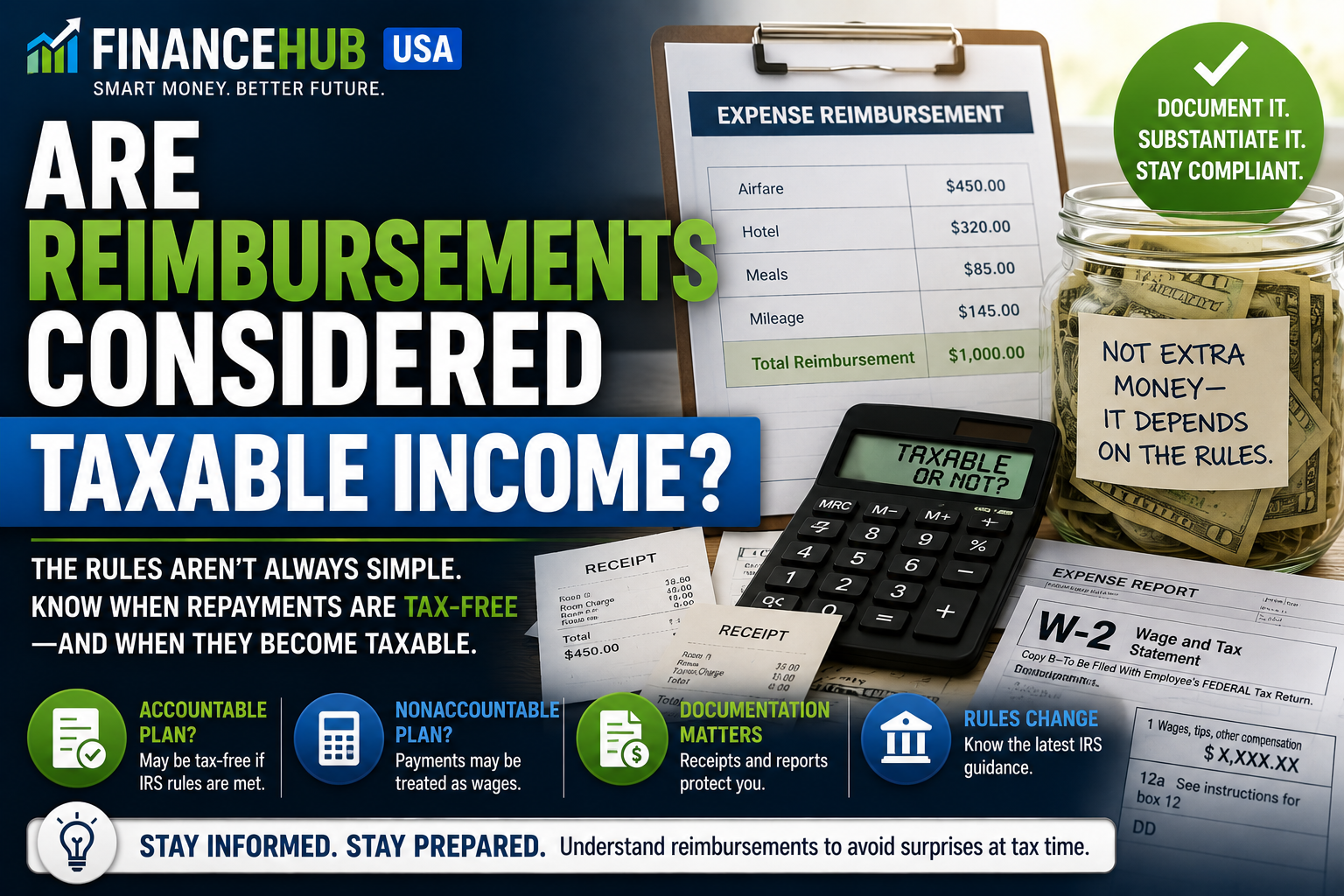
Are Reimbursements Considered Taxable Income?
Are reimbursements taxable income? Learn when employer expense repayments are tax-free, when they become wages, and how accountable plans work.

Getting reimbursed by your employer can look like extra income when the payment appears in your bank account. You might spend $600 on airfare for a business trip, submit the receipt, and later receive $600 from your employer. But receiving cash does not automatically mean you earned additional taxable wages.
So, are reimbursements considered taxable income? The answer depends largely on how the reimbursement arrangement is structured. Under current IRS rules, qualifying business-expense reimbursements made through an accountable plan generally aren't treated as wages and aren't subject to federal income, Social Security, Medicare, or FUTA taxes. By contrast, payments under a nonaccountable plan are generally treated as wages.
Understanding that distinction can help employees read their W-2 correctly, keep better financial records, and recognize when money received from an employer is repayment of a legitimate business expense rather than additional compensation.
Key Takeaways
- Employee reimbursements are not automatically taxable income.
- Qualifying reimbursements under an accountable plan generally aren't treated as wages.
- Employees generally must substantiate business expenses and return excess reimbursements within a reasonable period.
- Payments under a nonaccountable plan are generally treated as taxable wages.
- Medical reimbursements, moving expenses, and independent-contractor reimbursements can follow different rules.
When Are Employee Reimbursements Not Taxable?
The IRS's 2026 Employer's Tax Guide explains that reimbursements paid through an accountable plan aren't wages when the applicable requirements are satisfied. The arrangement must require employees to meet three fundamental rules.
- Business connection: The employee must pay or incur an allowable expense while performing services as an employee, and the reimbursement must actually relate to that expense rather than replacing wages.
- Substantiation: The employee must adequately account for the expense to the employer within a reasonable period of time.
- Return of excess amounts: The employee must return reimbursement or advances exceeding the properly substantiated expenses within a reasonable period of time.
When all three conditions are satisfied, IRS Publication 15 states that amounts paid under the accountable plan aren't wages and aren't subject to federal income, Social Security, Medicare, or FUTA taxes.
| Reimbursement Situation | General Federal Treatment |
|---|---|
| Documented qualifying business expense under accountable plan | Generally not treated as wages |
| Expense not adequately substantiated | Generally treated under nonaccountable-plan rules |
| Excess advance returned on time | Accountable-plan treatment can generally be preserved |
| Excess advance not returned on time | Excess can be treated under nonaccountable-plan rules |
| Payment labeled reimbursement but actually replaces wages | Does not qualify as an accountable-plan reimbursement |
This means the word reimbursement on a payroll statement does not by itself determine the tax result. The arrangement and the underlying expense matter.
What Is an Accountable Plan?
An accountable plan is not necessarily a separate insurance policy or employee benefit account. It is an employer reimbursement arrangement that satisfies IRS requirements.
Imagine Sarah travels to Chicago for a required business meeting. She personally pays $750 for qualifying airfare and lodging. Her employer requires an expense report and receipts. Sarah submits the documentation promptly, and the company reimburses exactly $750.
Assuming the expenses and arrangement satisfy the applicable rules, that $750 generally does not become additional wages simply because Sarah received the money from her employer. She effectively paid an employer-related business expense and was repaid for it.
The IRS also says employees need to adequately account for their expenses. Records can include an expense statement, account book, diary, or similar documentation supported when necessary by evidence such as receipts for travel, mileage, and other business expenses.

When Do Reimbursements Become Taxable Wages?
Reimbursements can receive very different treatment when an employer's arrangement does not satisfy accountable-plan requirements.
According to the IRS's 2026 Publication 15, payments under a nonaccountable plan are wages and are treated as supplemental wages. They are subject to federal income tax withholding as well as Social Security, Medicare, and FUTA taxes as applicable.
An arrangement can be treated as nonaccountable when, for example, the employee isn't required to substantiate expenses in a timely manner, doesn't have to return unused advances, receives money regardless of whether legitimate business expenses are expected, or receives a so-called reimbursement that substitutes for wages the employee otherwise would have received.
Example: A Monthly Expense Allowance
Suppose an employer gives an employee $500 every month for "business expenses," but the employee never has to submit receipts or other records and can keep whatever isn't spent.
The fact that the company calls the $500 an expense allowance does not automatically make it tax-free. If the arrangement fails the accountable-plan requirements, the payments can be treated as wages.
| Arrangement | Receipts Required? | Unused Amount Returned? | General Result |
|---|---|---|---|
| Qualifying accountable plan | Appropriate substantiation required | Excess must be returned | Qualifying reimbursement generally excluded from wages |
| Nonaccountable arrangement | No adequate substantiation | Employee can keep excess | Payment generally treated as wages |

What Happens If Your Employer Reimburses Too Much?
Receiving more money than you actually spent does not necessarily mean the entire reimbursement becomes taxable. The important question is what happens to the excess.
Consider an employee who receives a $2,000 business-travel advance but can substantiate only $1,800 of qualifying expenses. There is a $200 excess.
| Amount | Illustrative Treatment |
|---|---|
| Advance received | $2,000 |
| Properly substantiated qualifying expenses | $1,800 |
| Excess amount | $200 |
| If $200 is timely returned | Accountable-plan treatment can generally continue |
| If $200 isn't timely returned | Excess is generally treated under nonaccountable-plan rules |
IRS Publication 463 explains that when an employee fails to return excess reimbursements within a reasonable time, the excess is treated as paid under a nonaccountable plan.
How Do Reimbursements Appear on Your W-2?
The W-2 treatment can provide an important clue about how your employer classified the payment.
IRS Publication 463 states that when an employee meets the accountable-plan rules, the employer generally should not include qualifying reimbursements in Box 1 of Form W-2. If qualifying accountable-plan reimbursements were incorrectly included in Box 1, the IRS publication advises the employee to ask the employer for a corrected W-2.
Under a nonaccountable plan, however, reimbursements are generally combined with wages, salary, or other compensation and reported as wages.
This difference matters because a $1,500 deposit labeled "expense reimbursement" can have a different tax result from $1,500 of additional compensation even though both increase your bank balance by the same amount.
Are Mileage and Travel Reimbursements Taxable?
Mileage, travel, meals, and similar employee business reimbursements can potentially receive accountable-plan treatment when they satisfy the applicable requirements.
IRS Publication 15 explains that employers can use certain per diem, mileage, or other fixed allowances under applicable federal rules. Amounts that qualify under an accountable plan and do not exceed applicable government rates can receive different tax treatment from amounts that exceed those rates.
For example, a properly structured mileage reimbursement for legitimate business use of an employee's personal vehicle can potentially be excluded from wages when accountable-plan requirements are satisfied. However, merely paying a flat "car allowance" every month does not automatically make the payment nontaxable.

Important 2026 Change: Moving Expense Reimbursements
One area where older tax articles can now be misleading is moving-expense reimbursement. IRS Publication 15-B for 2026 states that legislation enacted in 2025 permanently eliminated the general exclusion for qualified moving-expense reimbursements from employee income.
However, exceptions remain for qualifying members of the U.S. Armed Forces on active duty who move because of a permanent change of station pursuant to a military order. The 2026 IRS guidance also describes an exclusion for qualifying intelligence-community employees or appointees who relocate because of a qualifying change in assignment.
As a result, employees should not assume that an employer-paid relocation expense is tax-free merely because older online guidance describes moving reimbursements as excludable.
What About Medical Expense Reimbursements?
Medical reimbursements can operate under a different set of tax rules from ordinary business-expense reimbursements.
Certain employer-sponsored health arrangements may reimburse qualifying medical expenses on a tax-advantaged basis when applicable federal requirements are satisfied. Examples can include qualifying health reimbursement arrangements, commonly known as HRAs.
Because health-benefit rules can vary significantly depending on the arrangement, employer, employee eligibility, and type of medical expense, workers should review their plan documents rather than assuming every health-related payment receives identical tax treatment.
IRS Publication 15-B provides additional federal guidance concerning employer-provided fringe benefits and certain health-related benefits.
What About Independent Contractors?
The tax treatment of reimbursements involving independent contractors can differ from the rules applying to employees.
Businesses and workers should not automatically assume that an expense payment made to an independent contractor receives the same payroll or reporting treatment as an employee reimbursement under an accountable plan.
Contractors generally operate as self-employed individuals and may have separate rules for reporting business income and deducting ordinary and necessary business expenses.
Because worker classification itself can have significant tax consequences, businesses should correctly determine whether someone is an employee or independent contractor before applying reimbursement and reporting rules.
What If You Paid a Business Expense With Your Personal Credit Card?
Using a personal credit card does not automatically transform a legitimate business expense into a personal expense.
Suppose an employee purchases a $400 airline ticket for required business travel using a personal credit card. The employee later submits the receipt and other required documentation, and the employer reimburses the $400 under a qualifying accountable plan.
The fact that the original purchase appeared on a personal credit-card statement does not necessarily determine the tax result. What matters is whether the underlying expense was a legitimate employee business expense and whether the reimbursement arrangement satisfies the applicable requirements.
This is another reason employees should retain receipts and supporting documentation instead of relying solely on bank or credit-card statements.

Common Reimbursement Mistakes to Avoid
Even when an employer intends to reimburse legitimate business expenses, poor documentation or unclear procedures can create unnecessary tax and payroll complications.
- Failing to keep receipts: Employees may have difficulty adequately substantiating expenses without proper records.
- Waiting too long to submit expenses: Accountable-plan rules generally require substantiation within a reasonable period.
- Keeping excess advances: Employees may need to return amounts exceeding properly substantiated expenses.
- Assuming every allowance is tax-free: A fixed monthly allowance does not automatically qualify as a nontaxable reimbursement.
- Ignoring the W-2: Employees should review how reimbursements were reported and ask questions if something appears inconsistent.
- Mixing wages and reimbursements: Reimbursements should not simply be used as substitutes for taxable compensation.
Good documentation protects both employees and employers. A clear paper trail makes it easier to demonstrate what the expense was, why it was business-related, how much was spent, and whether any excess payment was returned.
FinanceHub USA Analysis: Follow the Money and the Documentation
The most useful way to analyze a reimbursement is to follow both the money and the documentation.
If an employee spends $900 on qualifying business travel and receives exactly $900 back under a properly administered accountable plan, the reimbursement primarily restores the employee's financial position. The employee does not keep an additional $900 after the business cost.
By contrast, if an employer pays $900 every month regardless of actual expenses, requires no documentation, and lets the employee keep the entire amount, the payment begins to resemble compensation rather than repayment.
That distinction explains why documentation matters so much. Receipts, mileage records, expense reports, invoices, and timely repayment of excess advances are not merely administrative paperwork. They help establish the nature of the payment itself.
For employees, the practical lesson is straightforward: don't determine whether a payment is taxable solely by looking at the deposit in your bank account. Look at why you received the money, what expense it relates to, what documentation was required, whether you kept any excess, and how your employer reported the payment.
This same principle applies to other situations where receiving money can create tax confusion. You may also want to read our guides on whether Zelle payments are taxable and how Venmo payments are treated for tax purposes.
Final Thoughts
So, are reimbursements considered taxable income? Not automatically. Qualifying employee business-expense reimbursements paid through an accountable plan generally aren't treated as wages when the IRS requirements are satisfied.
The situation changes when expenses aren't properly substantiated, excess advances aren't returned, payments substitute for wages, or the arrangement otherwise fails the accountable-plan requirements. In those circumstances, some or all of the payment may be treated as taxable compensation.
The safest approach is to keep detailed records, submit expenses promptly, return excess reimbursements when required, and review your W-2 carefully. Tax treatment can also differ for specialized situations such as medical benefits, moving expenses, and independent contractors.
For significant or unusual reimbursement situations, consider consulting a qualified tax professional who can evaluate your specific circumstances.
Continue exploring FinanceHub USA for practical guides covering taxes, credit, banking, investing, retirement planning, and personal finance.
Related reading: Do You Pay Taxes on Money You Borrow?
Tax Disclaimer: This article is for general educational and informational purposes only and does not constitute tax, legal, or financial advice. Tax rules can vary depending on individual circumstances and may change over time. Consider consulting a qualified tax professional regarding your specific situation.
Official IRS Sources
Frequently asked questions
Are reimbursements considered taxable income?
Not always. Qualifying employee business-expense reimbursements paid under an accountable plan generally aren't treated as taxable wages when IRS requirements are satisfied.
What makes an expense reimbursement tax-free?
Under an accountable plan, the expense must have a qualifying business connection, the employee must adequately substantiate it within a reasonable period, and excess reimbursement must be returned within a reasonable period.
Are reimbursements reported on Form W-2?
Qualifying accountable-plan reimbursements generally aren't included as wages in Box 1. Payments under nonaccountable plans are generally treated as wages.
What happens if I don't provide receipts for a reimbursement?
If you fail to adequately substantiate expenses as required, the payment may fail accountable-plan requirements and generally be treated under nonaccountable-plan rules.
Is a monthly expense allowance taxable?
It can be. A flat allowance that does not require adequate substantiation or return of excess amounts may be treated as wages under nonaccountable-plan rules.
Are mileage reimbursements taxable?
Qualifying business mileage reimbursements can receive accountable-plan treatment when the applicable requirements are satisfied. Excess or unsubstantiated amounts can be taxable.
Are medical expense reimbursements taxable?
Qualifying medical-care reimbursements under an eligible employer accident or health plan are generally excludable from employee wages, although special rules and exceptions can apply.
Are QSEHRA reimbursements taxable in 2026?
Qualifying QSEHRA reimbursements generally aren't included in an eligible employee's gross income when the applicable requirements, including qualifying health coverage requirements, are satisfied.
What are the 2026 QSEHRA limits?
IRS Publication 15-B lists maximum 2026 reimbursements of $6,450 for self-only coverage and $13,100 for family coverage.
Are moving expense reimbursements tax-free in 2026?
Generally not for ordinary employees. The general exclusion was permanently eliminated, although specific exceptions remain for qualifying Armed Forces members and certain intelligence-community employees or appointees.
What happens if my employer reimburses me more than I spent?
Under an accountable plan, excess reimbursement generally must be returned within a reasonable period. An excess amount that isn't timely returned can be treated under nonaccountable-plan rules.
Are reimbursements to independent contractors taxable?
Independent contractors have separate reporting rules, and the result depends on the reimbursement arrangement and underlying expenses. Contractors should maintain detailed records and determine the correct business income and expense reporting treatment.