Does Home Insurance Cover a Broken TV?
Does homeowners insurance cover a broken TV? Learn when fire, theft, lightning, water damage, accidents, and deductibles may affect your claim.
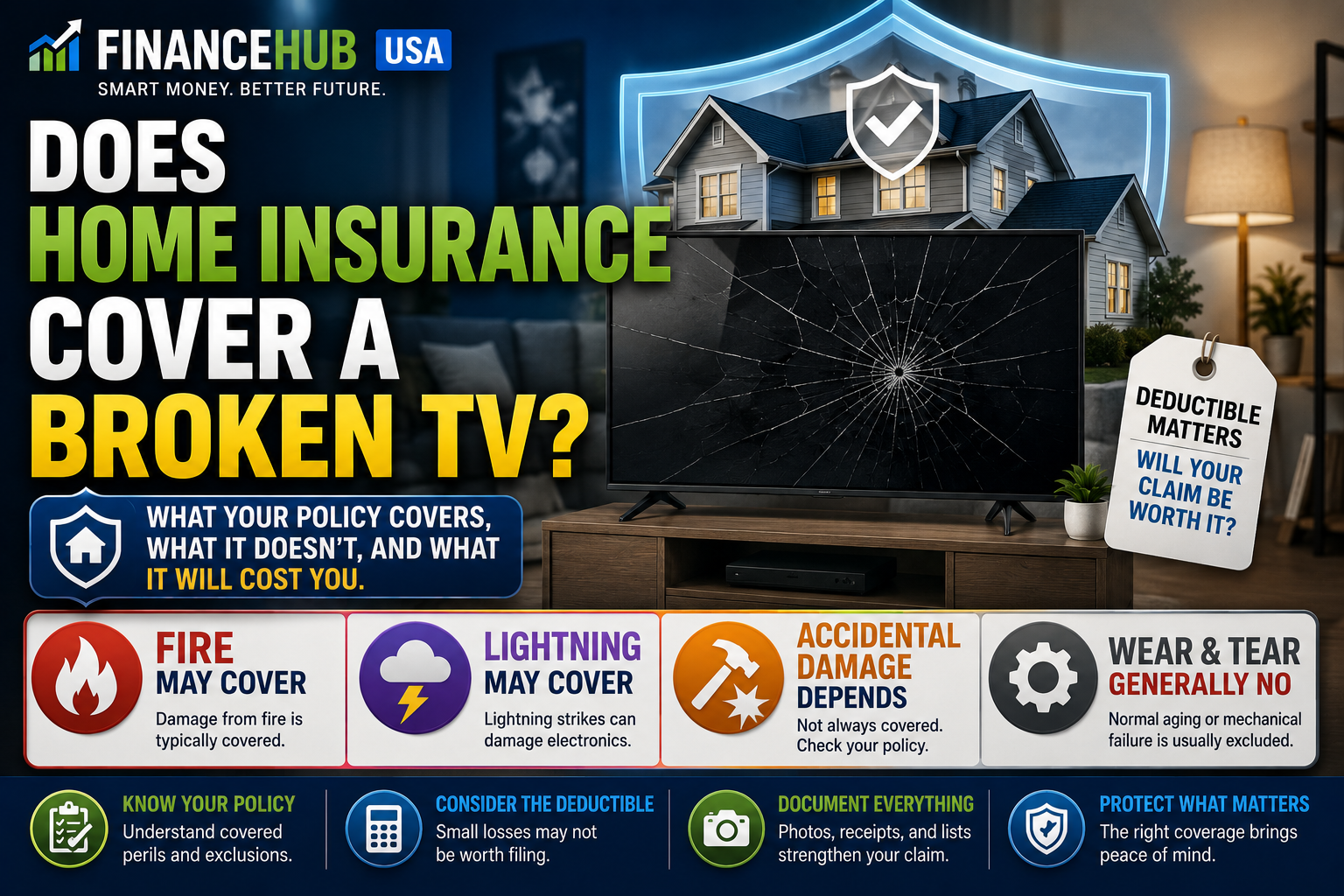

You walk into your living room after a thunderstorm and discover that your television no longer turns on. Or perhaps a pipe leaks above the room, a burglar steals the TV, or someone accidentally knocks the screen onto the floor. The television may be the same in every example, but whether homeowners insurance pays for the damage can be completely different.
So, does home insurance cover a broken TV? Potentially. Televisions generally fall under the personal property portion of homeowners insurance, which can protect electronics and other belongings when damage or loss results from a cause covered by the policy.
However, homeowners insurance is not a warranty for everything that stops working. The cause of the damage, your policy terms, exclusions, deductible, coverage limits, and the method your insurer uses to value your belongings can all determine whether a claim results in a payment.
When Does Homeowners Insurance Cover a TV?
The first question an insurer is likely to consider is not simply whether the television is broken. The critical question is what caused it to break.
The National Association of Insurance Commissioners explains that coverage for personal belongings can reimburse policyholders for possessions such as furniture, electronics, appliances, and clothing when they are damaged or lost because of a covered cause. The exact protection depends on the individual policy and the event responsible for the loss.
For example, a television destroyed in a house fire may be treated very differently from a television that simply stops functioning after years of use.
| What Happened to the TV? | Potential Coverage | Key Issue |
|---|---|---|
| Destroyed in a covered house fire | Often potentially covered | Fire is commonly an insured peril |
| Damaged by lightning | Potentially covered | Policy terms and the cause of damage matter |
| Stolen during a burglary | Potentially covered | Theft coverage and policy limits apply |
| Damaged by certain covered water events | May be covered | The source of the water is critical |
| Screen fails because of age | Generally not covered | Wear, deterioration, or mechanical failure may not qualify |
| Owner accidentally drops the TV | Depends heavily on the policy | Accidental breakage is not covered by every homeowners policy |
| Damaged by flooding | Generally not covered by standard homeowners insurance | Flood insurance is normally separate |
This is why two homeowners with identical televisions can receive different claim outcomes. The physical damage alone does not establish coverage. The cause of the loss and the terms of the insurance policy determine whether the damage may qualify.
Fire, Lightning, Theft and Water Damage: What's Covered?
Homeowners insurance commonly protects personal belongings against several specified risks. Standard policies frequently include protection against events such as fire and lightning, although the exact list of covered events depends on the policy.
Fire
Suppose a kitchen fire spreads into the living room and destroys a $1,500 television. If the fire qualifies as a covered loss and the television is included under the policy's protection for personal belongings, the TV could become part of the overall insurance claim.
Lightning
Lightning is another commonly insured peril. However, homeowners should document what happened and allow the insurer to determine whether the television failed because of the covered event.
The fact that a television stopped working during a storm does not automatically establish that lightning caused the damage.
Theft
If someone breaks into your home and steals your television, coverage for personal belongings may apply, subject to the deductible, coverage limits, exclusions, and other terms of the policy.
Documentation such as receipts, photographs, serial numbers, and a household inventory can make it easier to demonstrate what you owned.
Water Damage
Water losses require additional attention because the source of the water is extremely important. Certain sudden water events may be covered depending on the policy, while flooding is generally excluded from standard homeowners insurance and normally requires separate flood insurance.

What If You Accidentally Break Your Own TV?
This is where many consumers misunderstand homeowners insurance. Imagine you're moving furniture and accidentally knock your 65 inch television off its stand. The screen cracks instantly.
You should not automatically assume that your homeowners policy will replace it.
Coverage for personal belongings depends heavily on the policy and the causes of loss it insures. Some policies protect personal belongings against specifically named events, while broader policies may provide different protection.
Accidental breakage caused by simply dropping an item should therefore be checked against the actual insurance contract rather than assumed to be covered.
The same principle applies when a child throws an object into the screen or you damage the television while installing it. Home insurance is primarily designed to protect against insured losses. It is not intended to function as an unlimited electronics protection plan.
The Deductible Can Make a Covered TV Claim Worth Very Little
Even if the television was damaged by a covered event, that does not automatically mean filing a claim for the television alone makes financial sense.
Consider a simplified example. A covered event destroys a television with an insured loss value of $1,200, while the applicable homeowners insurance deductible is $1,000.
| Example | Amount |
|---|---|
| Illustrative covered TV loss | $1,200 |
| Applicable deductible | $1,000 |
| Difference above deductible | $200 |
This does not mean the insurer will necessarily write a $200 check. Claim valuation, depreciation, policy terms, other damaged property, coverage limits, and the insurer's adjustment process all matter.
The example simply demonstrates why the deductible should be considered before assuming insurance will meaningfully offset the cost of one damaged television.
The calculation can change dramatically when the TV is only one part of a larger covered loss. If a fire damages the television, furniture, computers, clothing, and other belongings, the combined loss may make the deductible much less significant relative to the total claim.

Replacement Cost vs. Actual Cash Value Can Change the Payment
One of the most important details is how your insurance policy values personal belongings.
With actual cash value coverage, depreciation can reduce the amount attributed to an older television.
With replacement cost coverage, qualifying property can generally be reimbursed based on the cost of replacing it with property of similar kind and quality, subject to the terms and limits of the policy.
For example, if a fire destroys an older television, replacement cost coverage may provide reimbursement based on the cost of obtaining a comparable new television. Actual cash value coverage, by comparison, generally takes depreciation into consideration.
The claims process also matters. Depending on the insurer and policy, an initial payment may reflect the depreciated value of damaged property. The policyholder may then need to purchase a qualifying replacement and provide documentation before receiving additional reimbursement available under replacement cost coverage.
| Coverage Type | General Approach | Effect on an Older TV |
|---|---|---|
| Actual Cash Value | Replacement cost adjusted for depreciation | Age can substantially reduce the insured value |
| Replacement Cost | Cost of a comparable replacement, subject to policy terms | Can provide greater protection against depreciation |
For homeowners with expensive televisions, computers, gaming equipment, and other electronics, understanding this distinction before a loss occurs can be more important than simply knowing the total limit available for personal belongings.
FinanceHub USA Analysis: Don't Look at the TV in Isolation
A $1,500 television sounds like a substantial loss, but insurance decisions should be evaluated in the context of the entire event and the policy.
Suppose a covered lightning event damages a TV, desktop computer, router, gaming console, and other electronics. Looking only at the television may significantly understate the potential loss.
Conversely, filing a claim solely because an older $600 television stopped working may make little sense if the cause is not covered or the applicable deductible exceeds the insured value of the loss.
Before deciding what to do, consider:
- What exactly caused the television to break?
- Is that cause covered under your specific insurance policy?
- What deductible applies to the loss?
- Was anything else damaged during the same event?
- Does your policy use actual cash value or replacement cost?
- Can you document the TV's model, age, purchase price, and condition?
- Does your policy contain any special limits relevant to electronics?
- Would the potential covered amount materially exceed your deductible?
What Documentation Should You Keep for an Expensive TV?
If your television is damaged by a potentially covered event, documentation can make the claim easier to evaluate.
You do not necessarily need the original receipt for every possession you own, but having evidence of the television's existence, model, approximate purchase date, and value can make it easier to support your claim.
A useful household inventory can include photographs or video of the television, its brand and model number, serial number, purchase receipt or online order confirmation, approximate purchase date, and information about other electronics in the same room.
The National Association of Insurance Commissioners encourages consumers to maintain an inventory of their belongings. This can become especially useful after a major fire, theft, or another event involving dozens of possessions rather than a single television.
| Documentation | Why It Can Help |
|---|---|
| Purchase receipt | Shows the purchase date and original price |
| TV model number | Helps identify a comparable replacement |
| Serial number | Helps document the specific television owned |
| Photos or video | Provides evidence of ownership and condition |
| Photos of the damage | Documents what happened after the loss |
| Repair technician report | May help establish the cause of the failure or whether repair is possible |
How Does a Home Insurance Claim for a Broken TV Work?
If you believe the damage resulted from a covered event, start by reviewing your policy and contacting your insurer or insurance professional.
Explain what happened accurately rather than trying to characterize the event yourself as covered or not covered.
The insurer may request photographs, receipts, model information, proof of ownership, a description of the event, or an opportunity to inspect the damaged property.
Avoid throwing the television away until you know whether the insurer needs to inspect it.
The settlement process can also depend on whether your belongings are covered using actual cash value or replacement cost. Even when replacement cost coverage applies, the insurer may initially calculate the damaged television using its depreciated value.
After purchasing a qualifying replacement and providing the required documentation, additional reimbursement may become available according to the terms of the policy.
A simplified claim process might look like this:
- Document the damaged television and surrounding damage.
- Identify what happened immediately before the damage occurred.
- Review the section of your policy covering personal belongings.
- Check the applicable deductible.
- Contact your insurer if you believe the event may qualify for coverage.
- Provide the documentation requested by the insurer.
- Keep the damaged television unless the insurer says it can be discarded.
- Review the insurer's coverage and valuation decision.
- Keep replacement receipts if your policy provides replacement cost coverage.
Is It Worth Filing a Home Insurance Claim for a TV?
This question requires more than comparing the television's original purchase price with your deductible. You also need to consider its insured value and whether other property was damaged during the same covered event.
Consider three simplified scenarios using a hypothetical $1,000 deductible:
| Illustrative TV Loss | Deductible | Amount Above Deductible | Initial Observation |
|---|---|---|---|
| $500 | $1,000 | $0 | The loss by itself is below the deductible |
| $1,500 | $1,000 | $500 | Potential benefit depends on coverage and valuation |
| $3,000 | $1,000 | $2,000 | The potential claim value becomes more significant |
These figures are intentionally simplified and are not estimates of what an insurance company would actually pay.
A $3,000 television that is several years old could have a substantially lower insured value when depreciation is considered. Replacement cost coverage may provide greater protection if all requirements under the policy are satisfied.
The analysis also changes if the television is part of a larger event. A lightning loss that damages a $1,500 television, a $2,000 computer, a $600 gaming console, and other covered electronics should not be evaluated as though only the television were damaged.
What If the Insurance Company Denies the TV Claim?
A denied claim does not necessarily mean the insurer is saying your television was not damaged.
It may mean the insurer determined that the cause of the loss is not covered, an exclusion applies, the insured loss does not exceed the deductible, or another condition in the policy affects coverage.
Ask for the insurer's explanation and compare it with the relevant language in your policy. If you believe the decision is incorrect, gather supporting documentation and ask about the insurer's review or appeal process.
State insurance departments can also provide consumers with information and assistance regarding insurance issues.
Related reading: What Happens If Your Insurance Claim Is Denied?
Common Mistakes Homeowners Make With Electronics Claims
- Assuming every broken TV is insured. Coverage depends heavily on what caused the damage.
- Confusing insurance with a warranty. Homeowners insurance generally is not designed to replace electronics simply because they become old or stop functioning.
- Ignoring the deductible. A covered loss can still produce little or no payment when its value is below or only slightly above the applicable deductible.
- Throwing the TV away immediately. The insurer may need photographs, documentation, or an inspection.
- Forgetting about depreciation. Actual cash value can produce a substantially lower valuation for an older television.
- Failing to document other damaged property. A TV may be only one component of a larger covered loss.
- Not maintaining an inventory of your belongings. Reconstructing ownership information after a major disaster can be much more difficult.
- Assuming replacement cost means immediate full reimbursement. Some claims may initially be valued using depreciation, with additional reimbursement becoming available after a qualifying replacement is purchased and documented.

FinanceHub USA Analysis: The Cause Matters More Than the Price
When homeowners ask whether insurance covers a $500, $1,500, or $3,000 television, price naturally becomes the focus. But the first insurance question should usually be different: Why did the TV break?
An expensive television damaged only by ordinary deterioration may not represent a covered homeowners insurance loss. Meanwhile, a less expensive television destroyed as part of a covered fire may qualify as personal property within a much larger claim.
After establishing the cause, the economics become important. Compare the insured value of all damaged property with your deductible and determine whether depreciation applies.
This prevents the common mistake of assuming that the retail price printed on an old receipt equals the amount an insurer will pay today.
The broader lesson extends beyond televisions. Computers, monitors, gaming consoles, speakers, tablets, and other electronics can represent thousands of dollars of household property.
Maintaining an updated inventory and understanding how your policy protects personal belongings before something happens can make a future claim considerably easier to document.
Final Thoughts
So, does home insurance cover a broken TV? It can, but the reason the television broke is usually more important than the fact that it is broken.
Damage caused by a covered fire, lightning event, theft, or another insured peril may fall under coverage for personal belongings. Ordinary wear, mechanical failure, flooding, or accidental breakage may be treated differently depending on the policy and the circumstances.
Before filing a claim, review the cause of the loss, your deductible, the coverage limits for personal belongings, and whether your insurer uses actual cash value or replacement cost to determine reimbursement.
Document the television and any other damaged property before disposing of anything.
A homeowners insurance policy should not be treated like an electronics warranty. Its real value is protecting your household against covered financial losses that could otherwise be difficult to absorb.
Continue exploring FinanceHub USA for practical guides about homeowners insurance, auto insurance, insurance claims, deductibles, banking, credit, and personal finance.
Sources and Further Reading
Frequently asked questions
Does homeowners insurance cover a broken TV?
It may if the television was damaged or lost because of a peril covered by your policy. Coverage depends on the cause of loss, policy terms, deductible, limits, and how personal property is valued.
Does home insurance cover a TV damaged by lightning?
Lightning is commonly an insured peril under homeowners coverage, but the insurer will evaluate whether the television damage resulted from the covered event and whether other policy terms apply.
Does homeowners insurance cover a stolen TV?
Theft of personal property may be covered under many homeowners policies, subject to the policy's terms, deductible, limits, and documentation requirements.
Does home insurance cover accidentally dropping a TV?
Not necessarily. Accidental breakage from dropping a television may not be covered under standard personal-property protection. Coverage depends on the specific policy form and endorsements.
Does homeowners insurance cover a TV that stops working?
A television that stops working because of age, wear, deterioration, or mechanical failure is generally different from property damaged by an insured peril. Homeowners insurance is not intended to function as a standard electronics warranty.
Does homeowners insurance cover flood damage to a TV?
Standard homeowners insurance generally excludes flooding. Separate flood insurance may be needed, and its personal-property coverage has its own terms and limitations.
Should I file an insurance claim for a $500 TV?
If the applicable deductible is greater than the insured loss and no other property was damaged, the claim may provide no payment. Review the entire loss and your policy before deciding.
What is actual cash value for a television?
Actual cash value generally reflects the cost to repair or replace the property after accounting for factors such as age, wear, and depreciation.
What does replacement cost mean for a broken TV?
Replacement-cost coverage generally bases qualifying reimbursement on replacing damaged property with property of similar kind and quality without deducting depreciation, subject to policy terms and limits.
Do I need a receipt to claim a broken television?
A receipt can be useful evidence, but insurers may request different forms of documentation. Photos, model and serial numbers, purchase records, and a home inventory can also help establish ownership and value.