What Happens to Insurance After the Policyholder Dies?
What happens to insurance after a policyholder dies? Learn how life, auto and home policies may be handled, who receives benefits and what families should do.
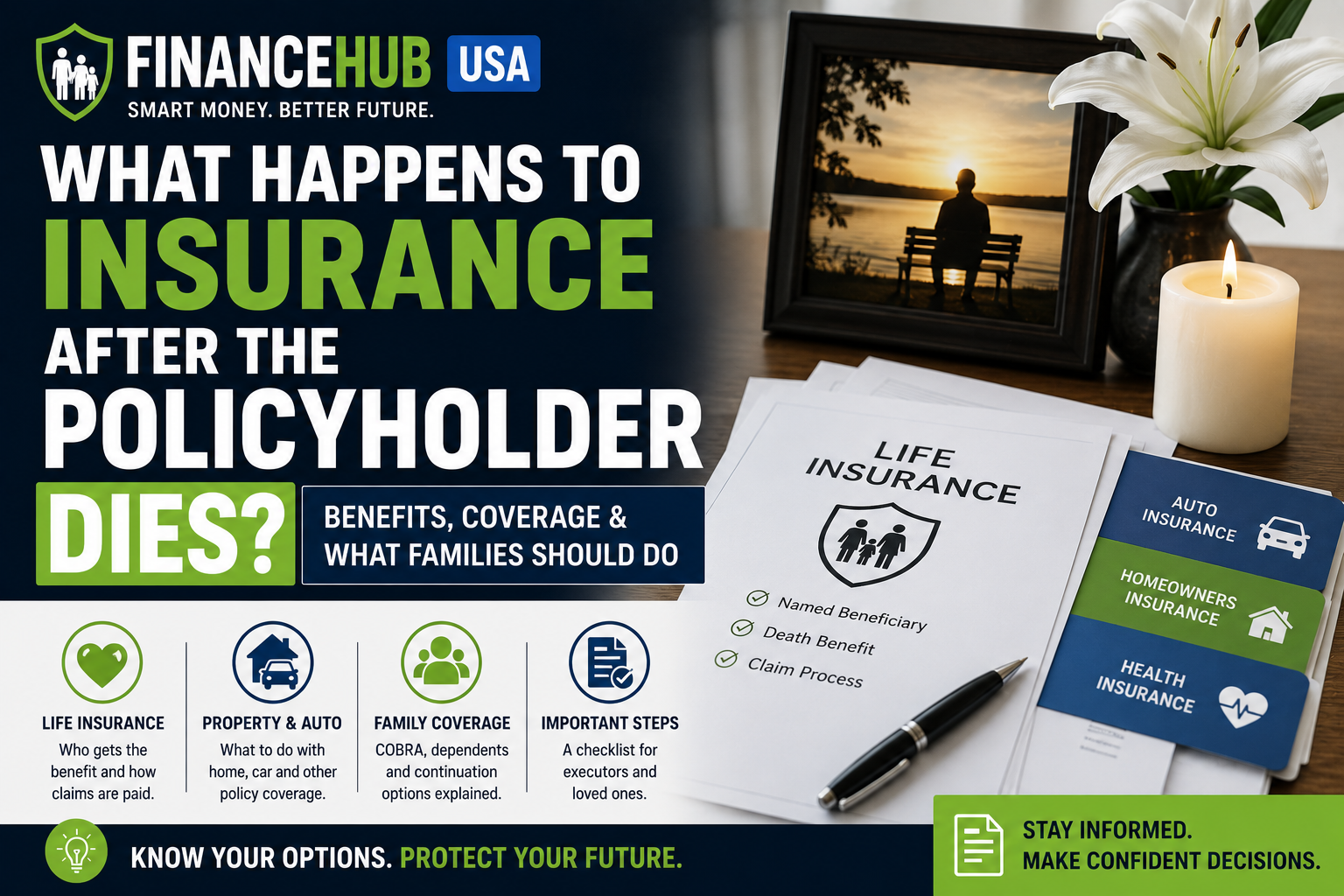

When a family member dies, insurance can quickly become one of the most important—and confusing—parts of settling their financial affairs. Life insurance may provide money to beneficiaries, while auto, homeowners, health, and other policies can require very different actions.
One potentially costly mistake is assuming that every insurance policy automatically ends when the policyholder dies.
So, what happens to insurance after the policyholder dies? It depends on the type of policy. Life insurance generally moves into the death-claim process, while property and casualty policies such as homeowners and auto insurance may still need to protect property during estate administration. Health insurance can create separate coverage decisions for surviving spouses and dependents.
Beneficiary designations, policy ownership, additional insureds, premiums, outstanding policy loans, estate administration, occupancy, vehicle ownership, and state insurance law can all affect what happens next.
Key Takeaways
- Insurance does not necessarily disappear automatically when a policyholder dies.
- Life insurance generally pays eligible death benefits according to the policy's beneficiary provisions.
- A valid named life insurance beneficiary generally receives proceeds outside the normal distribution process under a will, although exceptions and disputes can arise.
- Life insurance death benefits are generally excluded from federal gross income when received because of the insured's death, but interest and certain special situations can be taxable.
- Homeowners insurance may still be needed while a house remains in an estate.
- Auto insurance should be reviewed promptly, particularly if the vehicle is still being driven.
- Surviving spouses and dependents may have COBRA or other health-insurance enrollment options.
- Families should generally contact insurers before canceling policies or making major coverage changes.
- The NAIC Life Insurance Policy Locator can help families search for a deceased person's missing life insurance policy.
Does Insurance Automatically End When the Policyholder Dies?
Not necessarily. The effect of death depends heavily on the type of insurance involved and the terms of the individual contract.
Life insurance is specifically designed around the death of an insured person. If an in-force policy covers the deceased and a valid claim is established, the insurer generally pays the applicable death benefit according to the policy's beneficiary provisions.
Auto and homeowners insurance work differently. These policies protect vehicles, homes, liability exposures, and other insured interests rather than simply paying a predetermined benefit because someone died.
Those policies should generally be reviewed promptly with the insurer or insurance agent because the insured property may continue to face financial risks while ownership and estate matters are being resolved.
| Insurance Type | General Issue After Death | Typical Next Step |
|---|---|---|
| Life insurance | Death benefit may become claimable | Beneficiary contacts insurer and files a claim |
| Auto insurance | Vehicle may still need coverage | Estate or authorized family member contacts insurer |
| Homeowners insurance | Home remains exposed to property and liability risks | Notify insurer and explain occupancy and ownership changes |
| Health insurance | Deceased person's coverage ends while dependents may face separate coverage issues | Contact employer, plan administrator, or insurer promptly |
The practical lesson is simple: do not automatically cancel every insurance policy immediately after a death. Doing so prematurely could potentially leave a home, vehicle, or other property without appropriate protection.
What Happens to Life Insurance When the Insured Dies?
Life insurance is generally the most straightforward category because death is the event the coverage is designed to address.
After the insured dies, the beneficiary generally needs to identify the insurer and contact the company to begin the claims process.
The insurer may request documents including:
- A certified copy of the death certificate
- Completed claim forms
- Policy information, when available
- Identification and beneficiary information
- Additional documentation when required by the circumstances
The National Association of Insurance Commissioners explains that primary beneficiaries generally receive all or part of the policy benefit if they survive the insured. Contingent beneficiaries can become relevant when a primary beneficiary dies before the insured, depending on the beneficiary designation and policy terms.
Example: A $500,000 Life Insurance Policy
Suppose a parent has a $500,000 life insurance policy and validly designates two adult children to receive equal shares.
If the policy remains in force and the claim is payable according to its terms, the distribution could look like this:
| Death Benefit | Beneficiary Share | Illustrative Payment |
|---|---|---|
| $500,000 | 50% | $250,000 |
| $500,000 | 50% | $250,000 |
The actual distribution depends on the policy's beneficiary designation and provisions rather than simply on what relatives expect to inherit.

Does Life Insurance Go Through Probate?
When a valid individual beneficiary is named, life insurance proceeds generally can be paid according to the beneficiary designation rather than being distributed under the deceased person's will.
This distinction is important because a will generally does not override a valid life insurance beneficiary designation.
If a policyholder names an adult child as the beneficiary but later writes a will stating that another relative should receive the person's assets, the beneficiary designation on the life insurance contract can still control the insurance proceeds, subject to applicable law and the particular circumstances.
The situation can become more complicated when:
- The estate is named as beneficiary.
- No valid beneficiary survives the insured.
- The beneficiary designation is incomplete or invalid.
- There is a dispute over the beneficiary designation.
- Applicable state law affects the distribution.
If the proceeds become payable to the estate, they generally become part of the estate-administration process and probate considerations may become relevant.
Are Life Insurance Death Benefits Taxable?
For U.S. federal income tax purposes, life insurance proceeds received by a beneficiary because of the insured person's death are generally excluded from gross income.
That does not mean every dollar associated with a life insurance payment is automatically tax-free in every situation.
The IRS explains that interest received on life insurance proceeds is generally taxable. Special rules can also apply in certain situations, including some policies transferred for valuable consideration.
| Payment | General Federal Income Tax Treatment |
|---|---|
| Life insurance death benefit paid because of death | Generally excluded from gross income |
| Interest earned on proceeds | Generally taxable as interest |
| Certain transferred-for-value policies | Special federal tax rules can apply |
Example
Suppose a beneficiary is entitled to a $300,000 life insurance death benefit. The $300,000 principal received because of the insured's death would generally be excluded from federal gross income.
If the insurer separately pays $4,000 of taxable interest because the proceeds remained with the insurer for a period, the interest can receive different federal tax treatment from the underlying death benefit.
When proceeds are paid in installments, part of each payment can represent excluded death-benefit principal while another portion may represent taxable interest.
What Happens to Cash Value After Death?
Permanent life insurance policies can accumulate cash value while the insured is alive, but beneficiaries should not automatically assume they will receive the stated death benefit plus the accumulated cash value.
Depending on the type and design of the policy, cash value may be incorporated into how the death benefit works rather than being paid as a completely separate amount.
Outstanding policy loans can also reduce the amount ultimately paid.
Example With a Policy Loan
| Policy Detail | Illustrative Amount |
|---|---|
| Stated death benefit | $400,000 |
| Outstanding policy loan and interest | $35,000 |
| Illustrative remaining benefit | $365,000 |
This simplified example demonstrates why beneficiaries should obtain the insurer's actual claim calculation instead of assuming the amount shown on an older policy statement is necessarily the amount they will receive.
What Happens to Auto Insurance After the Policyholder Dies?
Auto insurance should be addressed promptly after the named policyholder dies, particularly when the insured vehicle is still being driven.
The executor, surviving spouse, or another authorized person should contact the insurer and explain:
- That the named policyholder died
- Who currently possesses the vehicle
- Who is currently driving it
- Where the vehicle is normally stored
- Who currently owns or controls the vehicle
- Whether the vehicle will be sold, transferred, or inherited
Do not assume another family member automatically becomes the insured merely because that person inherits or temporarily possesses the vehicle.
Coverage can depend on policy language, named insureds, permissive-use provisions, ownership, household status, and state law.
Families should also be cautious about immediately canceling auto insurance while the estate still owns the vehicle. Even an undriven vehicle can be exposed to theft, vandalism, fire, severe weather, and other losses.
A vehicle that continues to be driven without appropriate insurance can create even greater financial and legal exposure.
Can a Family Member Keep Driving the Deceased Person's Car?
Families should not assume that a relative can continue driving the deceased person's vehicle indefinitely under the existing policy without notifying the insurer.
Temporary coverage may depend on the policy's definitions, who qualifies as an insured, vehicle ownership, permissive use, estate provisions, and applicable state law.
The safest practical approach is to contact the insurer promptly and explain exactly who will be driving the vehicle and what will happen to its ownership.
If the vehicle is eventually transferred to an heir, the insurer can explain whether a new policy or other coverage change is required.
What Happens to Homeowners Insurance After Death?
A house does not stop needing insurance because its owner died.
Fire, wind, theft, water damage, liability claims, and other risks can continue while the property is being administered by an estate, prepared for sale, or transferred to heirs.
The executor or other authorized estate representative should notify the homeowners insurer promptly and explain:
- That the homeowner died
- Who currently occupies the property
- Whether the house is vacant or unoccupied
- Who is responsible for maintaining it
- Whether it will be sold or transferred to an heir
Occupancy can be particularly important because homeowners policies can contain provisions affecting vacant or unoccupied properties.
If the house will remain vacant for an extended period, the insurer may require changes to the existing coverage or a different form of insurance.

FinanceHub USA Analysis: The Biggest Risk Is Acting Too Quickly
One of the most important financial mistakes families can avoid is treating every insurance contract as though it serves the same purpose.
Life insurance is designed to create a financial benefit after an insured person's death. Auto and homeowners policies serve a fundamentally different purpose: they protect assets and liability exposures that can continue to exist after the owner dies.
Canceling property coverage immediately can therefore create a gap at exactly the wrong time.
Example
Imagine a homeowner dies and the property remains vacant for four months while the estate prepares it for sale.
The home is still exposed to risks including:
- Fire
- Storm damage
- Theft
- Vandalism
- Water damage
- Potential liability incidents
If the family simply cancels the homeowners policy without first arranging appropriate protection, the estate could potentially face a major uninsured financial loss.
A better approach is to inventory every policy, notify each insurer, identify beneficiaries and insured property, and obtain guidance about what changes are necessary before canceling anything.
What Happens to Health Insurance After the Policyholder Dies?
Health insurance requires separate attention because the death of a covered employee can affect a spouse and dependent children who obtained coverage through that person's employer-sponsored health plan.
The U.S. Department of Labor explains that the death of a covered employee can be a COBRA qualifying event for a covered spouse and dependent children when the event causes them to lose group health coverage.
For qualifying plans and circumstances, eligible surviving spouses and dependent children may be able to temporarily continue the employer-sponsored coverage through COBRA.
Continuation coverage after a qualifying death can generally be available for up to 36 months for eligible spouses and dependent children, although COBRA does not apply to every health plan and beneficiaries generally must pay the required premiums.
| Potential Health Coverage Option | What Surviving Family Members Should Know |
|---|---|
| COBRA | Eligible spouses and dependent children may be able to temporarily continue qualifying employer coverage |
| Surviving spouse's employer plan | Loss of other coverage may create a special enrollment opportunity |
| Health Insurance Marketplace | Loss of qualifying coverage may create a special enrollment opportunity |
| Other government or private coverage | Eligibility depends on individual circumstances and program rules |
Because enrollment windows and notification deadlines can apply, surviving family members should contact the employer's benefits department, plan administrator, or insurer promptly instead of waiting until medical care is needed.
What If There Is No Life Insurance Beneficiary?
Life insurance can become more complicated when there is no surviving valid beneficiary.
The outcome depends on the policy's beneficiary provisions and applicable state law.
Some policies specify who receives the proceeds when no designated beneficiary survives. In other circumstances, proceeds may ultimately become payable to the insured person's estate.
If the estate receives the proceeds, they generally become part of estate administration rather than being paid directly to an individual beneficiary.
This can potentially introduce probate procedures, estate obligations, creditor issues, and other legal considerations.
It is one reason policyholders should periodically review beneficiary designations, especially after major life events such as:
- Marriage
- Divorce
- Birth or adoption of a child
- Death of a beneficiary
- Major changes in family circumstances
What If the Beneficiary Died Before the Policyholder?
This is one reason life insurance policies commonly allow both primary and contingent beneficiaries.
Suppose a policyholder names a spouse as primary beneficiary and an adult child as contingent beneficiary.
If the spouse dies before the insured and the beneficiary designation is not otherwise changed, the contingent beneficiary may become entitled to the proceeds when the insured later dies, subject to the policy terms and applicable law.
| Situation | Potential Outcome |
|---|---|
| Primary beneficiary survives insured | Primary beneficiary generally receives designated proceeds |
| Primary beneficiary dies first and contingent beneficiary survives | Contingent beneficiary may receive proceeds |
| No surviving valid beneficiary | Policy provisions and state law determine payment; estate may become relevant |
| Estate named as beneficiary | Proceeds generally become payable to the estate |
Families should avoid assuming that a will automatically determines who receives life insurance proceeds. The insurance contract and beneficiary designation are central to determining payment.
How Do You Find a Lost Life Insurance Policy?
A surprisingly difficult problem after someone's death is determining whether the person had life insurance at all.
Family members may remember hearing about a policy but not know which insurer issued it. In other cases, relatives may have no idea that coverage existed.
The National Association of Insurance Commissioners provides a free Life Insurance Policy Locator that can help consumers search for life insurance policies and annuity contracts belonging to a deceased person.
The service sends the request to participating insurance companies. If a participating company identifies a policy or annuity and determines that the requester is entitled to information, the insurer can contact the appropriate person.
Documents and Records Worth Checking
- Bank statements showing insurance premium payments
- Credit-card statements
- Email accounts
- Physical mail
- Old insurance policy documents
- Employer benefit records
- Tax and financial records
- Safe-deposit boxes when legally accessible
- Records from insurance agents
- Financial adviser records
Using the NAIC locator can be particularly useful when the family suspects a policy exists but cannot identify the insurance company.
What Should the Family Do After the Policyholder Dies?
Insurance should be included in the broader financial checklist following a death. Acting systematically can help prevent both missed benefits and accidental coverage gaps.
- Obtain certified death certificates. Insurers and financial institutions may request them.
- Create an insurance inventory. Identify life, auto, homeowners, health, umbrella, and other policies.
- Locate policy documents. Find policy numbers, insurer names, agent information, and premium records.
- Contact life insurers. Ask how beneficiaries should submit a death claim.
- Notify auto and property insurers. Explain what is happening with the home and vehicles before canceling coverage.
- Contact the employer or benefits administrator. Surviving dependents may have health-coverage options.
- Review beneficiary designations. Determine who is actually named under each applicable policy.
- Check for policy loans. Outstanding life insurance loans may reduce the death benefit.
- Keep necessary premiums current. Avoid unintended lapses while the estate and insurer determine the appropriate next steps.
- Document communications. Save claim numbers, emails, letters, dates, and names of insurance representatives.
- Search for missing policies. Consider the NAIC Life Insurance Policy Locator when additional coverage may exist.
Common Insurance Mistakes Families Make After a Death
| Mistake | Potential Consequence |
|---|---|
| Canceling homeowners insurance immediately | Estate property could become uninsured or inadequately protected |
| Allowing auto coverage to lapse while a vehicle is still being used | Potential uninsured property and liability exposure |
| Assuming the will automatically controls life insurance | The beneficiary designation may produce a different result |
| Waiting too long to investigate health coverage | Family members could miss important enrollment or election deadlines |
| Assuming life insurance benefits are always fully taxable | Death proceeds are generally excluded from federal gross income, subject to exceptions |
| Ignoring outstanding policy loans | Expected life insurance proceeds may be lower than anticipated |
| Failing to search for unknown policies | Potential death benefits may remain unclaimed |
| Continuing to drive a vehicle without contacting the insurer | Coverage assumptions may be incorrect after ownership or household circumstances change |

Example: One Death, Four Different Insurance Issues
Consider a married homeowner who dies while owning a $500,000 life insurance policy, a family vehicle, a house, and employer-sponsored health insurance covering a spouse and child.
The family should not handle all four policies in the same way.
| Policy | Possible Immediate Action |
|---|---|
| $500,000 life insurance | Named beneficiary contacts insurer and files a death claim |
| Homeowners insurance | Estate representative contacts insurer and maintains appropriate protection |
| Auto insurance | Insurer is notified about the death, vehicle ownership, storage, and current drivers |
| Employer health insurance | Surviving family investigates COBRA and other available enrollment options |
This example shows why asking what happens to "insurance" after death is too broad. Each insurance contract protects against a different financial risk and therefore requires a different response.
FinanceHub USA Analysis: Insurance Is Part of Estate Organization
Insurance planning should ideally begin long before a claim occurs.
Families can make the eventual process substantially easier by maintaining an updated record of:
- Insurance companies
- Policy numbers
- Named beneficiaries
- Insurance-agent contact information
- Premium payment information
- Important policy documents
Life insurance deserves particular attention because a policy can represent one of the largest financial assets transferred after death. A beneficiary who does not know a policy exists cannot promptly file a claim.
An outdated beneficiary designation can also produce a result very different from what the policyholder intended.
Property insurance deserves equal attention for a different reason. A home or vehicle can remain financially exposed during estate administration. Canceling coverage merely because the original owner died can create unnecessary risk.
The better approach is coordinated: identify benefits that should be claimed, assets that still require protection, policies requiring changes, and coverage options available to surviving family members.
For another FinanceHub USA guide about handling insurance problems, read What Happens If Your Insurance Claim Is Denied?.
Final Thoughts
So, what happens to insurance after the policyholder dies? The answer depends on the type of policy.
Life insurance generally moves into the claims process, with eligible death benefits paid according to the policy's beneficiary provisions. Homeowners and auto insurance may still be needed while property remains in an estate, and surviving family members should contact insurers before making coverage changes.
Employer-sponsored health coverage can also require quick attention because eligible spouses and dependent children may have COBRA or other special enrollment opportunities.
The best first step is generally not to cancel everything. Instead, identify every policy, contact the appropriate insurers, verify beneficiaries, protect property that remains exposed to risk, and investigate available benefits and continuation options.
Families that cannot locate a suspected life insurance policy can also consider using the NAIC's free Life Insurance Policy Locator.
Continue exploring FinanceHub USA for practical guides covering insurance, taxes, banking, investing, retirement planning, and everyday personal finance.
Insurance and Tax Disclaimer: This article is for general educational and informational purposes only and does not constitute insurance, tax, legal, estate-planning, or financial advice. Insurance contracts, beneficiary rights, estate rules, tax consequences, COBRA eligibility, and state laws vary. Families handling insurance after a death should review the applicable policies and current government guidance and consider consulting qualified insurance, tax, or legal professionals when appropriate.
Official Resources
Frequently asked questions
Does insurance automatically end when the policyholder dies?
Not necessarily. Life, auto, homeowners and health insurance serve different purposes, and the effect of death depends on the policy terms, insured parties, beneficiaries and applicable law.
What happens to life insurance when someone dies?
If an in-force policy covers the deceased and the claim is payable, the insurer generally processes a death claim and pays the applicable benefit according to the policy's beneficiary provisions.
Does life insurance go through probate?
Life insurance payable to a valid named beneficiary generally passes according to the beneficiary designation rather than through the deceased person's will. If proceeds are payable to the estate, estate administration becomes relevant.
Do beneficiaries pay income tax on life insurance?
Life insurance proceeds received because of the insured person's death are generally excluded from federal gross income. Interest paid on the proceeds is generally taxable, and special exceptions can apply.
What happens if there is no life insurance beneficiary?
The result depends on the insurance contract and applicable state law. In some situations, proceeds may ultimately become payable to the insured person's estate.
What happens if the life insurance beneficiary died first?
A surviving contingent beneficiary may become entitled to the proceeds when one was properly designated. Otherwise, the policy's default provisions and applicable state law determine what happens.
What happens to car insurance when the policyholder dies?
The insurer should be notified promptly. Coverage should not automatically be assumed to transfer to an heir, and insurance may still be needed while the estate owns or uses the vehicle.
Should homeowners insurance be canceled after the owner dies?
Generally, families should contact the insurer before canceling coverage. The home can remain exposed to fire, theft, weather and liability risks while the estate is being settled.
Can a spouse keep health insurance after the covered employee dies?
In qualifying employer-sponsored plans, a covered spouse and dependent children may be eligible for COBRA continuation coverage for up to 36 months after the employee's death. Other special enrollment options may also exist.
How can I find a deceased relative's lost life insurance policy?
The NAIC Life Insurance Policy Locator is a free service designed to help consumers locate life insurance policies and annuity contracts belonging to deceased individuals.