Insurance Premium vs Deductible Explained
Learn the difference between insurance premiums and deductibles, how each affects your costs, and how to choose the right coverage for your financial goals.
Insurance Premium vs. Deductible: What's the Difference?

Insurance costs can be confusing because the price you pay for coverage is not limited to one number.
Two of the most important terms to understand are the insurance premium and the deductible. Both affect what insurance costs you, but they apply at different times and serve different purposes.
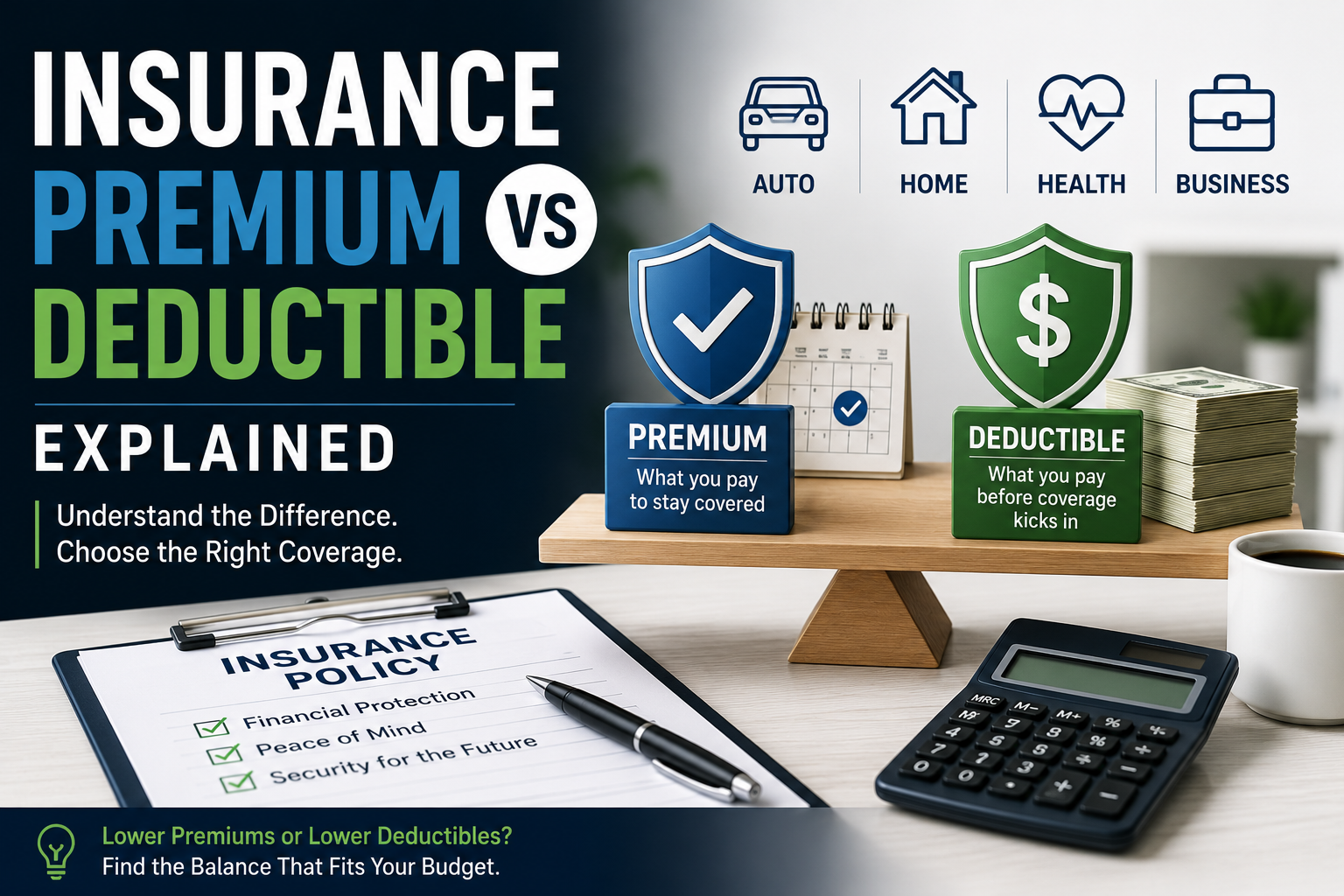
Your premium is generally the amount you pay to keep a policy in force. Your deductible is generally the amount you may need to pay toward certain covered losses before or as part of the insurer's payment obligation, depending on the policy.
Understanding the difference can help you compare auto, homeowners, renters, and health insurance more intelligently instead of choosing a policy based only on its monthly price.
What Is an Insurance Premium?
An insurance premium is the amount charged for insurance coverage.
Depending on the policy and insurer, premiums may be paid:
- Monthly
- Quarterly
- Semiannually
- Annually
Paying the premium helps keep the policy active according to its terms.
You generally pay premiums whether or not you file a claim.
Example: Auto Insurance Premium
Suppose your auto insurance costs $150 per month.
Your approximate annual premium would be:
$150 × 12 = $1,800
You may pay the full $1,800 during the year even if you never make a claim.
What Determines Your Insurance Premium?

Insurance companies use many variables when pricing coverage.
The factors vary significantly by insurance type.
Auto Insurance
Factors may include:
- Driving history
- Vehicle type
- Location
- Coverage limits
- Deductible
- Mileage or vehicle use
- Other rating factors permitted by applicable law
Homeowners Insurance
Pricing may be influenced by:
- Home location
- Replacement cost
- Construction characteristics
- Coverage limits
- Deductibles
- Claims history
- Local catastrophe risk
Health Insurance
Health insurance premiums depend on the plan, market, employer arrangement, location, age where permitted, household circumstances, subsidies when applicable, and other factors.
The rating rules are different from those used for property and casualty insurance.
What Is an Insurance Deductible?
A deductible is an amount the policyholder may be responsible for paying toward a covered loss before or alongside insurance benefits, depending on the type of policy and claim.
The exact mechanics vary.
Example: Homeowners Insurance
Suppose a covered storm causes $8,000 of damage and your applicable deductible is $1,000.
A simplified illustration could look like this:
| Covered Damage | Deductible | Potential Insurer Payment |
|---|---|---|
| $8,000 | $1,000 | Up to $7,000, subject to policy terms |
The actual payment could differ because of:
- Coverage limits
- Exclusions
- Depreciation rules
- Replacement-cost provisions
- Coinsurance provisions
- Special deductibles
- Other policy terms
Premium vs. Deductible
| Feature | Premium | Deductible |
|---|---|---|
| What it is | Price charged for coverage | Amount you may pay toward covered losses |
| When you pay it | Regularly according to billing schedule | When an applicable claim or covered service occurs |
| Paid even without a claim? | Yes | Generally no |
| Can affect overall policy cost? | Yes | Yes |
How Premiums and Deductibles Usually Interact
For many insurance products, choosing a higher deductible can reduce the premium because the policyholder assumes more of the cost of a covered loss.
A lower deductible can increase the premium because the insurer may begin paying eligible claim costs sooner.
However, the relationship is not always perfectly proportional.
Changing a deductible from $500 to $1,000 does not automatically cut the premium in half.
Example: Higher Deductible vs. Lower Deductible
Consider two hypothetical auto insurance options:
| Policy A | Policy B | |
|---|---|---|
| Annual premium | $1,800 | $1,500 |
| Collision deductible | $500 | $1,000 |
Policy B saves:
$1,800 − $1,500 = $300 per year
But the policyholder accepts an additional $500 of potential deductible exposure on an applicable collision claim.
The question becomes whether saving $300 per year is worth taking on an extra $500 of claim cost.
How Long Does It Take for the Higher Deductible to Break Even?
Using the same example:
- Extra deductible exposure: $500
- Annual premium savings: $300
A simplified break-even calculation is:
$500 ÷ $300 ≈ 1.67 years
If you avoid an applicable claim for longer than roughly 20 months, the premium savings could exceed the additional deductible amount.
This is only a simplified financial comparison. Claims frequency, coverage terms, future premium changes, and other factors can alter the result.
A Higher Deductible Is Not Always Better
A higher deductible can reduce premiums, but it can create a problem if you cannot afford the deductible when a loss occurs.
Suppose you choose a $2,500 homeowners deductible to reduce your premium.
If you have only $500 in accessible savings when a covered loss occurs, the policy may still leave you struggling to fund your portion of the repair.
This is why deductible selection should be connected to emergency savings.
A Lower Deductible Is Not Always Better Either
A very low deductible can reduce out-of-pocket exposure after a claim, but you may pay substantially higher premiums year after year.
If claims are infrequent, the additional premium may eventually exceed the deductible savings.
The appropriate balance depends on:
- How much emergency cash you have
- How much premium savings the higher deductible provides
- Your ability to absorb a loss
- The frequency and severity of potential claims
- The type of insurance
Auto Insurance Deductibles
Auto policies can contain different coverages with different deductible rules.
For example, collision and comprehensive coverage may each have their own deductible.
Liability coverage generally works differently and typically does not use the same deductible structure as collision or comprehensive coverage.
Always review the declarations page and policy documents to determine which deductible applies to which coverage.
Homeowners Insurance Deductibles

Homeowners policies can have more than one type of deductible.
A policy may include:
- A standard dollar deductible
- A percentage-based deductible
- A separate wind or hurricane deductible
- Other catastrophe-specific deductibles depending on location and policy
Percentage Deductible Example
Suppose a home is insured for $400,000 and a particular covered peril is subject to a 2% deductible based on the insured value.
A simplified calculation would be:
$400,000 × 2% = $8,000
That is significantly different from a $1,000 flat deductible.
Consumers should confirm whether a deductible is a fixed dollar amount or percentage.
Health Insurance Deductibles Work Differently
Health insurance deductibles should not be interpreted exactly like auto or homeowners deductibles.
A health insurance deductible is generally the amount you pay for certain covered health care services before the plan begins paying according to its benefit structure.
But many plans may cover some services before the deductible is met.
After the deductible, you may still owe:
- Copayments
- Coinsurance
- Other cost sharing
That continues until applicable plan rules or the out-of-pocket maximum are reached.
Health Insurance Example
Suppose a health plan has:
- $2,000 deductible
- 20% coinsurance after the deductible
- An applicable annual out-of-pocket maximum
If you receive a covered service with an allowed cost of $5,000 and the entire deductible remains unpaid, a simplified illustration could be:
| Cost Component | Illustrative Amount |
|---|---|
| Allowed cost | $5,000 |
| Deductible | $2,000 |
| Remaining amount | $3,000 |
| 20% coinsurance on remaining amount | $600 |
| Illustrative patient responsibility | $2,600 |
This is only an illustration. Actual health insurance cost sharing depends on network status, covered services, negotiated rates, plan design, and other terms.
Deductible vs. Copay vs. Coinsurance
| Term | General Meaning |
|---|---|
| Deductible | Amount you may pay before certain plan benefits begin sharing eligible costs |
| Copay | Fixed amount you pay for certain covered services |
| Coinsurance | Percentage of eligible costs you pay after applicable plan rules are met |
What Is an Out-of-Pocket Maximum?
For health insurance, the out-of-pocket maximum is another important number.
It generally limits how much you pay during the plan year for covered in-network services subject to the plan's cost-sharing rules.
Premium payments generally do not count toward the out-of-pocket maximum.
Consumers comparing health plans should therefore look beyond the deductible alone.
The Cheapest Premium Can Be the Most Expensive Choice
A policy with the lowest premium is not automatically the lowest-cost policy overall.
Consider two hypothetical health plans:
| Plan A | Plan B | |
|---|---|---|
| Monthly premium | $300 | $450 |
| Annual premium | $3,600 | $5,400 |
| Deductible | $5,000 | $1,500 |
Plan A saves $1,800 in annual premiums.
But a household expecting substantial medical care could potentially face much higher out-of-pocket costs under Plan A.
The correct comparison depends on expected health care use, plan network, cost-sharing rules, prescription coverage, and financial risk tolerance.
How to Compare the Real Cost of Insurance
Instead of comparing only premiums, evaluate several components together.
| Cost | What to Review |
|---|---|
| Premium | What you pay to maintain coverage |
| Deductible | Potential amount you must absorb before or as part of claim benefits |
| Copays and coinsurance | Additional cost sharing, especially in health insurance |
| Coverage limits | Maximum amounts the policy may pay |
| Exclusions | Losses or services the policy does not cover |
| Out-of-pocket maximum | Important for applicable health insurance plans |
Insurance Limits Matter as Much as the Deductible
A low deductible does not compensate for inadequate coverage limits.
Suppose a liability policy provides $50,000 of applicable coverage but a covered loss results in $150,000 of damages.
The deductible may be relatively small, but the coverage limit can be the much more important financial issue.
This is why consumers should not choose insurance based solely on deductible size.
Exclusions Can Matter More Than Price
An inexpensive policy can provide poor protection if the loss you are concerned about is excluded.
Depending on the insurance type, exclusions may apply to:
- Flood damage
- Earthquakes
- Certain business activities
- Specific property
- Intentional acts
- Other risks defined by the policy
Always review what is covered and what is excluded.
FinanceHub USA Analysis: Your Deductible Should Match Your Emergency Fund
One useful way to evaluate a deductible is to compare it with the amount of accessible cash you could realistically use after an unexpected loss.
| Emergency Savings | Deductible | Potential Concern |
|---|---|---|
| $500 | $2,500 | Large funding gap after a claim |
| $5,000 | $1,000 | Deductible may be easier to absorb |
| $15,000 | $2,500 | Greater capacity to accept higher deductible risk |
This does not mean the deductible should always be smaller than the emergency fund.
It means the policyholder should understand exactly where the money would come from if a claim happened tomorrow.
Should You Keep the Deductible Amount in Savings?
For property and auto insurance, maintaining enough accessible cash to cover the deductible can reduce the chance of turning an insured loss into new credit-card or personal-loan debt.
If your homeowners deductible is $2,000 and your auto collision deductible is $1,000, consider how you would handle either expense.
You do not necessarily need separate savings accounts for every deductible, but your emergency fund should reflect realistic household risks.
Related reading: How Much Should You Save From Every Paycheck?
Should You Raise Your Deductible to Save Money?
Before increasing a deductible, calculate the premium savings.
Example
Suppose increasing your auto deductible from $500 to $1,500 saves $180 per year.
You are accepting an additional:
$1,500 − $500 = $1,000 of potential claim cost
At $180 of annual premium savings, the simplified break-even period is:
$1,000 ÷ $180 ≈ 5.6 years
If the premium difference is small, accepting substantially more deductible risk may not be attractive.
When a Higher Deductible May Make Sense
A higher deductible may deserve consideration when:
- You have sufficient emergency savings
- The premium reduction is meaningful
- You can comfortably absorb the deductible after a claim
- You are deliberately choosing to self-insure more of the smaller losses
When a Lower Deductible May Make Sense
A lower deductible may be preferable when:
- Your emergency savings are limited
- A high deductible would force you to borrow
- The premium difference is relatively small
- You value more predictable out-of-pocket exposure
Can You Have More Than One Deductible?
Yes.
A policy can contain multiple deductibles depending on coverage and type of loss.
Examples include:
- Separate auto collision and comprehensive deductibles
- Separate homeowners wind or hurricane deductibles
- Individual and family health plan deductibles
- Prescription or service-specific cost-sharing structures in some health plans
Never assume the deductible listed in one section of a policy applies to every possible claim.
Common Premium and Deductible Mistakes
- Choosing insurance based only on the monthly premium. The cheapest policy may expose you to much higher out-of-pocket costs.
- Choosing a deductible you cannot afford. Insurance is less useful if you cannot fund your portion of a covered loss.
- Assuming every deductible works the same way. Auto, homeowners, and health insurance can apply deductibles differently.
- Ignoring percentage-based deductibles. A percentage deductible can equal thousands of dollars.
- Ignoring coverage limits. A low deductible cannot compensate for insufficient insurance limits.
- Ignoring exclusions. Coverage that does not protect against the relevant risk may provide little value.
- Assuming a higher deductible always produces major savings. Compare the actual premium difference before making the change.
- Looking only at the health insurance deductible. Copays, coinsurance, network rules, and out-of-pocket limits also matter.
FinanceHub USA Framework: Compare Insurance in Five Steps
| Step | Question |
|---|---|
| 1 | What risks and events are actually covered? |
| 2 | What are the coverage limits? |
| 3 | What deductible applies? |
| 4 | What is the annual premium? |
| 5 | Can I comfortably absorb the remaining out-of-pocket risk? |
This approach is more useful than asking only which insurer offers the lowest monthly payment.
Example: Comparing Total Potential Annual Cost
Suppose two auto policies offer otherwise comparable coverage:
| Policy A | Policy B | |
|---|---|---|
| Annual premium | $2,000 | $1,600 |
| Collision deductible | $500 | $1,500 |
| Premium + deductible after one applicable claim | $2,500 | $3,100 |
If no claim occurs, Policy B costs $400 less that year.
If one qualifying claim occurs and the full deductible applies, Policy A produces the lower simplified combined cost.
This example shows why the lowest premium does not automatically create the lowest total financial exposure.
Questions to Ask Before Choosing a Deductible
- How much would my premium change?
- Is the deductible a fixed dollar amount or a percentage?
- Does the deductible apply to every type of claim?
- Could I pay it tomorrow without borrowing?
- Do different coverages have different deductibles?
- What are the coverage limits?
- What exclusions apply?
- For health insurance, what are the coinsurance and out-of-pocket limits?
Final Thoughts
An insurance premium and deductible are both costs, but they operate very differently.
The premium is what you generally pay to maintain coverage.
The deductible is an amount you may need to absorb when an applicable covered loss or health care expense occurs, depending on the policy.
A higher deductible can sometimes reduce premiums, while a lower deductible can reduce the amount you need to pay after a covered event. Neither option is automatically better.
The right balance depends on:
- Your emergency savings
- Your monthly budget
- The amount of premium savings available
- Your ability to absorb a claim
- Coverage limits
- Policy exclusions
- The specific type of insurance
For health insurance, remember that the deductible is only one part of the cost structure. Premiums, copays, coinsurance, provider networks, prescription coverage, and out-of-pocket maximums can be equally important.
For auto and homeowners insurance, confirm exactly which deductible applies to each type of covered loss and whether any percentage-based or catastrophe-specific deductible exists.
The objective is not simply to minimize your monthly premium. It is to choose coverage that your budget can support while protecting you from losses that could seriously damage your finances.
Continue exploring FinanceHub USA for practical guides covering insurance, budgeting, emergency savings, credit, debt, and personal finance.
Related reading: How Much Should You Save From Every Paycheck?
Related reading: How Much Money Should You Have Left After Bills?
Sources and Further Reading
Frequently asked questions
What is the difference between an insurance premium and a deductible?
A premium is the amount you pay to keep your insurance policy active, while a deductible is the amount you generally pay out of pocket before your insurance company begins covering eligible claim costs.
Does choosing a higher deductible lower my premium?
In many cases, yes. Policies with higher deductibles often have lower premiums because the policyholder assumes more of the financial risk.
Should everyone choose the highest deductible?
Not necessarily. A higher deductible can reduce monthly premiums, but you should only choose one if you have enough savings to comfortably cover that amount after a covered loss.
Do I pay my deductible every month?
No. Your deductible is generally paid only when you file a covered claim. Your premium is the recurring payment required to keep your insurance policy active.
How do I choose the right insurance policy?
Compare premiums, deductibles, coverage limits, exclusions, and your personal financial situation. The best policy balances affordable monthly costs with protection you can rely on during unexpected events.